
Wrench Types Guide: Complete Overview for Every Application
Wrenches find their worthy place among the basic tools found in any toolkit. They are key in any industry, such as automotive repair, plumbing, construction, and many others. Because different types of wrenches have been developed for very particular types of jobs and degrees of fine craftsmanship, it is highly important to know the notion of the tool as well as its use. This category of explanation is what this manual is about: The most commonly used variants of wrenches are discussed here, parts of their features, and jobs for which these forms are meant. Whether you are a career mechanic, a DIY enthusiast, an engineer, or simply someone interested in the nitty-gritty facets of everyday tools, this document will provide you with points of wisdom from which you can make a well-conversed decision and maximize your work efforts.
Introduction to Wrenches
A wrench is a hand tool designed mainly to grip, tighten, or loosen bolts, nuts, and other fasteners. It operates on the principle of imparting torque to these components so as to bring about precision adjustment or secure fastening. Wrenches come under many different designs, with each especially cut out for some unique kind of work. The most common examples are the open-ended wrenches, which proffer a U-shaped opening that is versatile, or box-ended wrenches, which work with a fastener such that it is encircled in order to give a greater grip. Adjustable wrenches, for instance, are represented chiefly by the crescent wrench which is heavy in the business of handling different sizes of fasteners. The correct identification of the type of wrench needed for a particular job assures efficiency and prevents damage to the tools and components.
Understanding Wrenches and Their Uses
Modernized wrenches are made of materials designed to endure considerable torque and strain. Two among the common materials include chrome vanadium steel and carbon. Both give a good trade-off of strength and durability. Commonly, the manufacturers should be expected to adopt chrome plating for protection against corrosion and wear, extending the lifespan of the tool.
Wrench manufacturer will use forging to enhance the wrench with structural integrity, and then finish machines will ensure the dimensions and grip accuracy that are correct for use with fasteners. Advanced designs might also include ergonomic features such as rubberized grips or handles angled for enhancing comfort to users and avoiding hand fatigue. Awareness of these developments will enable the expert end-user to choose tools catered for single jobs that are particularly concerned about long-term durability and ease of operation.
Importance of Choosing the Right Type of Wrench
The selection of wrenches gives much influence in different aspects of mechanical operations, production, and safety. Various wrenches serve different tasks, vary in materials used, and offer various torque capabilities, necessitating matching the right kind of wrench to its specific application. For instance, torque wrenches provide for precise application of torque when screwing a nut or a bolt, thus minimizing the possibility of over-torquing, preventing injury to the fastener, causing failure of the equipment, or under-torquing, which might lead to slippage or loosening of fasteners. Adjustable wrenches are so-called because they can accommodate different sizes of bolts and nuts, whereas socket wrenches provide leverage in tight spaces. Meanwhile, huge advancements in available materials such as chrome vanadium steel have had a far-reaching impact on these tools; their efficacy is much bolstered, and they’re resistant to rusting and maintain a longer life than traditional tools. The understanding of these respective choices tends to help the professional to better optimize their work procedures so as to ensure a consistent state of performance.
Overview of Common Wrench Types
| Wrench Type | Design Features | Primary Uses | Material | Key Advantages |
|---|---|---|---|---|
| Adjustable Wrench | Open-ended, adjustable jaw | Versatile for multiple fastener sizes | Chrome vanadium steel | Flexibility, cost-efficient |
| Combination Wrench | Open and boxed ends combined | Tightening/loosening bolts or nuts | Alloy steel | Dual functionality |
| Socket Wrench | Interchangeable sockets | Confined spaces, high torque | Chrome-plated steel | Enhanced leverage, ease-of-use |
| Torque Wrench | Measures torque with precision | Applications requiring torque accuracy | Steel or aluminum alloy | Prevents bolt over-tightening |
| Pipe Wrench | Serrated jaw, firm pipe grip | Plumbing and pipe connections | Steel or cast iron | Strong grip for rounded surfaces |
| Ratcheting Wrench | Built-in ratchet mechanism | Fast work in tight spaces | Durable stainless steel | Speeds up operation, no repositioning |
| Allen Wrench (Hex Key) | L-shaped, fits hexagonal sockets | Machinery assembly, bicycle repairs | Hardened steel | Compact, lightweight |
| Monkey Wrench | Adjustable, flat jaws | Larger-scale gripping needs | Forged steel | High strength, industrial applications |
Common Wrench Types
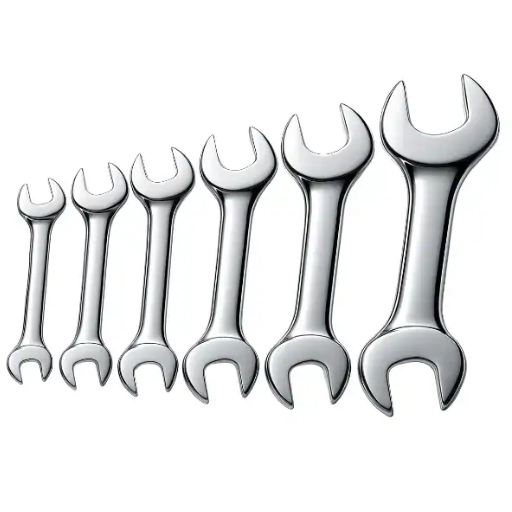
- Open-End Wrench: Designed to be used with two different sizes on the head of the wrench, the U-cuts make it capable of adjusting a nut from only one direction, while the other facial cut does the same.
- Box-End Wrench: This type of wrench pulls from behind the nut and surrounds the nut, providing a more secure grip and minimal chances of slipping. The box design maintains greater leverage.
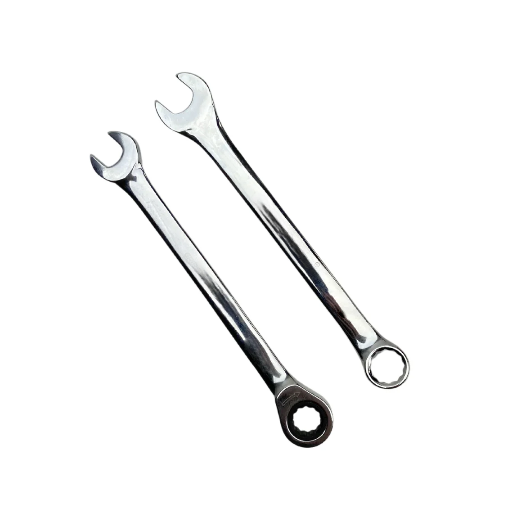
- Combination Wrench: Besides combining the box and open-ended shapes, combo wrenches serve as roll-offs and thereby come in handy when required to turn nuts from the convex end.
- Socket Wrench: The socket wrench has a ratchet handle and multiple interchangeable sockets designed to facilitate the removal or driving of bolts or nuts in varied applications where the nut or bolt cannot be properly approached.
- Torque Wrench: It refers to a tool that is supposed to apply a set amount of pressure or tension to nuts and bolts. Wherever fastening tensions are in automatic, the torque wrench is generally expected to address this concern.
Open-End Wrench
An open-end wrench is designed with U-shaped jaws that grip two opposite faces of a bolt or nut. Highly useful for confined spaces where box-end or socket wrenches do not fit, they are invariably double-ended with different sizes on each side and offer maximum flexibility for use in various applications. Open-end wrenches have been engineered with improved material technology for longer life and superior performance, featuring a new generation of high-strength alloy steels. They cater to diversified applications in sectors of automotive repair, plumbing, and equipment maintenance for faster adjustments on nuts and bolts located in confined or awkward positions. Accurate sizing is essential for the prevention of slipping, thereby ensuring that one is being kept safe while work is being performed, while at the same time ensuring precision throughout.
Box-End Wrench
Box-end wrenches are very useful tools that are designed to work securely with fasteners. It is always closed and because of this, it encloses the fastener head entirely, exerting the working force onto multiple sides and reducing the risk of rounding and damage. It existed mainly in its 6-point and 12-point configurations, where it preferred as much contact as possible with the fasteners, thus maximizing torque application and minimizing slipping under a heavy load. Modern manufacturing now uses the best materials available, such as chrome-vanadium steel, significantly improving its strength and corrosion resistance. This tool is particularly effective in countersunk ready access for wrenches that fail otherwise. In addition, the ergonomic design of box-end wrenches enhances user comfort when working for extended periods. Precision-machined dimensions of any box-end wrench guarantee compatibility with a wide variety of standard fastener sizes.
Combination Wrench
A combination wrench is a versatile hand tool featuring both an open-end wrench and a box-end wrench, with the application of either end depending on the need. For instance, the open-end side is most useful when dealing with things requiring less torque, while the box-end side offers an above-average grip to turn fasteners that require specialization under higher loads. Made from materials as strong as alloy steel, a combination wrench is heat-treated to enhance its strength and hardiness in tough job situations. Commonly printed or enameled onto the tool are size marks for easy identification that may be compatible with specific fastener dimensions. These tools are indispensable to some of the industries, such as automotive, building, and fabrication, where efficient and versatile tools are needed.
Specialized Wrenches
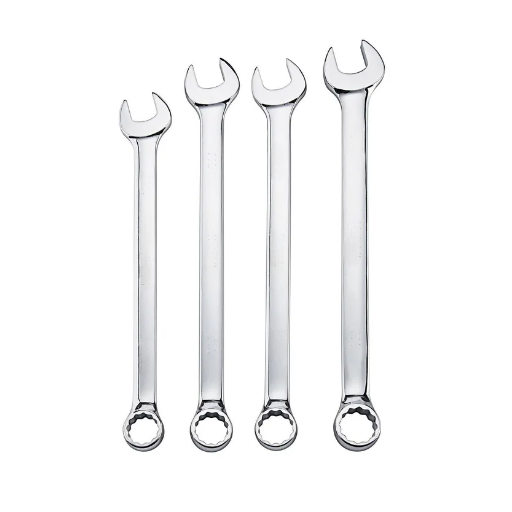
It is unlikely that an ordinary wrench will get the job done in specialized applications. Some examples include torque wrenches, which count newton-meter units down to the wire, and strap wrenches, which deploy nylon or leather straps to hold onto rounded objects, such as pipes, with an iron grip. Tools like pipe wrenches, allen wrenches, and torque wrenches are meant to solve peculiar challenges, such as overcoming space constraints, accessing specialized fasteners, and are must-haves in numerous industries, such as plumbing, aerospace, and automotive maintenance. Such specialized tools are engineered with the problems they solve in mind: productivity and accuracy of work. Their fabrication and subsequent modes of operation ensure an answer, warts and all, to target problems and requirements within each particular niche work.
Torque Wrench
A complete familiarity with genteel applications makes this mechanical torque wrench sufficient for securing one while in use. Chosen would be the requirement connected with the tightening of screws. sortOrder ensures the safety and utility of the assembled sections. Giving the combined number of advancements, today’s torque wrench is empowered with characteristics like a display screen for use with practically any standard face instrument to some degree. These show-offs are of more help.
Right on the bolt head is the torque-limit adjustment zone: some recognition is needed to accurately stop bolting once the target torque value is reached. Such adjustment tools and other countless recent refinements make them one of the most essential tools employed on many automotive repair, aerospace, and construction applications. On the other hand, for one to fully discover the nature of this instrument, he needs to enter into a study involving torque error, which has lately been reducing by 20% through rehabilitating understaffed factories, now moved towards a less unsafe 40% redemption when compared to the manual wrench. This is conducive to productivity and a ladder to safety in mechanical engineering.
Pipe Wrench
The pipe wrench is a quintessential tool that has been devised to grip and twist on cylindrical objects, like pipes or rods. These pipe wrenches have a jaw mechanism that can be adjusted and serrated teeth, enabling them to grip quite strongly and permit the desired degree of motion. Recent changes in pipe wrench models include minimal weight properties, such as aluminum alloys, that save on liability by 40% in their steel counterparts, reducing worker weariness while extending longevity. Some of the improvements made are relevant to the adjustment mechanisms, for example, the self-cleaning threads made with optimum wearing material or replaceable jaw inserts. The data supports that the improvement in pipe wrench efficiency has essentially reduced the incidence of slipping by up to several hundred times over traditional types, thereby making safe, easier, and quicker installations possible for plumbers, oil and gas workers, and the construction sector. These adaptations further highlight the growth of this amazing commonplace instrument in any professional and industrial environment.
Allen Wrench
The Allen wrench is a compact tool designed with an L-shape and a hexagonal shape. Usually produced using high-strength steels and alloys, it provides durability and accuracy in whatever aspects where it is needed to tighten or loosen hex-type screws. Advanced models have recently included ergonomic grips or ball heads to increase handling and use in confined areas. Because of their simplicity and strength, they function suitably on torque applications, for which hex keys are widely used in many industries such as automotive, furniture assembly, and aerospace. In order to have maximal returns, the latest sets come with a smaller number of galvanised coatings and a precise variety of sizes that comply with several standards, for example, metric sizes (mm) and imperial sizes (in). Thus, these changes define further innovation in a very important tool that has been underestimated.
Wrench Applications
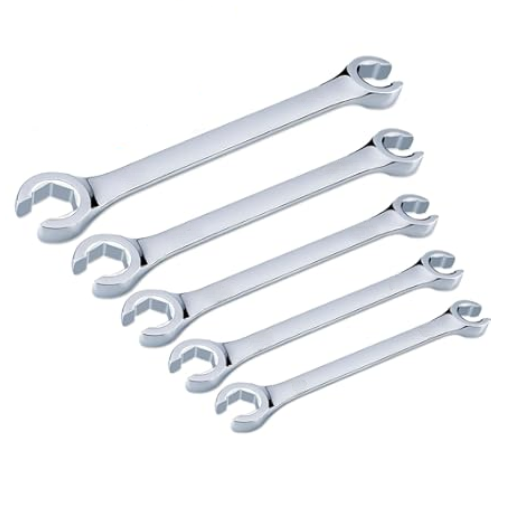
Wrenches are adaptable devices used mainly to grip, tighten, or loosen fasteners, such as nuts and bolts. A common use for its application would be automotive repair, where they are essential for engine maintenance and adjusting wheels, while construction activities use them for assembling the structure. Besides these, wrenches are also commonly used in plumbing for securing pipe fittings and machinery maintenance for verification of proper operation. Their acceptance of varied head sizes and shapes of fasteners makes them indispensable across industries.
Automotive Uses of Wrenches
Wrenches remain an essential component in the automotive sector, thanks to their versatility to do various tasks. The major application involves installing and removing the nuts and bolts as part of the engine repairs or assembly work. For instance, there is the use of torque wrenches, particularly designed to apply a very exact amount of force to ensure that bolts are neither under-tightened nor over-tightened, which is very important for engine safety and performance. Another form of wrench–the adjustable wrench–is used in the most common applications to allow for various fasteners of different sizes, thereby reducing the need for multiple repair tools.
Besides this, when it comes to wheel maintenance, wrenches are fundamentally necessary. These wrenches are runner tools designed to remove and secure lug nuts, bringing significant velocity to jobs such as tire rotations, alignments, and replacements. They are also quite useful; this is how a lug wrench works. The working distance has to be sufficient with this tool, permitting efficient work and safety. Besides this, the primary catalog includes ratchet wrench sizes that we know to be very helpful in such hard-to-reach places as under a car. Thus, these wrenches lessen the time spent on repairs under the belly of the car or on calibrations that involve difficult-to-reach areas.
Today, modifications concerning wrench materials and technologies compound their toughness, supporting the demand of the automobile sector for extreme accuracy. The chrome vanadium steel, predominant in wrench construction, has come to provide immense strength, the benefit of being highly resistant to corrosion, as well as dependability, making it advantageous for use in motor vehicle maintenance and assembly procedures.
Plumbing Applications
The adjustable wrenches, pipe wrenches, and basin wrenches are the three key types of wrenches used in plumbing. Each type is used for a certain set of application requirements. Materials like cast aluminum or steel are used to fabricate modern pipe wrenches, which are very important in assisting adequate tensile strength that is enough to withstand demanding operations while, at the same time, keeping their weight to convenient levels.
Since the introduction of technological advancements, we have also seen the introduction of ergonomic designs created to diminish user fatigue, especially during repetitive motions like those found in high-torque applications. Probably the most noteworthy of today’s innovations would be a non-slip handle and wrench-jaw configurations, which enhance grip by building a dynamic nature for holding on to objects that otherwise are cylindrical and irregularly shaped, irrespective of pressure.
Furthermore, integration of smart features like laser-etched measurement markings and adjustable torque settings only helps process efficiencies, enabling a plumber to achieve more specifically oriented results. These technological advancements in tools really point to the importance of the role of the wrench in terms of making the work flow more smoothly and providing accurate diagnostic results in a wide category of residential and commercial works.
General Home Maintenance
To maintain any private dwelling effectively, you want to take a shot at each individual subsystem with an organized approach, with the aim of preserving your warranty and keeping it full. So, each HVAC needs professional maintenance every six months to optimize its performance for efficiency and comfort effectiveness. Your choice of replacement dates can be anywhere from one month to three months, depending on utilization and location. The plumbing system needs to be monitored quarterly, including water leaks, corrosion, water pressure, and related issues. Ignoring plumbing leaks can cause very expensive structural damage, carrying a potential of wasting large sums on utility bills. The roof is another important focus, with an eye should be kept on broken or damaged shingles, blockage by leaves from the gutter and moisture infiltration to stop early on any heavy expense in repairs. This proactive maintenance would be an attempt to limit potential risk, offer increased value for the house, and present a pleasing amenity for residents.
Choosing the Right Wrench for Your Task
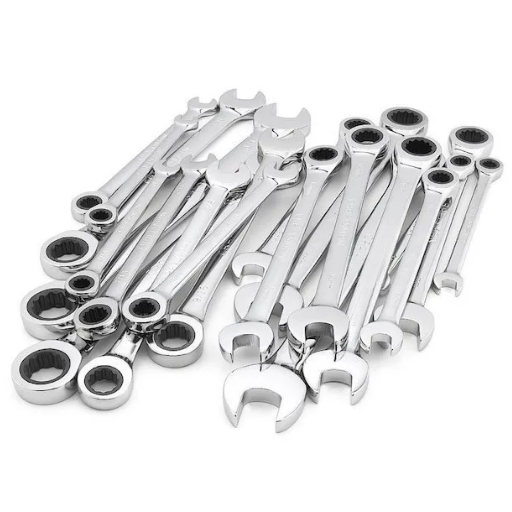
When searching for an appropriate wrench to meet your workplace demands, give a thought for the size and type of softie you are working on. Adjustable wrenches allow you to work on a wide variety of sizes, and combination wrenches are great for their open/add box open ends. Socket wrenches are high in torque and thus prove handy for extensive tasks. Always ensure that the wrench size you want corresponds to the fastener; otherwise, it may slip and cause damage. Pay great attention to the quality and strength of raw material because it is practically impossible with the execution of inferior tools.
Assessing Your Needs: DIY vs. Professional Use
When a toolset is indicated for its DIY or professional use, an assessment of the size, frequency, and workload of the tasks at hand is a must. Tools designed for home repair, light maintenance, and hobby projects see an eager demand from DIY consumers mainly because of their cost and multipurpose nature. Within that vein, a plethora of these tools is ergonomically crafted to maximize ease and, quite often, space-saving capacity, making the portable toolset a rather attractive tool chest for professionals. Quite oppositely, in professional use, tools are subjected to levels of use ranging from frequent to industrial, and hence, their longevity, precision, and other specialized purposes become quite relevant attributes. Take the example of mechanics or skilled labor divers: they put their trust in tools made of high-end materials like chromium-vanadium steel, which could stand up to a fair measure of wear-and-tear and still go on to offer useful service. In most cases, a local warranty or tool calibration scheme will determine if the product is worth picking for professional use, as such offers unquestioned reassurance in readiness for trouble-free operation over a long lifespan. By recognizing those criteria at the outset, the selection of the most competent set of tools becomes possible to fulfill the specific needs of that user.
Factors to Consider When Selecting a Wrench
- Material Composition
The material used to make the wrench dictates the wrench’s robustness and usefulness. Wrenches that meet certain international standards may then be made from chromium-vanadium (Cr-V) alloy, which has good tensile strength and decent corrosion resistance. For heavy industries needing extra strength, though, molybdenum or carbon-steel-alloy wrenches may be preferred for their high tensile strength. - Size and Compatibility
A wrench of the appropriate size has to be chosen for proper torquing application to prevent damage to fasteners. Wrenches are available in imperial (inch) and metric (millimeter) sizes, so the wrench has to fit the fastener. Adjustable wrenches offer more versatility, but some mechanical loss is experienced as opposed to a fixed-size wrench that could actually be applied precisely. - Ergonomics and Grip
Design the handle of a wrench so that long-term usage does not pose a threat to fatigue and tiredness in the hand. On top of all these measures for enhancing comfort, adding some antislip grips and contours may be advantageous in restricting any sliding due to oily and wet conditions. - Finish and Coating
Then there are varied surface finishes like chrome-plating that enhance the life of a product as far as rust and corrosion are concerned. A nice matte finish also reduces glare and increases grip in difficult settings. - Load Capacity (Torque Ratings)
In choosing a wrench, ensure the maximum torque it can be used safely with for your application needs. For industrial situations, they may need wrenches for high torque loads if they have to be left so as not to deform in usage. - Storage and Portability
Tools that come in some kind of storage form, like toolboxes or rolling bags, are useful in keeping tools properly organized and picked up. Most beneficial here are wrench sets that are small and can be taken on the go by professionals who need them.
Common Applications for Different Types of Wrenches
- Open-End Wrenches
Open-end wrenches are used to grip nuts or bolts in hard-to-reach places to loosen or tighten them. This type of design is appreciated when a bolt is hard to turn past a fraction. In light-duty applications, these are useful but not suitable for precision applications, e.g., plumbing and furniture assembly. - Box-End Wrenches
A wrench with a boxing end is a wrench with a high level of accuracy in applying enough torque that can be used in tight places where a slip would be disastrous. They also see a lot of use in automotive repair, especially when tightening hex-head or square-head bolts in the engine compartment, because they can snugly hold on to them without the risk of rounding off the corners of fasteners. - Combination Wrenches
A combination wrench, which joins two versatile wrench types – open-end and box-end – is a neat tool for repairs and maintenance in the mechanical construction field. It’s perfect because of its quick adjustability and also with the ability for high clamped spoke torque, like when setting up components of agricultural machinery or making routine HVAC maintenance work. - Socket Wrenches
The socket wrench is a tool that is well designed for the purpose of getting a speedy connection with and disconnecting from the bolts/nuts by a particular socket size(s). A sort of speed demon, these wrenches are adept at projects that need quickness and precision, for instance, working on a car (tightening the lug nuts down when changing tires) or handling the maintenance of industrial machinery in the manufacturing industry. - Adjustable Wrenches
A crescent or adjustable wrench is characterized by a jaw that can be adjusted to find the appropriate fit for all fastening sizes. They are most common in plumbing for gripping and turning pipes, and are also quite versatile for general maintenance, working with bigger bolts on equipment. - Torque Wrenches
A torque wrench is an accurate tool to apply a very specific torque to a fastener. It is most commonly employed in scenarios in which overtorquing could produce damage, namely in internal combustion engine construction, aircraft, and bicycles, to mention but a few examples. - Allen Wrenches (Hex Keys)
Allen keys are small and easy-to-use tools that help tighten or loosen hand screws and set screws using hexagon sockets. Currently, gone are the days when they once functioned as important tools for the assembly of bicycles, as simplicity demands. However, you can still find these keys in simple flat packs or dead on as general maintenance equipment for a few things, like turning screws on small machines. - Pipe Wrenches
Pipe wrenches are intended to grip and turn usually round or cylindrical objects like the ends of metal pipes. Their grooves help to hold the pipe tighter and provide a distinct advantage for the plumber. Consequently, they are best used for constructing pipelines and pipes and for fixing any loose fittings. - Ratcheting Wrenches
Ratcheting wrenches have a ratcheting mechanism in the closed end that allows for a continuous fastening and loosening operation without having to reposition hands. More popular in the field of engineering, where enterprise spaces can be limited, these tools are valuable because of their minute movements within the engine bay. - Impact Wrenches
Impact wrenches crank out immense rotational force that is generally provided by pneumatic or electric sources. Having an impact wrench in their hands is an absolute must for heavy-duty industries, for instance, in the automotive industry for the wheel axle’s assembly, or in the construction domain for fastening strong structural bolts to steel frames where manual tightening is rendered inefficient.
With a true understanding of the application and limitations of any kind of wrench, professionals will be able to make the exact discernment as to which tool is suited for their task; in the end, then, the tool is aimed at accuracy, efficiency, complete lack of error, damage prevention, and safety.
Reference Sources
- NC State ISE – Processes Lab
Wrenches – Processes Lab - SolarSPELL Digital Library
Wrench – SolarSPELL - Cornell University Blogs – Tool Reviews
Tool Reviews – Crescent Style Wrenches
Frequently Asked Questions (FAQs)
What is a ratchet wrench and how does a socket ratchet work?
A ratchet wrench, more commonly referred to as a socket wrench, is a device manufactured to tighten or loosen nuts and bolts using the traditional socket attachment. A ratchet wrench is a perfect tool in terms of various other wrenches being too big for use and applications. However, these ratchet packs vary according to size and typically form part of a set of combination wrenches or a set of sockets that naturally fit the typical wrench sizes. Since wrenches are versatile, they are commonly used in automotive repair and general maintenance, where loosening nuts and bolts rapidly is very important, which is facilitated by the ratchet wrench. Using sockets, ratchet wrenches make an excellent choice to cut down on the requirement for repeatedly removing and repositioning the wrench, thereby saving time on a diverse range of fasteners and pipe sizes.
When should you choose an impact wrench versus a ratchet wrench?
Impact wrenches are distinctively designed to afford great torque, albeit with sparse bursts for stubborn nuts and bolts or heavy industrial work. Impact wrenches operate in this way because they effect a hammer blow, thus necessitating the use of impact-rated sockets instead of regular sockets to prevent wear and tear. While wrenches can do a little bit of everything, impact tools do a better job with fasteners that can’t be removed manually or by using said wrench. The latter is generally classified by its various types and uses, speed, and power, effective in outperforming wrenches, although ratchets are preferable for more controlled tightening. Depending upon the application, one needs to remember that tools that produce a blow or high torque will usually require torque control to equally prevent overtightening that can lead to thread damage.
How does an adjustable wrench compare to a monkey wrench or adjustable pliers?
Both an adjustable and a monkey wrench possess definite jaws that can be adjusted to receive a variety of fasteners, so they may be classified as adjustable wrenches that can optimize a large number of nuts and bolts. Adjustable wrenches are usually employed to either tighten or loosen regular fasteners, although pliers and a monkey wrench can be of greater help in gripping and turning irregular shapes. Wrenches exist commonly in metric as well as standard wrench sizes and also in numerous sizes to include almost the entire spectrum of possibilities. Adjustable pipe wrenches are designed to handle pipes, while adjustable conventional wrenches are designed to work with hex bolts and nuts, and are the right tool to use to keep the fasteners from becoming rounded, thereby making the work easier.
What are cone wrenches and how are they used in bike maintenance?
Cone wrenches are sparse yet efficient spanners that are primarily used while on bicycles for fastening and adjusting cone-based bearings set in bicycle hubs and pedals, usually in very small or otherwise odd locations. The mechanics in the car repair trade, as well as bicycle maintenance, have their cone and pedal wrenches specifically because they engage and quench small flats unreachable by thick regular wrenches. Pedal wrenches comprise the most common pedagogy for working both on pedals and in enclosed spaces to give long leverage. Their necessity lies in the usage of the entire toolkit for bicycle mechanics and general maintenance; the use of a cone wrench is characteristic of spanner tools made for particular fastener geometries.