
Multimeter vs Oscilloscope: Which Tool Do You Need?
In the debate of multimeter vs oscilloscope, the choice comes down to what you need to measure. A multimeter gives you a precise number for voltage, current, or resistance. An oscilloscope shows you how a voltage changes over time as a waveform.
What if the power rail in your circuit reads a steady 12 volts but your device still crashes? A multimeter will tell you the voltage is fine. An oscilloscope might reveal noise, ripple, or brief dropouts that the multimeter cannot see. This is why many technicians end up owning both tools.
This guide explains the difference between these two essential electrical test equipment instruments, when to use each one, and how to choose the right test and measurement tools for your work. Whether you run a repair shop, manage procurement, or troubleshoot production equipment, you will learn how to match the tool to the task.
Key Takeaways
- A multimeter measures steady or slow-changing electrical values as numbers; an oscilloscope displays voltage waveforms over time.
- Use a multimeter for voltage, current, resistance, continuity, and basic go/no-go checks.
- Use an oscilloscope for signal shape, frequency, ripple, noise, timing, and fast-changing circuit behavior.
- Most repair and manufacturing workflows benefit from having both tools, with the multimeter as the first purchase.
- Key buying specs include true RMS, CAT safety ratings, bandwidth, sampling rate, and channel count.
What Is a Multimeter?
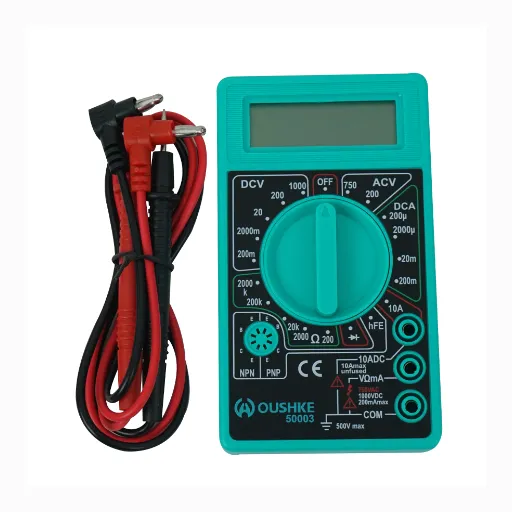
A digital multimeter, or DMM, is a handheld or benchtop instrument that measures electrical quantities and displays them as numbers. Most models measure DC voltage, AC voltage, DC, AC, resistance, and continuity. Many also test diodes, capacitance, frequency, and temperature.
Multimeters are the starting point for almost any electrical troubleshooting task. They answer simple questions quickly. Is the battery dead? Is the fuse blown? Is the power supply delivering 5 volts? Does this wire have continuity?
Because they are simple, portable, and affordable, multimeters are found in nearly every repair shop, maintenance department, and engineering lab. A basic handheld unit costs between USD 15 and 50. Professional models with true RMS measurement, higher accuracy, and better safety ratings range from USD 100 to 300. Benchtop precision multimeters can exceed USD 1,000.
The global digital multimeter market reflects this widespread use. According to Fortune Business Insights, the market is projected at approximately USD 1.20 billion in 2026, growing at around 6% annually through the mid-2030s. Industrial automation, automotive diagnostics, and renewable-energy installations are driving steady demand.
What Is an Oscilloscope?
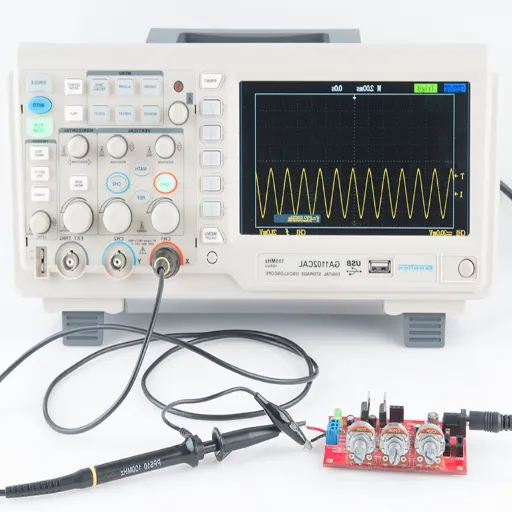
An oscilloscope is an instrument that plots voltage against time on a screen. Instead of showing a single number, it shows a waveform. This lets you see how a signal behaves, not just what its average value is.
Oscilloscopes are essential for dynamic signals. A power supply might show 12 volts on a multimeter, but an oscilloscope can reveal ripple, noise, or voltage dropouts that happen thousands of times per second. They are used to analyze clock signals, PWM outputs, sensor responses, communication buses, and audio waveforms.
Modern oscilloscopes fall into two main categories. Benchtop digital oscilloscopes offer high bandwidth, multiple channels, deep memory, and advanced triggering. Handheld or USB oscilloscopes are more portable and affordable but usually have lower bandwidth and fewer features.
The oscilloscope market is larger than the multimeter market in dollar terms. According to Persistence Market Research, the global oscilloscope market is estimated at approximately USD 4.1 billion in 2026. Coherent Market Insights gives a more conservative estimate of around USD 2.69 billion, with growth driven by telecommunications, semiconductors, automotive electronics, and power systems.
Core Differences: Multimeter vs Oscilloscope
The simplest way to understand the difference is to compare what each tool shows you.
| Feature | Multimeter | Oscilloscope |
|---|---|---|
| Primary output | Numeric value | Waveform graph |
| Best for | Static or slow-changing values | Dynamic, time-varying signals |
| Measures | Voltage, current, resistance, continuity | Voltage over time, frequency, shape, noise |
| Update speed | A few readings per second | Millions to billions of samples per second |
| Typical display | Digital readout | Voltage vs time graph |
| Learning curve | Low | Moderate to high |
| Portability | High | Benchtop units are less portable |
| Typical price | USD 15–300 for handheld | USD 67–1,500+ depending on type |
Fluke summarizes the difference well in their oscilloscope vs multimeter guide: a multimeter tells you the value, while an oscilloscope shows you what the signal is doing.
When to Use a Multimeter
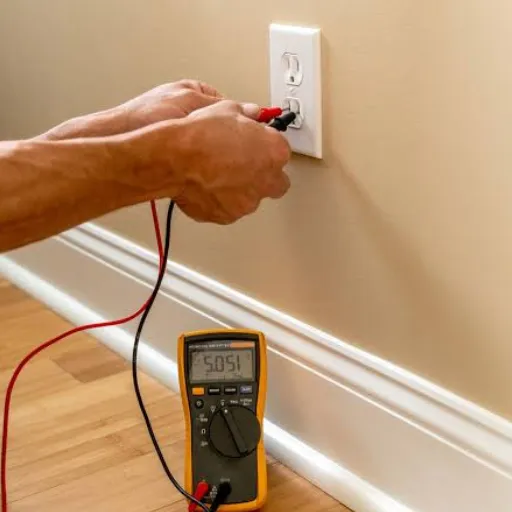
A multimeter is the right tool when you need a quick, accurate value. Common tasks include:
- Checking AC or DC voltage on batteries, power supplies, and outlets
- Measuring current draw of a device or circuit
- Testing resistance and continuity of wires, fuses, and components
- Diagnosing diodes, transistors, and capacitors on basic models
- Verifying wiring in appliances, vehicles, and control panels
- Performing routine maintenance and go/no-go inspections
When Omar, a maintenance technician at a small manufacturing plant in Turkey, troubleshooted a conveyor motor in early 2025, he reached for his multimeter first. The motor controller displayed an error, but the multimeter showed the input voltage was stable. That single reading ruled out the power supply and pointed him toward the motor drive. His next step was an oscilloscope, but the multimeter saved him an hour of unnecessary signal probing.
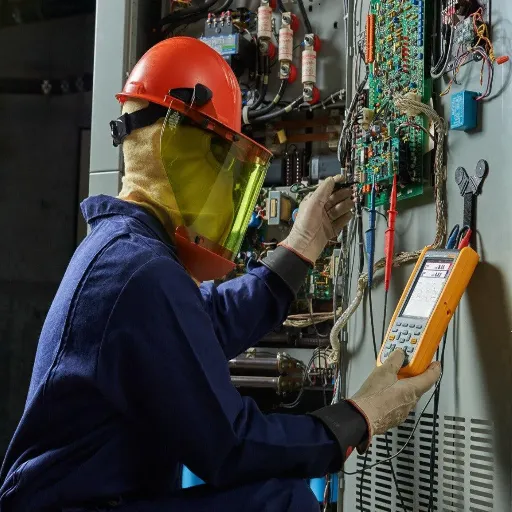
Multimeters are also safer for many field tasks. A good handheld multimeter with a proper CAT rating can withstand transient voltages that would damage a cheap meter or an unprotected oscilloscope probe. Safety ratings matter when you work on live electrical systems.
When to Use an Oscilloscope
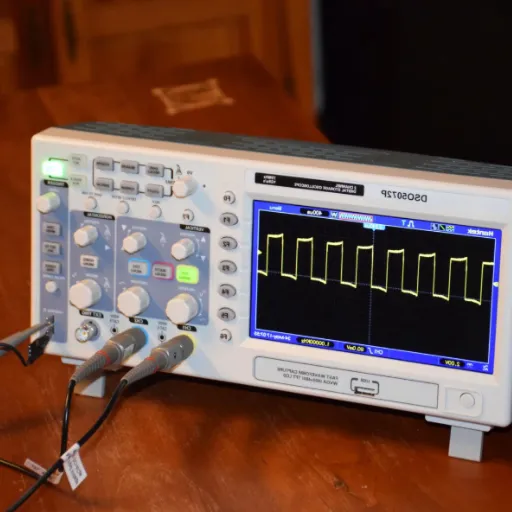
An oscilloscope becomes necessary when the behavior of the signal matters more than a single number. Common tasks include:
- Viewing waveform shape, such as sine, square, sawtooth, or PWM signals
- Measuring frequency, duty cycle, and rise/fall times
- Detecting ripple, noise, spikes, and glitches on power rails
- Debugging microcontroller clocks and digital timing
- Analyzing motor drive outputs and inverter signals
- Troubleshooting audio circuits and sensor outputs
- Working with communication buses such as CAN, I2C, SPI, or UART
When Priya, an electronics repair technician in India, worked on a failing switch-mode power supply, her multimeter showed normal output voltage. The oscilloscope revealed high-frequency ripple caused by a degraded capacitor. Replacing the capacitor fixed the supply. Without the oscilloscope, she would have replaced the wrong parts or returned the unit as unrepairable.
Oscilloscopes are indispensable for power electronics, embedded systems, automotive diagnostics, and RF work. They do not replace multimeters, but they extend what you can diagnose.
Multimeter vs Oscilloscope for Electronics Repair
Most repair shops need both tools, but the order of purchase matters. If you are building a diagnostic setup, start with a multimeter. It handles the majority of basic electrical checks at low cost. Add an oscilloscope once you start working with switching power supplies, motor controllers, microcontrollers, audio equipment, or communication systems.
For general electronics repair, the recommended starting point is:
- Digital multimeter with true RMS, continuity, diode test, and a CAT III 600 V safety rating.
- Entry-level oscilloscope with at least 50 MHz bandwidth, 1 GSa/s sampling rate, and two channels.
Rohde & Schwarz explain in their digital multimeter vs oscilloscope comparison that multimeters excel at precise measurements of stable values, while oscilloscopes reveal time-domain behavior that no multimeter can capture.
Key Specifications to Check Before Buying
Multimeter Specifications
- Voltage and current ranges: Make sure the ranges cover the circuits you work on.
- True RMS: Important for accurate AC measurements on non-sinusoidal signals.
- Resolution and counts: Higher counts give finer readings.
- Continuity and diode test: Essential for circuit troubleshooting.
- CAT safety rating: CAT III or CAT IV ratings are important for mains and industrial work.
- Build quality and probe quality: Cheap probes can fail or give unstable readings.
Oscilloscope Specifications
- Bandwidth: A common rule of thumb is five times the highest frequency you need to measure. For general repair, 50–100 MHz is a good starting point.
- Sampling rate: Higher rates capture faster signal details. Look for at least 1 GSa/s for general electronics work.
- Memory depth: More memory lets you zoom into captured waveforms.
- Channels: Two channels are enough for most repair work; four channels help with complex digital circuits.
- Trigger options: Good triggering makes it easier to capture intermittent events.
- FFT and connectivity: FFT helps analyze frequency content; USB or LAN connectivity helps save and share data.
Hanmatek provides practical guidance on choosing between these tools in their multimeter vs oscilloscope guide, including typical price ranges and recommended specs for repair technicians.
Hybrid Option: Oscilloscope Multimeter
For technicians who need both functions in a single portable device, oscilloscope multimeters or scopemeters combine basic DMM features with waveform display. These tools are useful for field service, on-site troubleshooting, and applications where carrying two instruments is impractical.
Examples include the Fluke 120B ScopeMeter and the ZOYI ZT-703S. These devices usually have limited bandwidth and fewer features than a dedicated oscilloscope, but they cover many common diagnostic tasks.
A scopemeter is not a full replacement for a benchtop oscilloscope or a high-quality multimeter. It is a compromise. If your work is mostly field-based and involves basic waveform checks, a scope meter may be enough. If you spend most of your time at a bench analyzing complex signals, separate tools will serve you better.
Sourcing Multimeters and Oscilloscopes from China
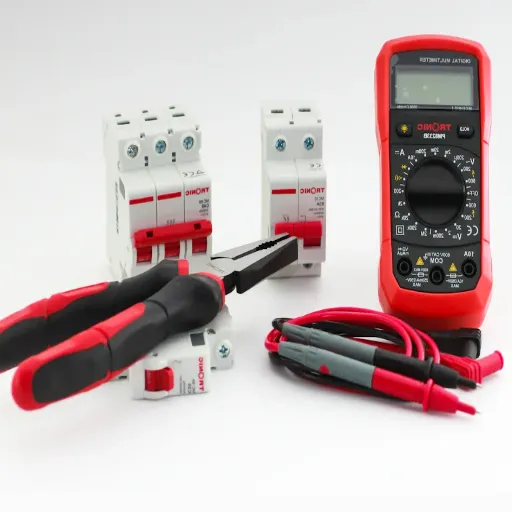
China is one of the world’s largest manufacturing bases for test and measurement equipment. Many global brands source components or assemble instruments there, and a large number of independent manufacturers produce multimeters, oscilloscopes, and accessories for export.
When sourcing from Chinese manufacturers, verify the following:
- Certifications: Look for CE, UL, or ETL marks for electrical safety, and RoHS compliance for environmental standards.
- CAT safety ratings: Independent verification matters. Some low-cost meters claim CAT ratings they do not actually meet.
- Calibration support: Ask whether the manufacturer provides calibration certificates or supports local calibration.
- Probes and accessories: Confirm that compatible probes, leads, and power adapters are included and available as spare parts.
- Warranty and documentation: A clear warranty, English manual, and technical support contact are minimum requirements.
- Sample testing: Order samples before committing to bulk purchases. Test accuracy, build quality, and safety yourself.
Conclusion
The multimeter vs oscilloscope decision is not really a choice between two competitors. It is a choice between two different ways of looking at an electrical circuit.
A multimeter gives you the numbers you need for quick diagnosis and verification. An oscilloscope shows you the behavior behind those numbers. For basic repair and maintenance, a multimeter is enough. For power electronics, embedded systems, and signal analysis, an oscilloscope is essential.
Most professional technicians and engineers use both. Start with a reliable multimeter that has true RMS and proper safety ratings. Add an oscilloscope when your work demands insight into signal shape, timing, or noise. If your work is mobile, a scopemeter can be a useful middle ground.
If you are sourcing test and measurement tools for your business, contact us today. Shanghai Oushike Hardware Tools Co., Ltd. offers factory-direct pricing, practical sourcing support, and long-term partnership to help you build a product line that fits your market.
Sources
- Fortune Business Insights. “Digital Multimeter Market Size, Industry Share | Forecast, 2026-2034.” https://www.fortunebusinessinsights.com/digital-multimeter-market-103916
- Persistence Market Research. “Oscilloscope Market Share & Future Scope, 2033.” https://www.persistencemarketresearch.com/market-research/oscilloscope-market.asp
- Coherent Market Insights. “Oscilloscope Market Size, Trends and Forecast, 2026-2033.” https://www.coherentmarketinsights.com/market-insight/oscilloscope-market-5766
- Fluke. “Oscilloscope vs Multimeter.” https://www.fluke.com/en-us/learn/blog/oscilloscopes/oscilloscope-vs-multimeter