
Custom Saw Blades: The OEM and Private Label Guide
In September, a buyer in Rotterdam sent the same request to three blade factories: 2,000 custom saw blades, his logo on the plate, retail packaging. The quotes came back at €1.80, €2.60, and €3.40 per blade.
None of the suppliers was overcharging. They were answering three different questions.
The €1.80 quote was a stock blade with a laser-etched logo. The €2.60 quote added a printed color box, which meant print plates and a die. The €3.40 quote was a blade with a non-standard bore, which meant a new plate program and a sample round.
All three suppliers called it a custom saw blade. Only one of them was selling what he thought he was buying.
If you are building a blade brand or commissioning a made-to-spec blade, you already know you need a supplier. The harder problem is knowing which of those three purchases you actually need, and in what order. This guide separates the tiers, shows which customization dimensions create real tooling cost, and explains what you take on legally once your name goes on the plate.
By the end, you should be able to read a quote and know which tier it is for.
Key Takeaways
- “Custom saw blades” describes three products: a branded stock blade, a branded blade with custom packaging, and a fully custom specification.
- You pay tooling for what is printed or ground, not for what is marked. A laser-etched logo needs no hard tooling; printed packaging and custom tooth geometry do.
- Customize in order: brand mark first, packaging second, blade specification last. Geometry is the most expensive bet, and most buyers place it too early.
- Private label moves compliance marking responsibility to you. Ask who supplies technical documentation in your company’s name before you brand anything.
- Private-label logo minimums commonly land at 100 to 500 pieces, with custom packaging at 500 to 1,000. Treat those as market benchmarks, not as quotes.
What Are Custom Saw Blades?
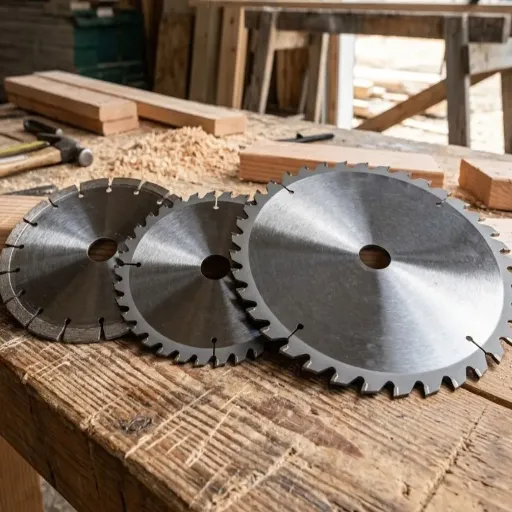
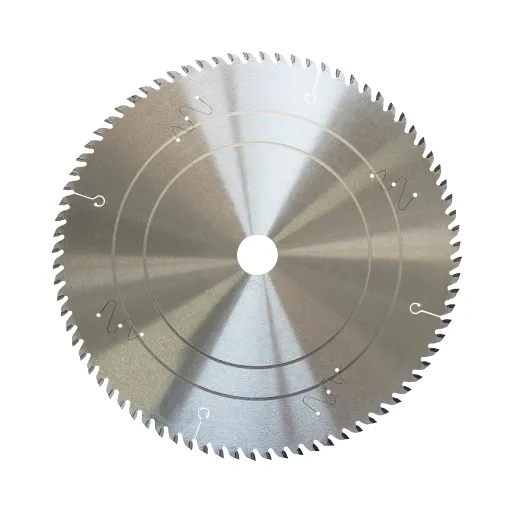
Custom saw blades are circular saw blades manufactured to a buyer’s brand or specification instead of being sold only as stock catalog items. The term covers two different purchases: private label, where a standard blade carries your logo and packaging, and custom specification, where diameter, bore, tooth geometry, or carbide grade is engineered for your application.
One clarification before we go further. This guide is about circular and TCT blades made to your brand or specification. It isn’t about band saw blades cut and welded to length, which is a different product with a different supply chain.
The distinction matters because both are searched under the same phrase, and a buyer who lands on the wrong one wastes a week of quoting.
The category is also large. The global saw blades market was estimated at USD 17.0 billion in 2025, according to IMARC Group, and circular blades are the segment most new brand owners enter first.
If you are still deciding which blade family fits your market, our guide to the types of circular saw blades is the better starting point.
Not sure which tier your project falls into? Send us the specification and we’ll tell you which of the three you’re actually buying. Request a quote →
The Three Kinds of Custom, and Why They Cost Different Amounts
This is the framework the rest of the guide depends on. Three tiers, three cost structures.
| Tier | What you change | What it takes at the factory | Tooling | Typical MOQ | Lead time | Best for |
|---|---|---|---|---|---|---|
| 1. Branded standard blade | Stock blade plus laser-etched logo and brand color | Marking program and artwork proof | None | ~100–500 pcs | Days | First brand, market test, low cash exposure |
| 2. Branded standard plus packaging | Tier 1 plus retail packaging | Print plates or die, artwork, proof, packing line | Real tooling | ~500–1,000 pcs | Adds 1–3 weeks | Retail shelf, e-commerce listing, gifting |
| 3. Custom specification | Non-catalog diameter, bore, kerf, tooth geometry, carbide grade, coating | Engineering, plate program, grinding profile, tensioning, sample iterations, test cuts | Engineering and samples | Highest, quoted per project | Weeks to months | OEM program, machine-specific blade, defensible differentiation |
The MOQ and lead-time columns are marketplace benchmarks as of October 2026, drawn from supplier listings. They are directional. Your quote will depend on diameter, finish, packaging format, and volume, so replace every number here with a written quote before you commit.
Why the cost curve is not linear
Buyers assume “custom” means expensive across the board. However, it doesn’t. The cost lands in specific places.
| Change | Tooling reality | Why the cost sits there |
|---|---|---|
| Laser-etched logo | No hard tooling, just a marking program | Cost is setup and proof, not tooling |
| Printed packaging | Print plates and a die-cut die | One-time cost spread across the run |
| Custom bore | Fixture or program change | Low tooling, but every bore is a separate SKU |
| Custom diameter | New plate program, tensioning, balancing | Engineering and test time, not material |
| Custom tooth geometry | Grinding wheel profile plus sample iteration and cut testing | Highest engineering cost in the list |
| Custom carbide grade | No tooling | Cost is the material and the mill’s minimum |
| Custom coating | Process setup | A batch process, so a minimum batch applies |
The rule to remember: you pay tooling for what is printed or ground, not for what is marked.
That single sentence explains why a logo can start at a few hundred pieces while a custom tooth profile can require a sample program before anyone quotes a production price.
What You Can Customize on a Saw Blade
Almost every dimension of a blade can be changed. The question is what each change costs you downstream. If you want the production background behind those changes, our guide to how saw blades are manufactured walks through the process.
| Dimension | What can change | What it costs you |
|---|---|---|
| Diameter | Standard metric and imperial families, plus non-catalog sizes | New plate program, and a new SKU |
| Bore / arbor | 5/8″ (15.87 mm), 16 mm, 20 mm, 22.23 mm, 25.4 mm, 30 mm, plus specials | Every bore is a separate SKU and a return risk |
| Kerf and plate thickness | Thin kerf through full kerf | Must be tested on your material |
| Tooth count | Within a family | Low cost, high catalog impact |
| Grind | FTG, ATB, TCG, ATBR, HATB | Grinding profile required |
| Hook angle | Application-specific | Changes cutting behavior and kickback risk |
| Carbide grade | YG6, YG8 and YG10 class grades, plus PCD | Material minimum applies |
| Coating and finish | Black oxide, paint, polished, specialty | Batch minimum applies |
| Max RPM rating | Must be rated from test evidence | Never raised on request |
| Laser marking | Logo, brand, specification text, part number, batch code | Program only |
| Packaging | Format, artwork, barcode, language | Print tooling |
What a responsible supplier will not customize
This part matters more than the table above. A supplier who says yes to everything is telling you they have not thought about it.
- A higher RPM rating cannot simply be specified. Raising a rating requires a re-rated design and test evidence. A blade marked faster than it is proven to run is a safety problem, not a specification.
- A bore cannot be enlarged without assessing the plate. The bore sits in the blade’s stressed center. Changing it affects clamping, balance, and how the blade behaves under load.
- Tooth geometry cannot be changed without a cut test. A profile that looks correct on a drawing can chip, grab, or overload the motor on real material.
- A blade cannot be made compliant by marking it. The marking records a design. It doesn’t create one.
If a supplier agrees to any of these without asking a question, treat it as a warning about how they’ll handle the rest of the order.
What to Customize First, and What to Leave Standard
Customize the brand first, the packaging second, the geometry last.
| Order | What you customize | Why now | Why not later |
|---|---|---|---|
| 1 | Brand mark | Lowest MOQ, no tooling, visible on shelf and in every product photo | Delaying it delays every downstream asset |
| 2 | Packaging | Turns a commodity blade into a retail product | Artwork depends on the brand mark being final |
| 3 | Specification | Only worth it once volume proves the segment | Custom geometry multiplies SKUs, MOQ, lead time, and reorder risk |
The commercial logic is simple. Brand and packaging are what your customer sees. Geometry is what they usually cannot tell apart.
That’s why the smartest first order is almost always a branded standard blade, not a custom one.
For example, Priya found this out the expensive way. In 2024 she launched a blade line in Manchester and opened with a custom 190 mm blade with a 20 mm bore, because that was the size her regional market used. Tooling and sampling pushed the minimum to 3,000 pieces and the lead time to eleven weeks.
By the time stock landed, her two largest accounts had standardized on 7-1/4 inch blades with a 5/8 inch arbor. The custom blade was correct for a market that turned out to be smaller than her stock options. She sold through it eventually, at a discount, and spent the next year rebuilding the range around standard sizes with her logo on them.
The custom bore was not a mistake in engineering. It was a bet placed before she had the sell-through data to justify it.
If your blade sizes are still open, our circular saw blade sizes and arbor chart covers the standard families before you commission anything non-standard.
Private Label Marking: The Part Most Buyers Miss
This is the section most guides skip, and it is the one with the longest tail.
A woodworking circular saw blade sold in the EU is expected to meet EN 847-1, the safety standard for milling tools and circular saw blades. The standard covers design, marking, maximum speed, and the information supplied with the tool.
Blade marking typically carries the diameter, bore, tooth count, maximum permissible speed, and the manufacturer or brand identity, along with the direction of rotation. Confirm the exact mandatory field set against the purchased standard text before you print anything, because secondary sources paraphrase it differently.
Here is the commercial consequence. When your brand goes on the plate, your name is on the marking. You become the party a customer, a retailer, or a market surveillance authority comes to with a question.
Marcus, a brand owner in Chicago, found this out when a regional retailer asked for the technical file for the blades he was supplying. He had the blades. He had the artwork. He didn’t have documentation in his company’s name, because he’d never asked the factory for it.
The order was held for three weeks while the paperwork was rebuilt.
Three questions to ask before you brand anything:
- Who applies the marking, and exactly which fields go on the plate?
- Will you supply the technical documentation in my company’s name?
- If a batch is challenged, what is the traceability path from the finished blade back to the steel lot and the carbide lot?
One scope limit worth stating plainly. EN 847-1 covers woodworking blades. Metal-cutting, masonry, and diamond blades fall under different requirements, so don’t assume one standard covers your whole catalog.
For US buyers, OSHA 29 CFR 1910.213 governs woodworking machinery. It applies to the machine, not as a substitute for blade marking.
Preparing Artwork for a Laser-Etched Blade
The mark is a surface change, not ink. That changes the artwork rules.
| Rule | Why it matters |
|---|---|
| Supply vector artwork | Raster art etches with ragged edges |
| One color, no gradients | Halftones and gradients don’t reproduce on steel |
| Respect a minimum line weight | Thin strokes disappear or read as scratches |
| Design for the plate finish | A mark that reads on black oxide may vanish on polished steel |
| Stay inside the marking area | The usable area is the flat body between arbor and gullets, and it shrinks with diameter |
| Keep text large enough to read at arm’s length | A part number nobody can read defeats traceability |
| Approve a physical sample | Screen color and steel are not the same surface |
That last row is the one people skip. A PDF isn’t a proof. The physical sample is the only thing that shows you how the mark actually reads on your chosen finish.
Fiber laser marking changes the steel surface either by annealing, which shifts the color, or by deeper engraving. Neither requires hard tooling, which is why logo minimums are low and why artwork, not tooling, is usually the long pole in the schedule.
Custom Packaging for Saw Blades
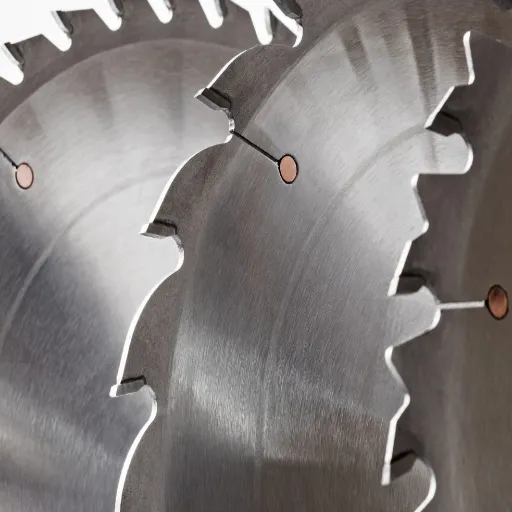
Packaging deserves a short section here and a longer read elsewhere, because the detail lives on our private label packaging checklist.
The formats, from cheapest to most expensive: poly bag with a printed header, color box, blister or clamshell, shrink pack with a hanger, and a printed sleeve with a master carton.
What drives the cost isn’t the box. It’s the print plates and the die-cut die, plus the format’s own minimum.
Watch for one trap. The packaging minimum often exceeds the blade minimum, and when it does, the packaging becomes your real opening order. If your blade minimum is 500 pieces and the color box minimum is 3,000, you’re ordering 3,000.
Launching a Custom Saw Blade Brand: The First 12 Months
The phased approach works because each stage produces the data the next stage needs.
| Phase | What you do | What to measure before moving on |
|---|---|---|
| Months 0–3 | Pick 3 to 5 SKUs for one market and one arbor. Brand mark only | Sell-through, return rate, reorder rate |
| Months 3–9 | Add retail packaging to the SKUs that sold | Return reasons, packaging damage, barcode failures |
| Months 9–12+ | Add a custom specification only where the market asks for something stock cannot do | Whether the custom spec wins orders the standard blade lost |
Four metrics, and each answers a different question. Sell-through tells you whether the SKU belongs, and return rate tells you whether the blade or the packaging is failing.
Reorder rate tells you whether the customer is real. Return reasons tell you which tier to fix next.
Finally, one honest note about cash. Every step up in tier raises the minimum and ties up more money in inventory. The first order is a bet. The second order is the signal.
For the bulk-order mechanics behind those minimums, freight, and payment terms, our wholesale saw blades guide covers the commercial side in detail.
The Custom Saw Blade RFQ
A standard RFQ gets you a price on a stock blade. A custom project needs a few more fields, and a good custom saw blade manufacturer will ask for all of them before quoting.
| Field | Example | Why it matters |
|---|---|---|
| Blade type | TCT circular saw blade, wood and general purpose | Sets the base family |
| Diameter | 7-1/4″ (184 mm), or a non-catalog size | Flags a plate program |
| Bore | 5/8″ (15.87 mm) with diamond knockout, or 20 mm | Flags a custom bore |
| Kerf and plate | 2.2 mm kerf, 1.6 mm plate | Drives test requirements |
| Tooth count, grind, hook | 40T, ATB, 15 degrees | Flags engineering input |
| Carbide grade | YG8 class, or supplier recommendation | Material minimum applies |
| Max RPM required | 7,000 RPM minimum | Never spec above a tested rating |
| Application and machine | Framing lumber on a handheld saw | The blade must fit the machine |
| Brand name for marking | Your company or brand name | Goes on the plate |
| Artwork status | Vector logo supplied, or pending | Blocks the schedule if missing |
| Packaging format | Color box, blister, poly bag and header | Drives packaging tooling |
| Tooling ownership | Who owns the plate program and the print die | Ask before you pay for it |
| Exclusivity request | Exclusive in a territory for 12 months | Changes the commercial terms |
| Annual volume and trial order | 20,000 per year, 500 trial | Sets the tier |
| Destination and Incoterm | Hamburg, FOB or CIF or DDP | Sets the quote basis |
| Compliance | EN 847-1 marking, documentation in brand name | Sets marking responsibility |
In addition, two questions buyers forget, and both are cheap to ask before the order and expensive to negotiate after: who owns the tooling, and is the specification exclusive.
Ready to price a project? Send the completed sheet to our team and we will confirm which tier applies, what tooling is involved, and what the sample round looks like. Request a quote →
Frequently Asked Questions
What is the minimum order for custom saw blades?
It depends on the tier. A laser-etched logo on a stock blade commonly starts at 100 to 500 pieces. Custom packaging commonly starts at 500 to 1,000. A fully custom specification is quoted per project, because the minimum is driven by engineering and sample cost rather than piece count.
Can I put my logo on a saw blade?
Yes. Laser etching is the standard method and requires no hard tooling, only a marking program and approved vector artwork. The practical minimum is driven by setup and proofing, not by tooling cost.
What is the difference between OEM and private label?
Private label means a standard blade carrying your brand and packaging. OEM generally means manufacturing to your specification, which may include a non-catalog diameter, bore, or tooth geometry. In practice the terms overlap, which is why it helps to name the tier rather than the label.
Can I get a custom diameter or bore?
Yes, and it is the most common custom request. Both create a separate SKU, so plan the catalog before you add sizes. Every extra bore is also a fit-related return risk.
How long does a custom saw blade take to produce?
Standard blades typically run 7 to 30 days, and custom work commonly adds 15 to 30 days. A full custom specification adds sample iteration and cut testing on top of that. Ask for the lead time in writing against your specific specification.
Do I own the tooling?
Ask before you pay for it. Ownership of print dies and plate programs varies by supplier and is usually negotiable at the quoting stage. Get the answer in writing.
Is a custom blade better than a standard blade?
Only if your application needs something the standard range cannot do, such as a machine-specific bore or a coating for a humid climate. For most first-year brands, a branded standard blade sells better because it is easier to restock and cheaper to test.
Can I private label without changing the blade at all?
Yes. That’s tier one, and it’s the right starting point for most new brands. You change the mark, not the cutting geometry.
Conclusion
Custom saw blades aren’t one product. They’re a branded stock blade, a branded blade in custom packaging, and a fully engineered specification, and they sit at three very different price points.
The buyers who get this right do three things. They start with the brand mark because it costs the least and shows the most. They add packaging only to the SKUs that proved themselves. And they save custom geometry for the account that actually needs it.
They also ask the question most buyers skip: who carries the marking responsibility once my name is on the plate.
If you are planning a custom saw blade project, start with the circular saw blades supplier guide for the full catalog and sourcing picture, then come back with a specification. If your blades will cross a border, our guide to importing saw blades from China covers classification, duty, and factory verification.
Send us your specification → We will tell you which tier fits, what tooling applies, and what to expect from the first sample round.
Sources
- EN 847-1, Tools for woodworking, safety requirements, Part 1: Milling tools and circular saw blades
- OSHA 29 CFR 1910.213, Woodworking machinery requirements
- USITC Harmonized Tariff Schedule, Chapter 82
- IMARC Group, global saw blades market estimate, 2025
- Supplier listing survey, Alibaba and Made-in-China, October 2026, for MOQ and lead-time benchmarks