
Work Lights: The Complete Buyer’s Guide for Industrial Applications
Within the last 12 months the global market for LED work lights has grown by less than $1 billion up to $10.06 billion and is increasing by 7.8% per year. However, in sector many industrial customers are still confronted with basic difficulty: finding work lights that are highly adjustable to actual needs and in compliance with state safety standards.
Last year, when Li Wei began enacting procurement function for a Shanghai-based construction company leaving some of his previous projects, he had obtained over five years’ worth of halogen work lights of varying makes. It was just that the lights did not cost much to procure and seemed to work during that project, the energy costs were on the rise, bulbs were constantly replaced and during the previous audit the safety officer had concerns about OSHA compliance. There was an urgent need to replace forty pieces of equipment, but White did not know where to start as there were too many options. Cord or cordless? Lightweight or not? How many lumens? What IP rating? His initial quotes ranged from 50 to 500 per unit for seemingly similar products.
Such recommendations undoubtedly help in preventing the problem of Li Wei. Equally, one is able to know what exactly to pay attention to, while choosing working lights which will be of good quality and which will meet all safety standards, since this, in turn, besides safety, it is able to provide proper appreciation. Let it be that you are told on how to get out of the overseas today as a result of this article as well as get this light, the device that creates the light that serves you for a particular period. Do you think that it will be useful for me to order more lighting?
Looking to source work lights for your business? Understanding these specifications helps you evaluate suppliers and negotiate better terms.
Understanding the Work Light Market
Market Overview and Growth Trends
Majority of usages in the industrial sector now use LED lighting compared with the past. Formation of the portable work lights section is more than $1.85 billion worldwide, marked by even 10.2% improvement every year. Construction is the largest consumer (over 35%), followed by production, car workshops and emergency service centres.
Several factors drive this growth:
- Energy regulations: Increasing restrictions on inefficient lighting
- Safety standards: Updated OSHA requirements favoring reliable LED systems
- Total cost awareness: Buyers recognizing lifecycle savings beyond purchase price
- Battery technology: Improved cordless options expanding application possibilities
The greatest part of an LED work lamp on world markets is undoubtedly produced in China, which accounts for about 60%. Such geographic concentration opens up the possibilities for direct-purchasing strategies but on the other hand requires detailed evaluation of the suppliers within the chain to guarantee a continuous supply of high-quality products in the cooperation.
Why LED Technology Dominates
LED work lamps have replaced the halogen and incandescent options used in professional lighting due to their logical advantages:
Energy efficiency: LEDs produce the equivalent of halogen lights and are 50-90% less electricity-consuming than halogen lights. Power saving is a huge advantage to installing numerous lights that are in use for more than twelve hours a day in most premises.
Lifespan: In most cases, quality LED work lights are good for 50,000 hours of continuous use, while halogen bulbs come in the range between 2,000 and 5,000 hours. Moreover, the amount of money saved as a result of not having to replace the bulb as frequently far outstrips the costs of energy savings throughout the time span of the product.
Durability: With LEDs, the concern of vibration, impact, and wide range of temperature are the worry no more as LED engineered-made will be able to withstand these issues, especially compared to filament bulbs which are less tough than LEDs. This makes them very important for construction and service industries where heavy-duty equipment wears and tears.
Heat reduction: The use of LED lamps reduces safety hazards in enclosed spaces compared to halogen lamps.
Work Light Fundamentals
Understanding Lumens and Brightness
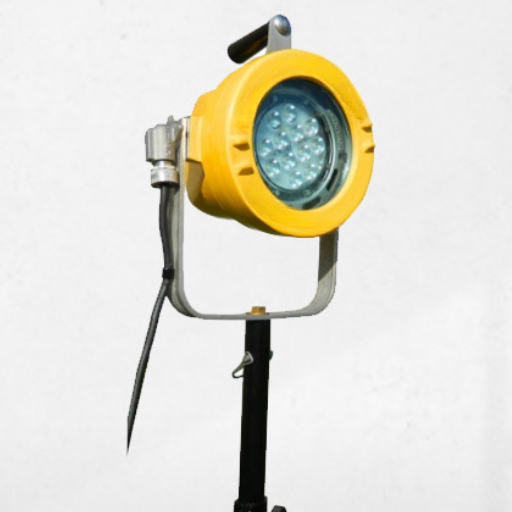
1The overall brightness of a light is measured in lumens. This is unlike power which is quantified in watts. A lamp rated at a specific lumen output is basically telling you how much light will come out of it. Choosing the appropriate lumen level helps to provide sufficient light without going overboard and losing energy.
| Application | Recommended Lumens | Use Case |
|---|---|---|
| Small task lighting | 500-1,000 | Inspection, detailed mechanical work |
| General workshop | 1,000-3,000 | Standard maintenance, assembly |
| Automotive repair | 2,000-5,000 | Engine work, undercarriage inspection |
| Construction sites | 3,000-10,000 | Framing, concrete work, large area coverage |
| Heavy industrial | 10,000+ | Mining, large-scale fabrication |
Zhang had renovated his auto repair facility in Shenzhen and had opted for practical 1000-lumen hand-held light general work units. The car self-service units still had some dark patches in certain areas where the mechanics had detailed engine work because they complained of eye fatigue. It wasn’t until superseding them with 3000-lumen adjustable light installations that the issue was resolved. More lumens produced viable light for the area, whereas dialing it down to some extent helped in the avoidance of reflective materials’ glare.
Color Temperature for Work Applications
Color temperature, measured in Kelvin (K), affects visibility and worker fatigue:
4000K-5000K (Cool White): Ideal for general construction and industrial tasks. Provides clear visibility without harsh blue tones that cause eye fatigue.
5000K-6500K (Daylight): Best for detailed inspection, color matching, and quality control. Mimics natural daylight for accurate color perception.
2700K-3000K (Warm White): Generally unsuitable for work applications. The yellow tint reduces visibility and can cause drowsiness during long shifts.
Most professional work lights now offer 4000K-5000K as standard, with premium models providing adjustable color temperature.
OSHA Lighting Standards
Not only do the Occupational safety and Health Administration’s lighting levels require certain measures under the 29 CFR 1926.56 Formalized consensus, but consumers new to these safety standards need to be put in place so as to reduce the risk of penalties.
| Work Area | Minimum Foot-Candles | Equivalent Lux |
|---|---|---|
| General construction | 5 fc | 50-100 lux |
| Outdoor active areas | 3 fc | 30 lux |
| Workshops and plants | 10 fc | 100 lux |
| Detailed work areas | 10-30 fc | 100-300 lux |
| First aid stations | 30 fc | 300 lux |
1To convert foot-candles to lumens for work light selection, calculate: Square footage × Required foot-candles × Light loss factor (1.2-1.5). A 2,500 square foot work area requiring 5 foot-candles needs approximately 16,250 lumens total.
Serious default penalties are up to $16,550 per default. Therefore, without a proper illumination, it is more probable that accidents and errors may arise and poor productivity could lead to financial losses that could exceed the costs of proper lighting systems.
IP Ratings and Durability
IP (Ingress Protection) ratings indicate dust and water resistance. The first digit measures solid particle protection, the second measures liquid protection.
IP65: Dust-tight and protected against water jets. Suitable for most construction and outdoor applications.
IP67: Dust-tight and protected against temporary immersion (up to 1 meter for 30 minutes). Required for wet environments or areas prone to flooding.
IP68: Dust-tight and protected against continuous immersion. Used for mining, marine, and severe weather applications.
For general construction work, IP65 provides adequate protection. Manufacturing facilities with washdown procedures may require IP67 or higher.
Types of Work Lights
Handheld and Trouble Lights
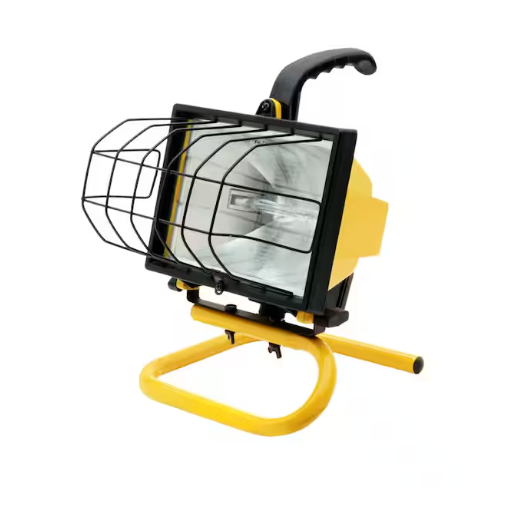
Handheld work lights provide targeted illumination for detailed tasks. Typical output ranges from 500 to 3,000 lumens.
Key features:
- Magnetic bases for attachment to metal surfaces
- Hooks for hanging from overhead structures
- 360-degree rotating heads for directional control
- Impact-resistant housings
Best applications: Mechanic work, electrical panel inspection, confined space entry, equipment maintenance
Tripod and Stand Lights
Tripod-mounted work lights illuminate larger areas. Output typically ranges from 2,000 to 10,000+ lumens.
Key features:
- Telescoping poles extending 7-10 feet
- Adjustable heads for directional control
- Single or dual-head configurations
- Stabilizing legs for uneven terrain
Best applications: Construction framing, concrete pouring, painting operations, general site lighting
String Lights
String lights are a popular means of providing distributed lighting over large areas. While the strength of each individual lamp is, in most cases, 1,000-2,000 lumens, the overall system performance can go up to 10,000+ lumens.
Key features:
- 50-100 foot lengths
- Daisy-chain capability for extended coverage
- Individual lamp hooks for easy installation
- Rugged construction for outdoor use
Best applications: Corridor lighting, large site perimeter illumination, temporary tunnel lighting, event setup
Headlamps
Head-mounted work lights provide hands-free illumination. Output ranges from 600 to 3,000 lumens.
Key features:
- Motion sensors for hands-free operation
- Multiple beam patterns (spot/flood)
- Adjustable straps for hard hat compatibility
- Lightweight designs for extended wear
Best applications: Inspection work, climbing, confined spaces, precision assembly
Vehicle and Equipment Mounted
When using integrated luminaire systems, they are usually installed on the machine’s surface. Such fixtures have varying lumen output, largely depending on the application – e.g., utility vehicle lighting of 2,000 lumens up to more than 20,000 lumens for mining equipment.
Key features:
- Vibration-resistant construction
- Direct electrical system integration
- Remote control operation
- Extreme temperature tolerance
Best applications: Mining equipment, agricultural machinery, emergency vehicles, material handling equipment
Power Source Options
Corded AC Power
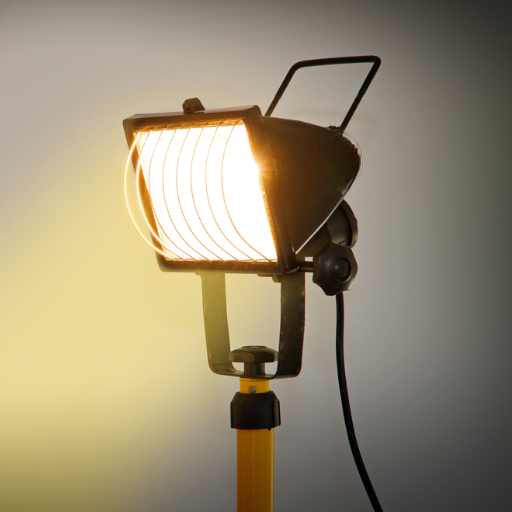
Corded work lights connect to standard electrical outlets or generators. They provide unlimited runtime and maximum brightness potential.
Advantages:
- Continuous operation without battery management
- Highest lumen output options
- Lower long-term operating cost
- No battery replacement expense
Limitations:
- Requires electrical access or generator
- Cord management challenges on job sites
- Trip hazards in high-traffic areas
- Limited mobility
Cordless and Battery Powered
The other category of worklights are those powered by batteries. These lights are powered by rechargeable lithium-ion batteries, following a shift from disposable types. The length for which these devices consume power can range from 4 hours to 16 hours depending on how dim they are and the size of the battery.
Advantages:
- Complete mobility without cord constraints
- Quick setup in remote locations
- Safe use in wet conditions (with appropriate IP rating)
- Compatibility with existing tool battery platforms
Limitations:
- Limited runtime requiring battery management
- Higher total cost of ownership
- Battery degradation over 3-5 year lifespan
- Reduced brightness compared to corded equivalents
Battery platform compatibility: Many of the current cordless tools flood the market, and we are currently working on integration with other cordless tool systems. For instance, we have the Milwaukee M18 battery system that would adopt the battery from Milwaukee M18 power tools, the 20 V max from the Dewalt power tools, the 18 V from the Makita power tools and so fuse all power sources into one suitable power source for a wide range of power tools.
Hybrid Systems
Hybrid work lights operate on both AC power and batteries. They offer flexibility for varying application requirements.
Advantages:
- Corded operation when power is available
- Battery backup for mobility or outages
- No downtime during power transitions
- Maximum versatility
Best applications: Facilities with reliable power that also require mobile lighting capability, emergency backup lighting, multi-location contractors
Choosing Work Lights by Industry
Construction Sites
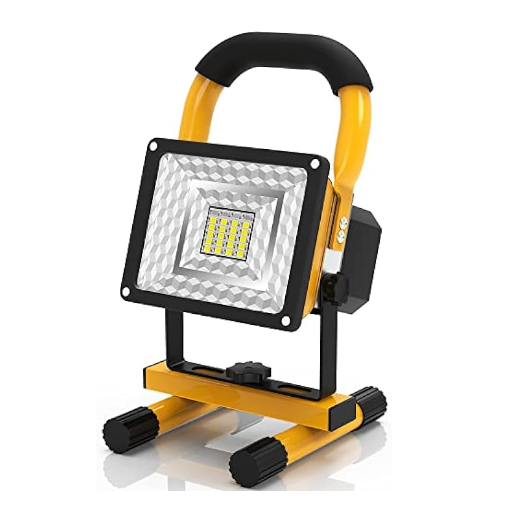
Construction applications demand rugged, high-output lighting systems.
Requirements:
- Brightness: 3,000-10,000 lumens for general work areas
- Durability: IP65 minimum, IK08+ impact resistance
- Portability: Tripod-mounted or vehicle-mounted systems
- Power: Hybrid or generator-compatible for remote sites
Recommended configurations:
- Tripod lights for stationary work areas
- String lights for corridor and perimeter illumination
- Handheld units for detail work and inspections
Manufacturing Facilities
Manufacturing environments require consistent, reliable lighting that supports quality control and safety.
Requirements:
- Brightness: 1,000-3,000 lumens for general areas, 3,000+ for inspection stations
- Color temperature: 5000K+ for quality control areas
- Durability: IP54 minimum for general areas, IP65+ for washdown zones
- Power: Corded preferred for fixed stations, cordless for maintenance
Recommended configurations:
- Permanent overhead LED systems for production lines
- Portable work lights for maintenance and changeovers
- Task lighting for inspection and assembly stations
Automotive Workshops
Auto repair shops need versatile lighting that adapts to varied tasks.
Requirements:
- Brightness: 2,000-5,000 lumens for general use
- Features: Magnetic bases, hooks, rotating heads
- Durability: Chemical and oil resistance
- Power: Cordless preferred for under-vehicle work
Recommended configurations:
- Handheld trouble lights with magnetic bases
- Rechargeable units with 4+ hour runtime
- Dimmable models for working with reflective surfaces
Emergency Response
Emergency and utility applications demand instant deployment and maximum reliability.
Requirements:
- Brightness: 3,000-10,000 lumens for scene illumination
- Runtime: 8+ hours on battery
- Durability: IP67+, extreme weather resistance
- Deployment: Rapid setup, minimal components
Recommended configurations:
- Telescoping tripod lights with battery power
- Vehicle-mounted systems for command vehicles
- Headlamps for hands-free operation
Cost Considerations and ROI
LED vs Halogen Total Cost of Ownership
Purchase price represents only a fraction of the total work light cost. Evaluating five-year ownership provides an accurate comparison.
Corded LED Work Light (5-Year Cost):
- Initial purchase: $150 (professional grade)
- Electricity (8 hours/day): $120
- Maintenance: $25
- Total: $295
Corded Halogen Work Light (5-Year Cost):
- Initial purchase: $75
- Electricity (8 hours/day): $600
- Bulb replacement (10 bulbs): $100
- Maintenance: $75
- Total: $850
Savings: LED reduces five-year cost by 65% despite higher initial price.
Bulk Procurement for Businesses
Volume purchasing creates additional savings opportunities for distributors, contractors, and facility managers.
Volume pricing tiers:
- 10-49 units: 5-10% discount
- 50-99 units: 10-15% discount
- 100+ units: 15-25% discount
Additional considerations:
- Warranty terms often improve with volume orders
- Custom branding available at 500+ unit quantities
- Payment terms may extend for established business relationships
Top Features to Look For
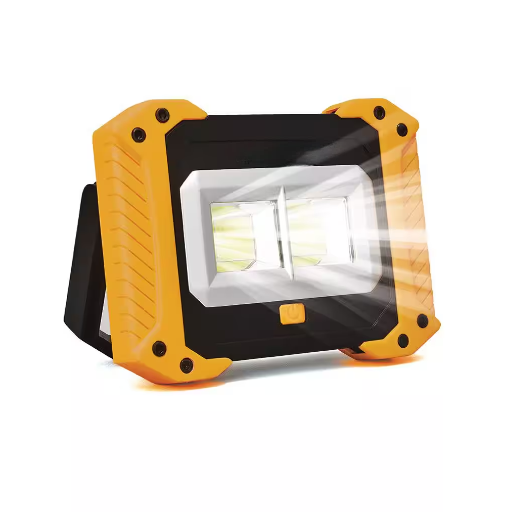
When evaluating work lights for industrial use, prioritize these features:
Adjustable brightness: Dimmable lights adapt to different tasks and extend battery runtime on cordless models.
Multiple mounting options: Magnetic bases, hooks, tripod mounts, and clamp attachments maximize versatility.
Battery level indicators: Visual or audible low-battery warnings prevent unexpected shutdowns during critical work.
Overheat protection: Thermal management systems extend LED lifespan and prevent safety hazards.
Warranty and support: Minimum 2-year warranty for professional-grade products. Evaluate supplier support responsiveness before large purchases.
Replacement parts availability: Ensure bulbs, batteries, and chargers remain available for the product’s expected lifespan.
Conclusion
To choose the perfect work lighting, manufacturers need to be able to resolve issues related to cost, relevant regulations and the quality standards of the lights. In the professional programs, the LED technology is found to be the most efficient at the moment which also has the maximum life and resistance characteristics when compared to the instruments that are now available in the market.
Key decision factors:
- Match lumen output to your specific application requirements
- Verify IP ratings match your environmental conditions
- Consider OSHA compliance minimums for workplace safety
- Calculate five-year total cost, not just purchase price
- Evaluate power source options based on mobility needs
For distributors and purchasing managers, attempting to maintain relationships with trustworthy manufacturers is vital to the success of the corporation. Ordering goods straight away, through intermediaries in the supply chain, will help in cost containment.
Ready to source professional-grade work lights for your business? Get in touch with us for volume and OEM pricing. Please note that the provided work lights are designed for use in demanding industrial applications.
Frequently Asked Questions
How many lumens do I need for a work light?
Lumen requirements depend on your application:
- Small detailed tasks: 500-1,000 lumens
- General workshop work: 1,000-3,000 lumens
- Construction and outdoor work: 3,000-10,000 lumens
- Heavy industrial applications: 10,000+ lumens
Analysis driven by the square footage and foot-candle requirements involves multiplying the required foot-candles with the square footage of the space (usually the maximum amount is 5 foot-candles as specified by OSHA for general fabrication). To this resulting figure, a factor of 20% to 30% will be added in order to account for light loss.
What is the best work light for construction?
The construction light with the highest efficiency including brightness of over 3000 lumens above has very impressive (up to IP65 and above and IK08 and above) durability as well as building applicability of the light. LED flood lights and road construction lights placed on tripods with the combined power sources (AC and battery) prove utmost convenience in use for almost every construction need.
Are LED work lights better than halogen?
Yes, work lights containing LED perform better in comparison to halogens in terms of many professional aspects: LED bulbs with the same brightness consume 50-90% less electricity, their service life is 10-25 times longer, LEDs are more shockproof, and they heat up less. Even though these LED lights are higher priced than others in the market, the overall cost savings in the first five years can be more than 65%.
What does IP rating mean on work lights?
The term “IP” (Ingress Protection) denotes the level of protection against dust and water penetration. The first element between 0-6 indicates the degree of security against solid objects such as particles of dirt. While the second numerical position within 0-9 shows the grade of security against moisture. It is to be noted that for work lighting equipment the minimum suitable rating is IP65 (the appliance is protected from ingress of dust and protection against water jets).
How long do rechargeable work lights last?
Efficient LED fixtures can be conveniently recharged and used for 4-16 hours, based on the light intensity level and battery duration. The lifespan of different types of LED bulbs can exceed 50,000 hours. Even so, due to frequent depletion, various criticisms suggest that batteries will need to be replaced every 3-5 years after being bought.
What color temperature is best for work lights?
4000K-5000K (cool white) for most industrial and construction-related tasks, find that visualizing equipment or objects in such an environment is the best as far as visibility is concerned. 5000K-6500K (daylight) is what most workers who do inspection work or need to assure correct color balance should use. Acquire 2700K-3000K as less visibility and blurring may cause eye problems.
Are work lights OSHA-compliant?
Work lights themselves are not OSHA certified but they are required to provide enough light to satisfy OSHA illumination requirements for more info this can be found in Www.osha.gov. All construction work areas should get 5 foot candles, workshops 10 foot candles and more detailed assembly work about 10 to 30 foot candles. Start buying working lights that give out enough backlight for the specific work area needed.
Sources and References
- [OSHA – Workplace Lighting Standards](https://www. osha. gov)
- [Coherent Market Insights – LED Work Light Market Report](https://www. coherentmarketinsights. com/market-insight/led-work-light-market-3873)
- [Business Research Insights – Portable Lights Market](https://www. businessresearchinsights. com/market-reports/portable-lights-market-100106)