
M6 Allen Key & Hex Key Sizes: The Tools For M6 Fasteners
An M6 socket head cap screw is driven with a 5 mm Allen key, not a 6 mm one. M6 button-head, flat-head, and low-head socket screws take a 4 mm key, M6 set screws take a 3 mm key, and M6 hex bolts and hex nuts take a 10 mm wrench or socket. That mix is why asking for an “M6 Allen key” often gets you the wrong tool. This guide gives you the complete M6 driver map, explains the “M6 vs 6 mm” confusion once and for all, and shows you what to look for in the hex keys themselves.
M6 fasteners are everywhere: furniture, electronics racks, machine guards, automotive brackets. Almost every one is turned by an Allen key or a wrench, and the driver is easy to get wrong because the naming is genuinely confusing. A seller lists an “M6 Allen key” that actually fits a specific M6 screw in their kit, while the literal 6 mm key you buy in a set fits M8 socket caps instead. Get the size wrong and you round out the socket, which turns a two-minute job into a drilled-out screw. We make the driver tools at our factory, so this is the reference we hand to customers who ask, “which one do I actually need?”
Key Takeaways
- A standard M6 socket head cap screw (DIN 912 / ISO 4762) takes a 5 mm Allen key; button, flat, and low-head M6 socket screws take 4 mm; M6 set screws take 3 mm.
- A 6 mm Allen key is the driver for M8 socket cap screws, not M6. Match the key to the head socket, never to the thread size on the label.
- M6 hex head bolts and hex nuts (DIN 933 / DIN 934) use a 10 mm wrench or socket, normally on a 1/4 in or 3/8 in drive.
- For powered driving, use a 5 mm hex bit in a cordless driver at low, clutch-limited torque to avoid over-tightening.
- Buy hardened hex keys (Cr-V or S2 steel, about HRC 52–60) with a precision-ground hex, and always use the exact size so you do not round the socket.
What Size Allen Key Do You Need for an M6 Screw?
An M6 socket head cap screw uses a 5 mm Allen key. M6 button-head, flat-head, and low-head socket screws use a 4 mm key, and M6 set screws use a 3 mm key. M6 hex bolts and hex nuts use a 10 mm wrench or socket.
The rule that removes the guesswork: match the driver to the hex socket or hex head, not to the thread size written on the screw or the label. The thread is always M6, but the drive recess differs between head types. That is why one “M6” screw takes a 5 mm key and a different “M6” screw takes a 4 mm key.
If you only remember two numbers, make them these. The 5 mm Allen key and the 10 mm wrench or socket cover the large majority of M6 fasteners in service. Between them they handle the socket cap screws, hex bolts, and hex nuts that dominate real assemblies. Everything else in the M6 family is a smaller-profile variant that uses a smaller key.
For the full M6 thread callout and dimensional background, see our M6 screw size guide. Here we stay on the tools.
“M6 Allen Key” vs “6 mm Allen Key”: The Confusion, Explained
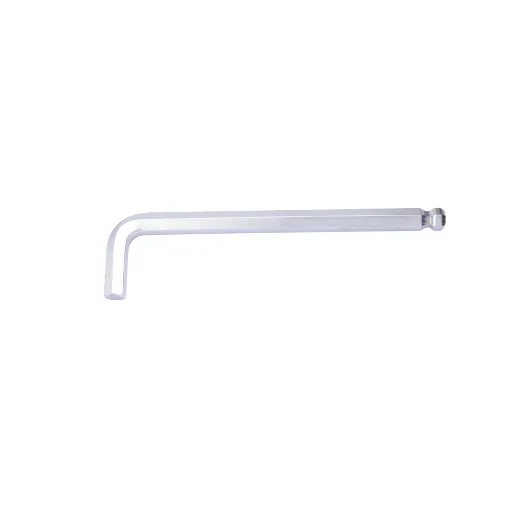
The term “M6 Allen key” has two meanings, and most of the confusion online comes from not telling them apart.
Meaning A: the Allen key that fits an M6 screw. This is the useful meaning. A standard M6 socket head cap screw is made to DIN 912 / ISO 4762 and has a hex socket that measures 5 mm across the flats, so it needs a 5 mm hex key. A key described as “for M6 screws” is normally a 5 mm key, and that is correct.
Meaning B: a 6 mm Allen key. This is a key whose hex measures 6 mm across the flats. A 6 mm key is the driver for M8 socket head cap screws (and many M10 countersunk DIN 7991 screws), not for M6. In proper metric terminology, “M6” names the screw thread size, never the tool size, as the Wikipedia entry on hex keys makes clear.
So where does the confusion come from? Some sellers, especially in camera, cinema, and 3D-printer accessories, label their driver by the screw it ships with and call it an “M6 Allen key” even when the key itself is 4 mm or 6 mm for the specific hardware in the box. That loose labeling is not a standard. Buy a bare “6 mm Allen key” and you have a key for M8 socket caps, which will not fit an M6 screw at all.
The practical rule: ignore the label’s thread size and measure, or match, the driver to the socket. Hold the key against the recess. The correct key seats fully and snugly. An undersized key wobbles and rounds the socket the moment you lean on it, and a rounded M6 socket cap is very hard to remove. An oversized key simply will not go in.
M6 Hex Key Size by Screw Type: The Full Driver Map
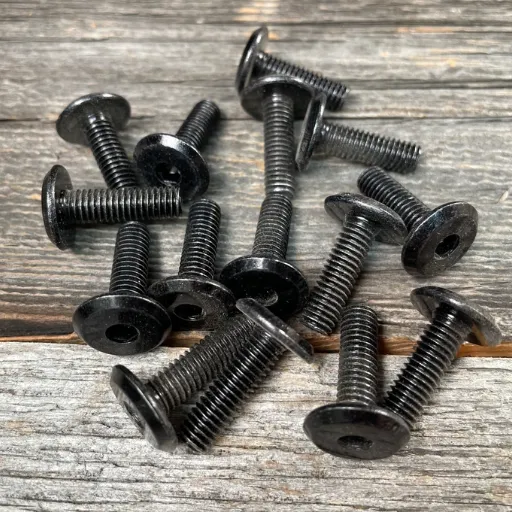
Each M6 head type has its own drive size. The table below pairs every common M6 fastener with the exact driver, which is the map to keep on the bench.
| M6 fastener type | Standard | Hex (Allen) key | Wrench / socket |
|---|---|---|---|
| Socket head cap screw | DIN 912 / ISO 4762 | 5 mm | Allen-driven |
| Button head socket screw | ISO 7380 | 4 mm | Allen-driven |
| Flat / countersunk head | DIN 7991 / ISO 10642 | 4 mm | Allen-driven |
| Low head socket cap | DIN 7984 | 4 mm | Allen-driven |
| Set (grub) screw | DIN 916 | 3 mm | Allen-driven |
| Hex head bolt | DIN 933 / ISO 4017 | — | 10 mm wrench / socket |
| Hex nut | DIN 934 / ISO 4032 | — | 10 mm wrench / socket |
| Pan-head machine screw | ISO 7045 | — | #2 Phillips or T20 Torx bit |
Two notes on the wrench and socket rows. A 10 mm socket for M6 hex nuts and hex head bolts is normally sold on a 1/4 in or 3/8 in square drive. Where the nut sits recessed or in a tight counterbore, pick a deep or thin-wall socket so it seats fully. Pan-head machine screws are cross- or star-driven rather than hex, so they take a screwdriver or bit, which you can read about in our screwdriver range and Torx drivers.
One drilling note before you fasten. An M6 socket cap screw threads into a 5.0 mm tapped hole, and a plain through-hole needs a 6.6 mm clearance hole. Our M6 tap drill and clearance hole sizes guide covers the drill bit for every M6 head type.
The head types behind those rows, and the full dimensional tables for each, are covered in our guide to types of M6 socket head cap screws. That page and this one are the pair you want: it tells you which head you are looking at, and this tells you which tool turns it.
Allen Key Sizes for Metric Screws: The M-Series Chart
The pattern above repeats across the whole metric series. Every socket head cap screw size has a fixed hex key size, and the M6 row sits in the middle of the range that most workshops actually use.
| Screw (socket cap) | Hex key | Screw (socket cap) | Hex key |
|---|---|---|---|
| M1.4 | 1.3 mm | M6 | 5 mm |
| M1.6 / M2 | 1.5 mm | M8 | 6 mm |
| M2.5 | 2 mm | M10 | 8 mm |
| M3 | 2.5 mm | M12 | 10 mm |
| M4 | 3 mm | M14 | 12 mm |
| M5 | 4 mm | M16 | 14 mm |
You can read this chart two ways. If you are holding an M6 screw and need the key, read across the bold row: 5 mm. If you are holding a hex key and need to know which screw it fits, work in reverse: a 6 mm key belongs to an M8 socket cap, an 8 mm key to an M10, and so on. That reverse reading is exactly where the “M6 vs 6 mm” mix-up happens.
The values in the chart are the standard socket-cap drive sizes, and they match the metric socket screw drive size tables published by fastener suppliers. Button-head, countersunk, and set-screw rows within each screw size take the smaller keys we gave in the M6 map. The full metric and SAE hex key chart, with the general DIN and ISO background, lives in our Allen wrench sizes and hex key guide.
5 mm & 6 mm Hex Key Dimensions (DIN 911 / ISO 2936)
Standard L-shaped hex keys are made to DIN 911, which is now ISO 2936, and the two sizes that matter for this topic have these typical reference dimensions.
| Hex size (S) | Long arm (L1) | Short arm (L2) | Typical use |
|---|---|---|---|
| 5 mm | about 80 mm | 28 mm | M6 socket cap screws |
| 6 mm | about 90 mm | 32 mm | M8 socket cap screws |
A long-arm variant, DIN 911L, stretches the reach: about 160 mm for the 5 mm long arm and 180 mm for the 6 mm. The across-flats tolerance on the hex itself is tight, roughly 0 to minus 0.04 mm, which is what lets a quality key seat without slop.
Treat these as reference values. Ball-end, T-handle, folding-set, and screwdriver-handle keys have their own shapes and do not follow the DIN 911 arm lengths. And because manufacturers differ by a millimetre here and there, confirm the exact dimensions against your supplier’s spec sheet. The DIN 911 standard reference on Fasten.it is a reliable cross-check if you are specifying keys in quantity.
Hex Key Types for M6: Which One Should You Use?
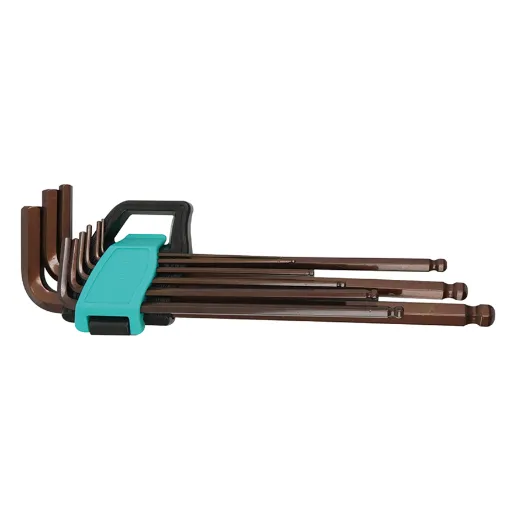
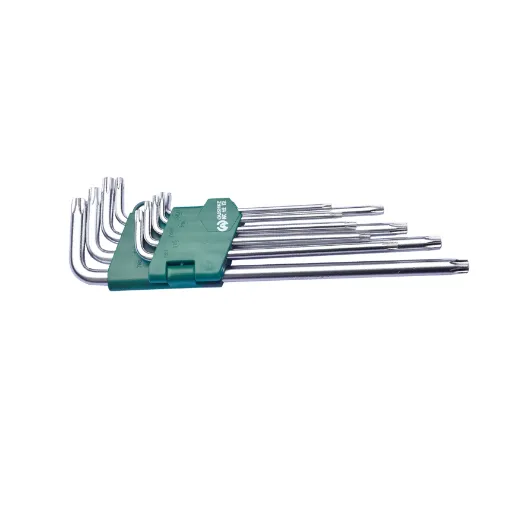
For M6 work the hex key is not one tool. Six basic forms exist, and each suits a different kind of job.
- Standard L-key (5 mm). The everyday choice for M6 socket caps. The long arm gives you leverage and torque; the short arm reaches screws in tight spots.
- Long-arm L-key. Extra reach for M6 cap screws buried in deep pockets, like engine brackets and machine guards. It also increases your turning leverage on a stubborn screw.
- Ball-end key (5 mm). Inserts at up to roughly 25–30 degrees off-axis, so it drives an M6 screw you cannot line up square with, common in furniture, panels, and electronics assemblies. The trade-off: a ball end can slip and round under high torque, so use the square end to break a tight screw loose first.
- T-handle or screwdriver-handle driver. Faster and more controlled for repeated M6 assembly on a bench or production line. You get more torque than a folding key without the wobble.
- Folding multi-tool key. A compact metric set that carries the 5 mm you need for field maintenance on bikes and equipment.
- Hex bit (5 mm, 1/4 in hex shank). For cordless drivers and impact drivers. Keep M6 driving to low, clutch-limited torque so you seat screws to spec instead of stripping them.
Matching the type to the job matters as much as matching the size. Furniture and flat-pack assembly, for instance, is full of M6 cam-and-screw joints at awkward angles; a 5 mm ball-end key is the tool that saves you realigning the whole panel every time. Marco, who runs final assembly at a cabinet shop, switched his crew to 5 mm ball-end keys and cut stripped-screw rework in half, because the operators could drive at an angle without fighting the alignment.
Automotive and machinery work is the mirror image. A mechanic reaching a recessed M6 socket cap behind a bracket finds a standard L-key will not seat straight; a long-arm 5 mm key drops in and turns the screw squarely. And for electronics and server racks, where dropping a key into live gear is the fear, a short, magnetized 5 mm key holds the screw and the driver in one hand.
Hex Key Quality & Materials to Look For
A 5 mm key is a simple object, but the difference between a good one and a frustrating one shows up fast in daily use. Four things decide how long a hex key lasts and how well it protects your M6 sockets.
Steel. Quality hex keys are made from chrome vanadium (Cr-V) or S2 alloy steel. S2 holds up better under the shock loads of powered driving; Cr-V is the strong, economical standard for hand keys.
Hardness. Look for keys hardened to roughly HRC 52–60. A key that is too soft wears its corners and starts rounding sockets; one that is properly heat-treated keeps its sharp hex edges for thousands of insertions.
Grind and fit. The hex is precision-ground so it seats in the M6 socket with a snug, slop-free fit. A sloppy fit is what wears the socket. Check for clean, burr-free corners on both ends.
Finish. Black oxide and phosphate give light rust resistance for shop use; nickel and chrome are tougher and cleaner for consumer and food-adjacent work. Some keys add a magnetized tip, which is a practical extra for M6 screws in hard-to-reach holes.
If you are checking a 5 mm key before buying in quantity, the same checks apply. Seat it in an M6 socket cap: it should drop in fully and feel solid, not wobbly. Run your thumb over the hex flats for burrs, and confirm the key is consistently hardened from tip to bend by testing hardness on a sample from the batch. For the stripped-socket warning that applies to every key above, the rule is short: always use the exact size. An undersized Allen key is the fastest way to permanently round out an M6 socket.
Sourcing M6-Ready Hex Key Sets for Distributors & Brands
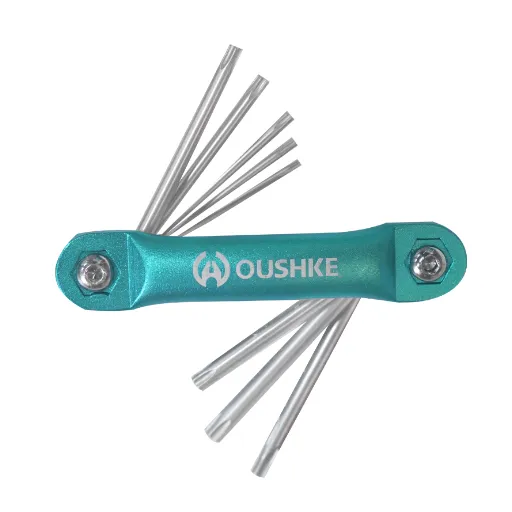
If you distribute tools, M6 is one of the highest-turnover reasons a customer reaches for a hex key, so your set assortment should make the 5 mm easy to find. A sensible metric stock line starts with a 1.5–10 mm set, which covers the everyday M-series range in the chart above. Add loose 5 mm singles in ball-end and long-arm forms for M6-heavy furniture and assembly markets, plus 5 mm hex bits for the cordless-driver crowd. That small mix answers nearly every “what do I drive this M6 with” question at the counter.
The set sales follow the fastener. Distributors who bundle the screws with the drivers that install them raise order value and close more of the job in one stop. The externally threaded fastener segment, screws and bolts, is the largest in the industrial fasteners market, and every one of those M6 screws needs a driver. Pairing your M6 fastening line with the matching keys is the natural upsell.
Sourcing the tools factory-direct keeps the quality and the pricing consistent. As a manufacturer of hex keys, wrenches, and sockets, we build sets to your assortment: choose the sizes, the key styles, the finish, and your own branding on the packaging. Because the world hand tools market keeps growing, a well-chosen M6-ready hex key line earns its shelf space for years. Start with one size or one set type to test your market, then scale the assortment once the line moves. Need a factory-direct quote for hex key sets, single 5 mm keys, or hex bits? Contact our team and we will help you plan a range that fits your customers.
M6 Allen Key FAQ
What size Allen key fits an M6 socket head cap screw?
A standard M6 socket head cap screw, made to DIN 912 / ISO 4762, takes a 5 mm Allen key. M6 button-head, flat-head, and low-head socket screws take a 4 mm key, and M6 set screws take a 3 mm key.
Is an M6 Allen key 5 mm or 6 mm?
The key that fits an M6 socket head cap screw is 5 mm. A 6 mm key is the driver for M8 socket cap screws, not M6. When a seller labels a key “M6,” they usually mean it fits M6 screws, so check the actual hex size before buying.
What is a 6 mm Allen key used for?
A 6 mm Allen key drives M8 socket head cap screws and many M10 countersunk screws. It does not fit M6 fasteners. If you hold a 6 mm key and wonder which screw it turns, the answer is an M8 socket cap.
Do M6 button head screws use the same key as socket cap screws?
No. A standard M6 socket cap screw uses a 5 mm key, while M6 button-head, flat-head, and low-head socket screws use a 4 mm key because their heads are lower profile with a smaller hex socket.
What size Allen key fits M6 set screws?
M6 set (grub) screws use a 3 mm Allen key. Set screws are headless, so the whole drive is the small hex recess in the end, and their key sizes run smaller than socket caps of the same thread.
What wrench or socket fits an M6 hex nut?
An M6 hex nut, made to DIN 934, and an M6 hex head bolt, made to DIN 933, both use a 10 mm wrench or socket across the flats. A 10 mm socket normally fits a 1/4 in or 3/8 in drive.
Can I use an impact driver on M6 with a hex bit?
Yes, use a 5 mm hex bit in a cordless or impact driver at low, clutch-limited torque. M6 is a small thread, and too much torque strips the socket or the thread, so keep powered driving gentle and finish by hand where accuracy matters.
Where can I buy M6 hex keys and Allen sets wholesale?
Factory-direct hex key sets, loose 5 mm keys, and hex bits are available from tool manufacturers like Shanghai Oushike. Choose your sizes, styles, and private-label packaging, and order at quantities that suit your market. Request a quote to start.
Conclusion
The M6 fasteners around you are not driven by one mystery tool. A standard M6 socket head cap screw takes a 5 mm Allen key, button, flat, and low-head versions take 4 mm, set screws take 3 mm, and hex bolts and hex nuts take a 10 mm wrench or socket. A literal 6 mm key is for M8, so match the driver to the head socket and never force an undersized key into an M6 recess.
For the workshop, that means owning the right sizes and types: a solid 5 mm L-key, a ball-end for awkward angles, a long-arm for deep pockets, and a 5 mm hex bit for powered work, all from hardened steel with a precision-ground fit. For the distributor and brand owner, it means stocking an M6-ready line where the screws and the drivers that install them sit together, because that is the fastening sale your customers actually finish.
Get the driver right and M6 work is routine. Need hex keys, sets, or bits built to your spec and delivered factory-direct? Contact our team for a quote on the M6-ready range.