

Thin Kerf vs Full Kerf Saw Blades: Cut Width, Plate Thickness and Saw Compatibility
Thin kerf vs full kerf is a tradeoff between a narrower cut and the stability a thicker plate can offer. Choose only after checking the blade against the saw, its mounting system and any required riving knife.
Two blades can share a diameter and arbor size yet need different knife thicknesses. If you’ve compared replacement listings that show only one width, the missing number can hold up a sound purchase decision. This guide separates those dimensions, explains the practical tradeoffs and gives buyers a specification sheet to use before ordering.
Illustrative scenario: A buyer finds a blade with the right diameter and bore. The listing says thin kerf but omits plate thickness. The correct next step is to obtain that dimension before approving the replacement; the label alone leaves the fit question open.
Key Takeaways
- Kerf is cut width; plate thickness is the steel body’s width.
- Thin and full are comparison labels, not machine approvals.
- Check plate, knife and kerf together against the exact manual.
- Less removed width does not prove the same saving in power or battery use.
Preparing an inquiry? Send your saw model and blade requirements to Oushike with both thickness dimensions, rather than just the thin/full label.
Thin Kerf vs Full Kerf: Cut Width Is Not Plate Thickness
What kerf measures
Kerf is the width of the slot a saw blade cuts through material. On a carbide-tipped woodworking blade, the cutting tips extend beyond the steel body. Plate thickness measures that body instead. Keep the two values separate: one describes the cut, while the other helps establish blade and riving-knife compatibility.
This distinction is the starting point for thin kerf vs full kerf. A thin-looking steel disc does not tell you the exact slot it will make. A product sheet should identify whether each dimension refers to the teeth, the body or the knife behind the blade.
What the steel plate measures
Picture an end view of the blade: the steel plate sits between the outer cutting edges. A riving knife, where the saw uses one, follows the cut behind the blade. Delta’s manual illustrates these separate widths in Fig. 39; its dimensional requirements appear in the compatibility example below.
For thin kerf vs full kerf comparisons, record the plate and kerf as separate fields. Don’t enter the riving knife’s marked thickness as either blade dimension. If a catalog gives only “thickness,” ask which feature it measures before making a cross-brand comparison.
Why nominal fractions are not fit specifications
You may see 1/8 inch used as a nominal full-kerf example and 3/32 inch as a thin-kerf example. Here they are illustrative widths, not universal standards. An exact part may have different dimensions, and the saw’s allowed range still controls selection.
Keep the units beside every value. Compare figures in the same unit and retain the maker’s stated precision rather than rounding a borderline combination into acceptance. In thin kerf vs full kerf selection, a familiar fraction cannot replace the actual specification.
Kerf also describes a dimension, not a complete cutting purpose. The types of circular saw blades guide explains the broader families; choose the material and intended cut separately from the width.
Thin Kerf vs Full Kerf: Power, Stability and Material Loss
Compare cutting demand without promising a percentage
A narrower kerf removes a smaller strip when cut depth and length are equal. Harvey’s thin-kerf guidance describes the potential benefit on lower-powered saws and the tradeoff in plate stability. That guidance does not establish a measured saving for every blade and machine.
When comparing thin kerf vs full kerf, keep the material, cut and blade condition in view. A dull edge or unsuitable tooth geometry can complicate a width-only comparison. There is no universal horsepower boundary that approves one class across all brands and applications.
| Decision factor | Narrower compatible kerf | Wider compatible kerf |
|---|---|---|
| Material removed | Smaller nominal slot for equal cut geometry | Larger nominal slot for equal cut geometry |
| Cutting demand | Can ease demand; no fixed saving promised | Assess with the intended blade, stock and saw |
| Plate stability | Thinner plate may flex more readily | Thicker plate can offer stability advantages |
| Fit | Requires its own documented checks | Requires the same documented checks |
Plate stability is one part of cut quality
Thin kerf vs full kerf does not decide the finish by itself. Consider plate design, stock support, alignment, sharpness and the intended feed conditions. Don’t add an arbitrary stabilizer to solve a suspected problem; accessories and mounting must follow the saw and blade instructions.
Use the published guide to choose circular saw blade tooth count by diameter, material and cut. This keeps the tooth decision separate from the dimensional comparison instead of treating more teeth or a thicker plate as a universal upgrade.
Calculate width loss without promising extra finished pieces
For an illustrative thin kerf vs full kerf calculation, compare 3/32 inch with 1/8 inch. The difference is 1/32 inch per pass, or 25% of the wider slot. Across 16 equal passes, the summed cut-width difference is 16 × 1/32 = 1/2 inch.
That arithmetic assumes equal cut length and depth. It doesn’t prove an extra finished part: board layout, trimming and required part widths decide whether the difference becomes usable stock. Nor does 25% less slot width establish 25% less electricity or a matching battery-runtime gain. Use measured results for the exact setup before attaching those outcomes to thin kerf vs full kerf.
Check Saw and Riving-Knife Compatibility Before Changing Kerf
Read body, knife and kerf together
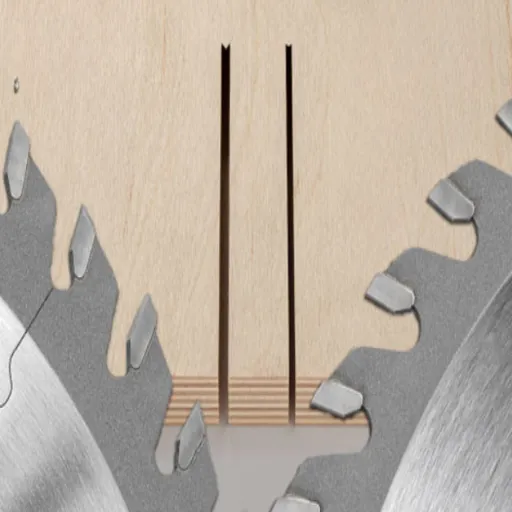
For the table-saw arrangement described in the Delta 36-L336 manual, printed pages 18–19, the knife must be thicker than the blade body and thinner than the kerf. The relationship is plate < knife < kerf, with the manual’s specific limits also applying.
The inequality is a useful first check in thin kerf vs full kerf selection. It does not replace the marked knife’s allowed blade diameter, minimum kerf or maximum body thickness. A tiny numerical clearance is not independent approval of an assembly.
A manual-specific acceptance envelope
Delta lists these marked-knife combinations for the cited 10-inch setup. Read the marking on the actual knife and match the correct saw and manual; don’t combine values from different rows.
| Delta knife marking | Minimum blade kerf | Maximum blade body |
|---|---|---|
| 2.7 mm supplied knife | 2.9 mm | 2.5 mm |
| 2.8 mm supplied knife | 3.0 mm | 2.5 mm |
| 2.2 mm accessory knife | 2.4 mm | 1.75 mm |
Illustrative scenario: A buyer proposes a blade with a 2.4 mm kerf for the cited 2.7 mm knife. The combination fails the stated 2.9 mm minimum kerf. Reject it for that setup; don’t grind the knife, remove it or force stock past it.
For contrast, a proposed 3.2 mm kerf and 2.2 mm body meet the stated thickness limits for the cited 2.7 mm knife. The body is below the 2.5 mm maximum, and the kerf is above the 2.9 mm minimum. That passes this dimensional comparison only; it is not approval of an unnamed blade.
Before accepting it, the buyer still needs the correct diameter, mounting, speed rating and intended application. Write down which document supports each check. If the blade is intended for another saw class or material, the thickness result cannot override that restriction.
The accessory row does not authorize an improvised conversion. The approved knife and mounting must match too. This is why thin kerf vs full kerf needs an actual model reference rather than a general thin-kerf recommendation.
Harvey’s ranges show the limits of labels
Harvey’s RF-22 and standard-knife guidance gives another model-specific comparison. For the Alpha/Ambassador 10-inch setup discussed there, the 0.086-inch RF-22 has a stated kerf range of 0.094–0.118 inch. The 0.100-inch standard knife has a range of 0.102–0.126 inch.
These are Harvey’s stated ranges, not cross-brand rules. They show why a thin kerf vs full kerf label cannot tell you which knife to fit. Check the full machine documentation, body limits and mounting details as well.
Keep the saw classes separate
Check the saw class first. Handheld, track, miter and table saws can have different blade and guarding requirements; don’t assume each uses the knife arrangement above. For thin kerf vs full kerf changes, check these items against that machine’s instructions:
- Allowed blade diameter and bore or mounting interface.
- Blade speed rating against the saw’s specified speed.
- Intended material and cutting application.
- Relevant flange, guard and track-system restrictions.
Our broader industrial saw blade selection guide provides purchasing context; it doesn’t replace the exact machine manual.
Stumpy Nubs’ supplemental video addresses thick and thin splitters/riving knives. Use it for general explanation, with the manufacturer’s instructions controlling your setup.
Measure and Record the Blade You Actually Use
Start with markings and documents
Keep the blade maker, part number and current specification together. A thin kerf vs full kerf decision based on an old label may describe the previous blade rather than the replacement. Check that the drawing or data sheet covers the exact part offered.
Ask for separate body and kerf values when either is missing. Keep missing information marked pending. A diameter match, a reseller’s photograph or the word thin does not fill in an absent body thickness.
Measure the body and cut separately
Disconnect the machine from power before physical blade inspection, and follow its instructions for access and handling. Measuring the flat steel plate is different from measuring the cutting width. Don’t take a reading across the carbide tips and call it plate thickness.
Delta’s sequence separates the checks: measure the body, make a shallow cut in scrap to measure kerf, then select the knife and check its passage through that cut. Follow the complete manual for that setup. Don’t test a known mismatch. For another machine, use its own approved procedure.
If material drags or binds as it reaches the knife, Delta directs the operator to switch off, disconnect power and correct the knife selection before another cut. Increased feed force is not a remedy. In thin kerf vs full kerf evaluation, stop at an unresolved fit problem rather than trying to prove it away through operation.
Keep published and observed values distinct
Record what the maker specifies separately from what an approved check finds. Include the units, blade identity and measurement method so the next person can interpret the record. A measurement without that context is hard to use for replacement approval.
After a blade change or service, recheck the relevant dimensions and setup under the maker’s instructions. Don’t assume the last blade’s cut width remains valid. The opening buyer’s missing field is resolved through documentation or an approved check, never a guess.
The circular saw blade supplier specification guide explains the wider sourcing discussion. Keep the exact blade record attached to it so thin kerf vs full kerf remains a traceable purchasing choice.
Build a Kerf Specification for a Professional Blade Order
Put the decisive fields on the SKU sheet
A purchase description that says only thin kerf leaves the cut width undecided. For thin kerf vs full kerf sourcing, use a record that another buyer can verify without relying on a remembered conversation.
| Field | Buyer entry |
|---|---|
| Machine | Model and applicable manual revision: ____ |
| Blade identity | Maker, exact part and document revision: ____ |
| Intended work | Material, stock thickness and cut direction: ____ |
| Physical fit | Diameter, bore and mounting interface: ____ |
| Cutting dimensions | Kerf: _; plate: _; units: ____ |
| Knife, if required | Part, marking and permitted range: ____ |
| Cutting design | Tooth count, grind and intended application: ____ |
| Speed and assembly | Blade rating and relevant machine restrictions: ____ |
| Decision | Approved by: _; or pending because: _ |
Compare against a defined intended cut
Illustrative scenario: A distributor compares two options sold as thin kerf. One includes body and kerf dimensions; the other omits the body figure. The second option stays pending until the missing document arrives. A shared label does not make it a substitute for an approved part.
Once fit is documented, compare samples using the same intended material and cut, following the machine’s instructions. Record blade condition, stock, cut dimensions and the criteria you are assessing. Don’t attribute every observed difference to thin kerf vs full kerf when tooth design or material also changed.
Ask a specific question when data is missing
Request the plate thickness and kerf for the exact part, with units and a supporting specification. If the answer remains incomplete, retain the pending status. Ask the relevant manufacturer to resolve any machine restriction before purchase approval.
Keep a copy of that response with the SKU record. If a substitute part is offered later, compare its documents afresh; approval of one part does not transfer to another because the packaging looks similar.
For an assortment, keep each approved machine/blade combination distinct; use our wholesale saw blade order planning guide for the broader buying process. An inquiry about thin kerf vs full kerf should carry the specification sheet so the discussion starts with the intended setup.
Frequently Asked Questions
Is thin kerf always better for a lower-powered saw?
No. A narrower compatible blade can ease cutting demand, but thin kerf vs full kerf also involves plate stability, blade condition and tooth design. Start with the saw’s permitted blade specifications, then consider the intended material and cut. Motor power alone does not establish blade compatibility or guarantee a better finish.
Can I use a thin-kerf blade with my existing riving knife?
Only when the exact blade and knife meet the machine’s requirements. In the cited Delta arrangement, the knife must lie between the body thickness and kerf width, with marked minimum and maximum limits also applying. Check the actual knife and manual rather than approving it from the thin/full label.
Is blade plate thickness the same as kerf?
No. Plate thickness measures the steel body; kerf describes the cut slot. Carbide cutting tips can be wider than the plate. For thin kerf vs full kerf comparisons, obtain both figures with units and confirm which feature each describes. One ambiguous thickness entry is not enough for the knife check.
Will a thinner kerf give the same percentage of battery savings?
Not automatically. A percentage reduction in cut width is geometry, while battery use depends on the whole cutting task and setup. The illustrative 25% width difference above is not a runtime test. Don’t turn it into a battery-saving claim without measurements for the specific blade, saw, stock and cut.
What if the supplier does not publish plate thickness?
Request it for the exact part before approval. Keep the record pending and seek manufacturer guidance if documentation is absent or unclear. For thin kerf vs full kerf replacement decisions, neither matching diameter nor a familiar product label resolves missing plate thickness. Use only checks permitted by the relevant machine instructions.
Choose a Documented Fit, Then Compare the Cut
Begin thin kerf vs full kerf selection with the machine, not a claimed universal winner. Record the allowed blade and safety-equipment dimensions, obtain the candidate’s kerf and body figures, then compare them against the exact requirements. Keep every unresolved field visible before approving a replacement.
Once fit is established, assess the cut you actually need. A narrower kerf can reduce removed width; a thicker plate can offer stability advantages. Neither alone proves longer life, a smoother finish or a fixed energy saving.
The buyer in the opening scenario needs a complete specification, not a stronger sales claim. Use the worksheet to turn that missing thickness into a clear request, then retain the supporting document with the decision.
For a thin kerf vs full kerf inquiry, send Oushike your saw model and blade specification requirements, including material, mounting, teeth, kerf and plate thickness. State which details still need confirmation.