
Welding Machine & Plasma Cutter Manufacturer Guide: How to Choose Industrial Equipment
Industrial applications require specific welding equipment that matches your material needs and production output requirements, and your electrical consumption needs. Plasma cutters provide the ability to perform rapid and accurate metal cutting operations because they do not require preheating. Your decisions will cause two effects that impact your business’s profitability and operational interruptions, and your ability to satisfy customers.
A Brazilian distributor purchased 200 basic MIG welding machines in 2024 to support its expanding construction market operations. The feedback during the first three months was extremely negative. The machines did not provide enough amperage output to process structural steel. The operational requirements of the system exceeded its duty cycle limitations. The distributor needed to sell the remaining inventory at reduced prices while they searched for new products. The machine brand name did not create the issue. The problem occurred because actual working conditions did not match the defined operational requirements. Welding equipment manufacturers with experience help organizations identify potential financial risks through machine testing.
Buyers do not realize that this situation happens in different markets more frequently than they think. The global welding equipment market reached a value of 15.2 billion dollars in 2024, according to Grand View Research, and the market continues to grow. The plasma cutting machine market expands at a faster pace than other industries because it experiences a 6.1 percent compound annual growth rate due to increased demand for efficient and accurate production methods.
Distributors who create tool catalogs, contractors who build fabrication shops, and brand owners who launch private-label welding equipment must know machine type differences to secure their financial assets. The guide will explain how to differentiate between welding machines and how plasma cutters function in the fabrication process, what specifications are essential for industrial purchases, and how to find trustworthy welding machine suppliers who meet qualification standards.
Key Takeaways
- MIG welders deliver speed for steel fabrication, TIG welders offer precision for aluminum and stainless steel, and Stick welders handle rugged field conditions without shielding gas.
- Plasma cutters cut faster and cleaner than oxy-fuel on thin to medium-gauge metals, with no preheating required.
- The three specifications which determine machine survival in industrial use are duty cycle and input voltage and inverter technology.
- Factory-direct sourcing from a welding machine manufacturer can reduce procurement costs by 30–50% compared to branded distribution channels.
- Reliable manufacturers provide CE and ISO and CCC certifications together with verified duty cycle testing and consistent batch quality.
What Is a Welding Machine and How Does It Work?
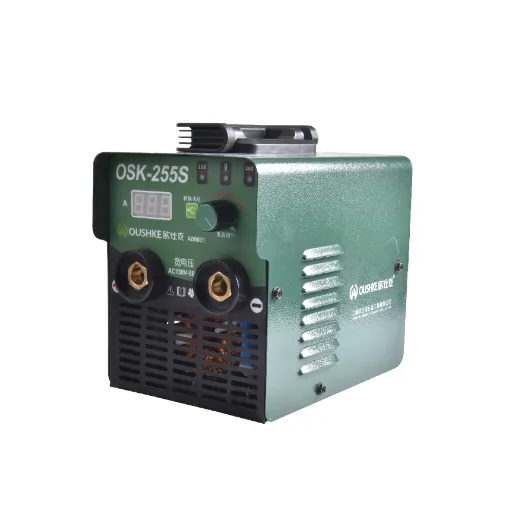
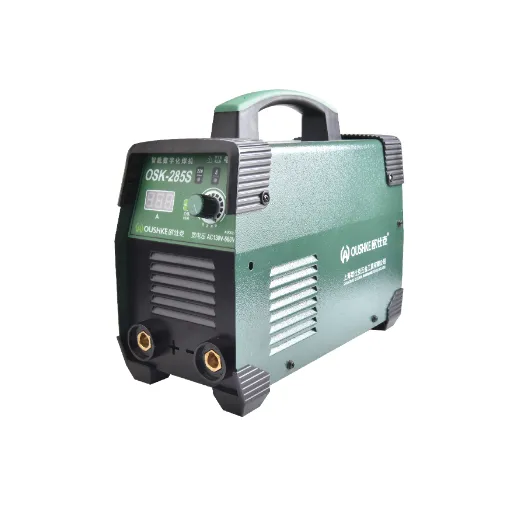
The welding machine operates as a power source that produces electrical current to establish an arc between an electrode and a metal workpiece. The arc generates extreme heat, which melts base metal and filler material to create a welding joint. Every welding machine manufacturer must design their power source system to maintain consistent arc performance while handling thermal conditions and safeguarding operator protection.
A welding machine consists of three main components, which include a transformer or inverter and a rectifier, and a control circuit. The transformer reduces incoming high-voltage electricity to a welding-compatible low-voltage power output. IGBT technology enables inverter-based machines to produce equivalent outcomes with decreased system weight and improved efficiency. The rectifier changes alternating current into direct current whenever DC welding needs arise. The control circuits handle three functions, which include controlling amperage output, managing arc force, and implementing safety shutdown procedures.
The machine requires connections to three components: a welding torch or electrode holder, a ground clamp and a wire feeder or gas supply system. The wire feeder system in MIG welding controls the speed at which consumable electrode wire moves through the torch. In TIG systems, the operator manually feeds filler rod while the machine automatically sustains arc current. In Stick welding, the machine supplies current to a coated electrode that provides its own shielding gas as it burns.
Poor power source design causes erratic arcs, together with difficulties in striking the arc and problems with inconsistent penetration. These issues create additional work requirements while destroying electrodes and creating difficulties for welders. When you evaluate a welding machine manufacturer, look for stable voltage output across the rated amperage range and effective thermal protection that prevents overheating during long welds.
Need help matching welding machine specifications to your target market? Contact our team for a technical consultation and competitive bulk pricing.
Types of Welding Machines and Their Industrial Uses
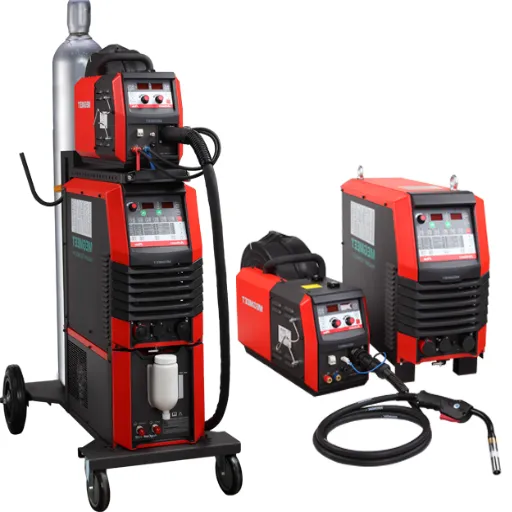
This section covers the five main categories you will encounter when sourcing from a welding machine manufacturer. Each serves different industrial tools for professional use needs.
MIG/MAG Welders (GMAW)
Metal Inert Gas (MIG) welding requires welders to operate a system that feeds wire electrodes while using shielding gas to protect the molten metal. Metal Active Gas (MAG) requires operators to use active gas mixtures, which include argon and carbon dioxide. The processes operate at fast production speeds. The processes serve as the primary method used in automotive production, shipbuilding operations, and steel fabrication because these industries need to produce high quantities of products.
The industrial MIG welding machines operate between 160 amps and 500 amps because they need to support different metal thicknesses, which range from light-gauge sheet metal to heavy structural plate. The application requires wire diameter selection, which ranges from 0.6 mm to 1.6 mm. The welding machine manufacturer must establish clear standards that include amperage ranges, duty cycles, and recommended wire sizes for each machine model.
TIG Welders (GTAW)
TIG welding uses Tungsten Inert Gas as its main welding method because it employs a tungsten electrode that does not burn away and uses a filler rod, which is added separately. The welder controls heat with a foot pedal or fingertip remote. TIG welding achieves precise results for stainless steel and aluminum, and magnesium and thin-gauge materials, which require exacting visual standards.
TIG welders come in AC/DC and DC-only configurations. The AC output system for aluminum welding provides essential cleaning functions because it removes oxide layers through its reverse polarity operation. The DC output system functions effectively with steel and stainless steel and most other metal materials. The industrial TIG welding machines operate between 160 amp and 400 amps. Pulse TIG features enable operators to control heat better on thin materials through alternating between high and low current.
Stick Welders (SMAW)
Stick welding uses a coated electrode that delivers both filler material and protective gas for weld operations. The process requires no external gas supply because it uses an internal gas component. Stick welders serve as the most dependable welding method for construction sites and field repair work, and remote sites that prohibit the transportation of gas cylinders.
Industrial Stick welders operate between 160 amps and 500 amps. The process enables the welding of dirty or rusty materials, which MIG and TIG methods cannot achieve. The process requires more time because of the lower operational speed and requires additional time to remove slag. Contractors who perform outdoor work on structural steel and pipelines, and heavy equipment repair work, need Stick welders for their essential requirements.
Multi-Process Welders
These machines offer the benefits of uniting MIG, TIG, and Stick welding functions in one machine. They can do the same job in small, flexible production areas like job shops, rental fleets, and mixed-production environments, letting operators switch among different jobs without reducing overall production level. In fact, a multi-process welder could minimize inventory costs and more quickly train a person.
It makes practical sense, then, to limit the machines’ operations to what can be done by single-process dedicated machinery. The amperages and duty cycles for the various processes are included in each machine, but these values are smaller than those needed to reach the maximum levels of amperage and duty cycle specific to a single process. The welding machine manufacturer designs these equipment units to openly admit that they are not hobby items.
Flux-Cored Welders
A flux-cored welding with the flux material will be filled with tubular wire. Self-shielded flux-cored wire does not require external gas. Gas-shielded flux-cored wire uses external gas for cleaner results. It is also possible to achieve faster deposition rates, which makes these popular in heavy fabrication, shipbuilding, and hardfacing applications compared to ordinary MIG welding.
MIG machines can often be associated with flux-cored welders, because there are almost identical procedures concerning the power source, as well as the wire feeder, that could be shared for two processes. To simplify the acquisition, the dual-purpose MIG/flux-cored machines were sourced by industrial buyers from a solitary welding machine manufacturer.
Consider the case of the Viktor shop owner in Germany, coming in the year 2024, expanding to include a line of fabrication businesses. He then accumulated some low-cost TIG welders rated at 160 amps, a step he took towards general workshop use in performing such functions. When a huge amount of work was ordered to create aluminum truck beds, it was difficult for the machines. The AC balance was extremely bad, and duty forced the stoppage of the welders every few minutes.
Viktor finally replaced them with 250 amp AC/DC TIG welding machines from a top-rated welding machine supplier. Production increased to 100 percent. Repairing work has dropped to 94.6 percent. These cost more upfront; originally competitive rates have increased by 25 percent, though over time, they paid for themselves within a quarter. The processes applied must match the materials and volume. It is a fundamental basis for profitable cutting and welding.
What Is a Plasma Cutter and When Should You Use One?
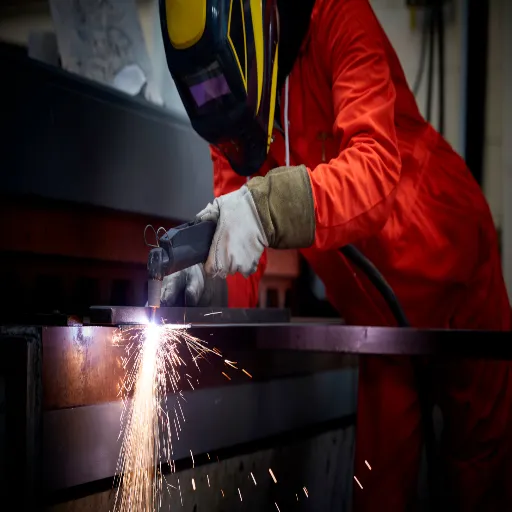
A plasma cutter is a tool that uses a high-speed jet of ionized, electrically conductive gas to cut through any metal. The plasma arc will melt the metal, and air pressure will blow off the molten metal to create a clean and narrow margin. The value of the global market for plasma cutting machines was around $1.2 billion in 2024, and ethnic minorities are already $1.8 billion in 2032, said Dataintelo.
There are some of the things going on in an easily measurable format. Plasma cutting is, however, faster than traditional oxygen cutting at thin and medium gauge. Thus, neither heating nor preheating is needed, saving time and reducing the heat-affected zone. Fewer burdens would also be imposed by the release of more precise cutting with less slag and distortion. Conductive to any metal, including aluminum and stainless steel, this type of cutting cannot be affected by oxyfuel.
Hand-held plasma cutters are a tiny, portable tool in the house, ready for use in work concerning sheet metal fabrication, repair, or demolition. Large-scale production and repeatable quality may be done through CNC-driven plasma cutting tables. Many fabricators switch from oxy-fuel to CNC plasma cutting and report 30 to 50% productivity increases in most situations.
The standard handheld plasma cutters range from 30 amps to 120 amps. A 40-amp machine would do an adequate job in cutting through mild steel up to 10 mm. There’s an 80-amp machine that can handle 25 mm. A 120-amp industrial unit goes through 50 mm or thicker. The primary source of power used to generate plasma gas is compressed air. Some models come with air compressors fitted onto the systems for the added convenience of portability, while others require external compressors.
Electrode, nozzle, shield cap, and swirl ring are termed consumables. Since these are worn out, they must be frequently renewed. Before you decide on plasma cutters for sourcing from the welding machine manufacturer or a plasma cutter company, ensure you confirm that consumables are easily available and at an affordable price. Otherwise, you are buying a device whose consumables are less costly but impossible to obtain.
Key Specifications B2B Buyers Should Verify
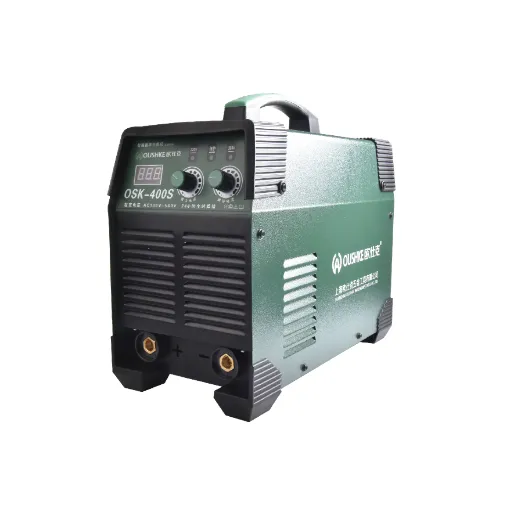
Amperage Range and Duty Cycle
Duty cycle determines how long the welding machine can be worked at a particular amperage level before overheating. The amperage setting determines how thick a material can be welded or cut by a certain machine. For example, a 300-amp machine with 60% duty cycle can be operated at full power for six minutes within ten minutes. For a high-volume factory, a higher duty cycle will produce less cessation and higher throughput.
The duty cycle for the manufacturer of your welding machine must be identified at realistic ambient temperatures and authenticated. Some manufacturers might inflate on these terms by testing at lower temperatures. Ask what they mean.
Input Voltage and Phase
Single-phase input at 110V or 220V is considered sufficient for most smaller store or movable load operations. For larger welding stations, over 300 amps, three-phase input at 380V or 440V is standard. A mismatch between the customer’s electrical infrastructure and the input requirements of the welding machine means problems during installation. A reliable welding machine manufacturer will arrange specialists for forward voltage set-ups for this welding machine in North America, Europe, Australia, and similar markets.
Inverter vs. Transformer Technology
IGBT inverter welders weigh less, use less energy, and provide smoother arc control than traditional transformer machines, making them occupy more than 65 percent of new welding equipment sales worldwide. Transformer welders, by comparison, are stronger, but they burn too much energy. Transformer welders, though rugged and efficient, can be a hassle to fix in very remote areas where acquiring electronic parts is a problem.
For most industrial buyers, inverter technology is of greater concern in terms of investment. It saves on electricity, it increases portability, and it provides a more even arc. However, for some developing market field contractors, transformer ruggedness will win over.
Plasma Cutter-Specific Specs
It is possible to note that the cutting rate inside dictates the nature of production in production planning. If a plasma cutter works at the rate of 500 mm per minute and can slice 10 mm steel, there is a 200% increase in productivity compared to a piece machine that works at the rate of 250 mm per minute. Pierce capacity determines the maximum thickness a torch can start cutting from the edge. Depth-of-cut capacity is where it offers the highest thickness it can cut through to the end, only at a slower rate.
Just like the air compressor, there are more practical details. Some portable plasma cutting systems come complete with an embedded compressor. Others would need an external compressor to measure the minimum required pressure and flow amount. This requirement should become known to customers before a purchase is made.
Build Quality and Certification
CE conformity marking is proof of compliance with European safety and health standards. The CCC mark is required for all products sold in China and is also widely recognized in Asia. UL listing refers to the USA. ISO 9001 is good; then the plant definitely has followed its own quality management system. RoHS, an environmentally friendly product line from China, prevents the use of dangerous substances in various electronic areas.
Don’t forget to check their currency and verify the certification when evaluating your company. Obsolete or forged certificates are among the biggest warning signs in global inspections.
How to Choose Welding and Cutting Equipment for Your Application
Match the Process to the Material
For the applications of mild steel and thick structural plates, the MIG or flux-cored welding process fits the need for speed. In aluminum and stainless steel parts, TIG is the best way to get accurate heat. Dirty, rusty, or outdoor jobs can make use of Stick welding, wherein a poor surface finish would not disturb the smoothness of the work. If it is for cutting purposes, plasma is very fast and clean, as it can cut through conductive metals more quickly than oxy-fuel cutting, especially on thin to medium gauges.
Match the Machine to Production Volume
A small repair shop that does a few joints a day can make do with a 160-amp machine and a 40% duty cycle. A shipyard or automotive plant that runs shifts around the clock must possess 300- to 500-amp machines. Industry uses machines with 60 to 100% duty cycles. A mistake in recommending an unsatisfactorily rated duty in this situation will lead to overheating, downtime, and above all, very irritated clients who have paid mad cash for it.
Match the Equipment to the Working Environment
Workshop welding favors stable three-phase power, longer cables, and heavier machines that stay in one place. Fieldwork and construction sites need portable inverter machines with generator compatibility and rugged housings that survive transport. CNC plasma tables require dedicated floor space, compressed air systems, and exhaust ventilation.
When Mateo, a contractor in Chile, won a bridge repair contract in early 2025, he bought the cheapest Stick welders he could find. They worked for the first two weeks. Then the tropical humidity caused internal condensation. Transformers shortened. Circuit boards failed. Mateo lost five days to repairs and nearly missed his deadline.
He replaced the budget units with IP23-rated industrial inverter welders from a verified welding machine manufacturer. The new machines had better moisture protection and thermal management. They lasted the entire project without a single failure. Environment matters as much as specifications. Always share your working conditions with your welding machine manufacturer upfront.
Sourcing from a Welding Machine Manufacturer: OEM and Wholesale Options
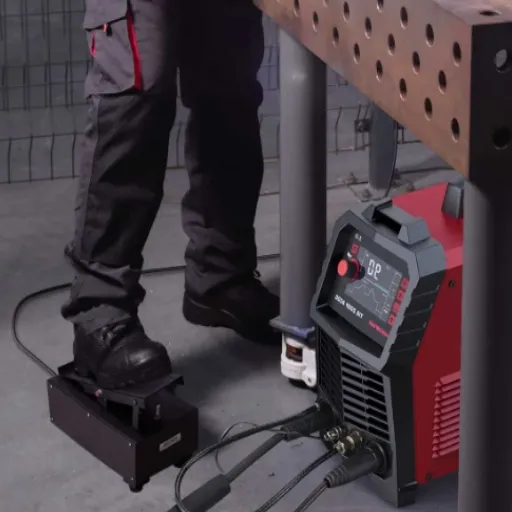
China abounds with many welding machine manufacturers and also plasma cutter manufacturers, from small garage shops to big exporting houses. According to MarketsandMarkets, the Asia-Pacific is the largest region in terms of welding equipment market volumes of shipments and is the fastest emerging one. Understanding how to make your way through this landscape will lead you to better procurement decisions.
Factory-Direct Pricing vs. Branded Markups
Factory direct pricing means purchasing welding equipment directly from a welding machine manufacturer and saving the cost of a middleman. Costs of procurement can be reduced by 30-50% with factory-direct pricing. in comparison to buying via brand distributors or trading companies. This improvement of margin should play a role in either boosting profitability or being more aggressive in bidding when competition retreats.
It’s finding the manufacturer rather than the cheap, lowest quality quote. The cheapest machine that fails in operation costs far more than a slightly more expensive but reliable unit.
OEM Customization
Many B2B buyers want more than standard machines. They want their own brand, their own packaging, and their own specifications. A reliable welding machine manufacturer can customize logos, color schemes, control panel languages, and voltage configurations. Some offer custom amperage ranges, specialized torch connections, or private-label user manuals.
These custom OEM solutions help distributors and brand owners differentiate their products in crowded markets. The right partner treats customization as a standard service, not an exception.
Take Priya, for example. She runs a tool distribution company in India. In 2024, she decided to launch her own line of welding equipment. She partnered with a welding machine manufacturer in China that offered low MOQ private-label programs.
Starting with just fifty customized 200-amp MIG welders, she tested the market under her own brand. The positive response allowed her to expand into TIG welders and plasma cutters within six months. Today, her branded equipment is sold through twelve retail locations, and she controls her own pricing and customer relationships.
MOQ Flexibility for Distributors and Brand Owners
Uniformity can be seen in the implementation of minimum order quantities. Thus, in the case of standard welding machines, plasma cutters without modifications, some factories in China have respective minimum order ranges from 10 to 50 pieces.
However, general OEM runs result in custom branding, packaging, and voltage configuration, and will need the greatest number of units, usually at 200-500 pieces. So, a flexible MOQ is essential when the market is yet unknown or cash flow management is a concern. A supplier with highly responsive capabilities usually changes testimony depending on the different growth stages.
Lead Times and Export Compliance
For already established welding manufacturers, a typical order may take 15 to 25 days from the time the order is placed until it’s shipped. While large industrial orders with specific custom make take up to 30 to 45 days to ship, similar to plasma cutter orders, but come with a little bit less time difference, CNC table systems may add more time for assembly to project timelines.
You should ascertain that your manufacturer possesses the relevant certifications for the market you will be targeting prior to making your order. These may include CE for Europe, UL for the USA, CCC for China, and perhaps ISO 9001 for general quality assurance. These factors are very severe causes of delays at customs and a major reason for liability.
Packaging and Documentation
When you import welding machines, packaging matters more than you might expect. Individual cartons with foam inserts prevent damage during sea freight. Palletized loading reduces handling risk. A full-service welding machine manufacturer can handle custom packaging, detailed specification sheets, certification copies, and multilingual manuals. This adds professional value to your resale offering.
Ready to test the market with your own branded welding equipment? Request a custom OEM quote and sample package today.
Quality Control: What Reliable Manufacturers Deliver
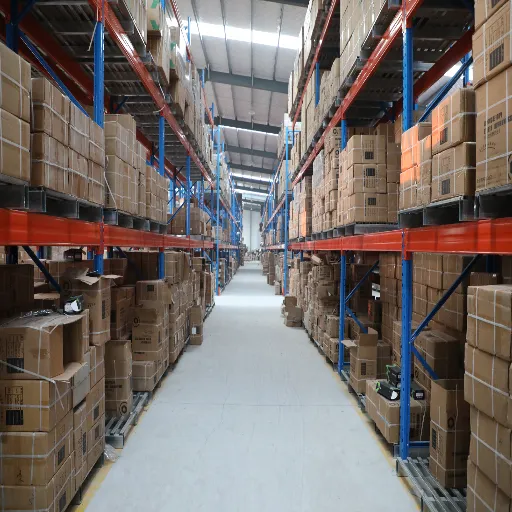
Certification Standards
CE marking verifies that the safety and health standards of the product meet European standards, while an ISO 9001 certification stands for the manufacturer’s documentation quality management system. RoHS compliance controls the toxic substances in electrical components. CCC certification is a mandate in China, where products are manufactured or marketed in the country, and acknowledges a greater acceptance throughout the whole Asian region.
When you evaluate the company that specializes in welding machines, identify and check the current certificates to see if they are up to date. Out-of-date or fake certificates are the most frequent red flags in global sourcing when switching suppliers.
Arc stability and duty cycle validation
A good machine will weld very well over all amp powers, maintaining a stable arc. A reliable manufacturer of welding machines will test that the rod is consistent under load and that the duty cycle holds up at the standard ambient temperatures. A heat-resistant test will determine whether transformers, inverters, and cooling systems can withstand regular operations without degrading.
Inverter Reliability and Thermal Protection Testing
Inverter welders contain sensitive electronic components. Manufacturers with serious tool quality control processes subject inverters to thermal cycling tests, overload tests, and voltage fluctuation tests. Machines that pass these tests resist failure from power surges, high ambient temperatures, and operator error far longer than untested alternatives.
Plasma Torch and Consumable Consistency
Plasma cutters depend on torch alignment, gas flow consistency, and consumable quality. A precision plasma cutter manufacturer tests electrode life, nozzle orifice consistency, and cut quality across the rated capacity range. Variations in these components cause rough cuts, excessive dross, and premature consumable wear.
Consistent Supply and Responsive Technical Support
Quality is not just about the product. It is also about whether the manufacturer can deliver the same specifications batch after batch. Unstable suppliers change materials or subcontractors without warning, which leads to quality swings that your customers will notice. A reliable partner communicates clearly, responds to issues quickly, and supports your business through production to delivery.
Conclusion
The right welding machine or plasma cutter revolves around four key pillars: machine type, specifications, application matching, and manufacturer reliability. A mistake in any of these pillars translates into downtimes for the end-users, rework, and frustration. On the other hand, in case you get them right, you will have started on a path of building a reputation as a provider who understands the needs of the industrials.
The welding equipment market is a quadrillion-dollar industry continuing to grow, supported by construction projects, auto manufacturing, shipbuilding, and infrastructure worldwide. In the cutting sections, Drag lines are skyrocketing; fabricators have abandoned ifs sticking to the self-cut model as a result of its swiftness and accuracy. The distributors, builders, and brand holders who actually grasp the technical differences between the Factory Types, such as MIG, TIG, Stick, or Plasma, generally make their buying decisions on a higher learning note.
Our power tools manufacturing capabilities and factory-direct sourcing will provide them with many opportunities to add value. An expert welding machine manufacturer can provide advice on voltage configurations, certifications, and exceptional customized options.
If you have searched for a welding machine manufacturer that offers long-lasting welding performance along with low MOQs and just-so-reliable supply, we are here to help! Let Shanghai Oushike Hardware Tools Co., Ltd. know the specifications you desire for demanding versions and samples, or ask for a competitive bid for your next order.