
Wrecking Bar Guide: Types, Sizes, and How to Choose the Right One
A wrecking bar is a heavy forged steel lever with a nail-pulling claw on one end and a prying wedge or chisel on the other. It’s the tool you reach for when the material you’re taking apart doesn’t need to survive. Standard wrecking bar sizes run from 12 to 36 inches, and 24 to 30 inches is the most useful all-round length for demolition, form stripping, and nail extraction.
Consider a scenario crews run into regularly. A 30-inch bar snaps clean in half while levering frozen formwork off a concrete pour, because it was welded at the neck rather than forged in one piece. The replacement bar costs less than the hours lost swapping it out.
Buying the right wrecking bar is rarely about the price on the tag. It’s about the forging, the length, and the claw.
This guide covers what actually separates a wrecking bar from a crowbar, the standard sizes with real weight figures, the steel grades that decide whether a bar bends or snaps, and how to source them in volume if you’re stocking a product line.
Key Takeaways
- A wrecking bar is a 1 to 5 ft forged bar with a curved nail-pulling claw and a prying wedge, distinct from a true crowbar, which is a digging bar over 4 ft.
- The five standard lengths are 12, 18, 24, 30, and 36 inches; 24 inches is the best first bar, and 30 inches is the average working size.
- One-piece drop forging is the single most important quality marker. Welded joints are where bars fail.
- Weight climbs with length, from roughly 1.8 lb at 18 inches to about 5.5 lb at 36 inches, and the gooseneck end delivers more leverage than the flat claw end.
- For bulk buyers, wrecking bars are a high-volume export category with MOQs commonly between 1,200 pieces and 2,000 sets.
What Is a Wrecking Bar?
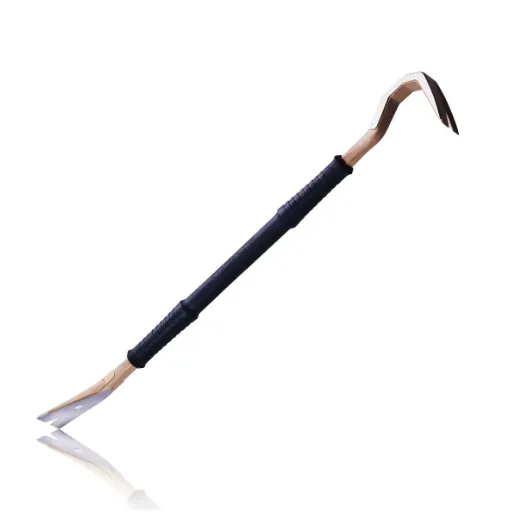
A wrecking bar is a one-piece forged steel lever, usually made from hexagonal or octagonal bar stock, with a prying wedge or chisel at one end and a nail-pulling claw at the other. The claw normally sits on a curved gooseneck so it can be driven under a fastener and rocked out.
It belongs to a class of tools called Class I levers, which means the fulcrum sits between the load and your hands. Length is therefore the leverage multiplier, and a longer bar moves more material with the same effort. Every wrecking bar is a direct trade: more length gives you more force, but it also gives you more weight, more fatigue, and more clearance to swing.
Three details define the tool. The stock is hexagonal or octagonal rather than round, which stops the bar rolling and gives a better grip. The claw is sharp and filed so it bites into a nail head. And the bar is forged in one piece, not assembled from parts.
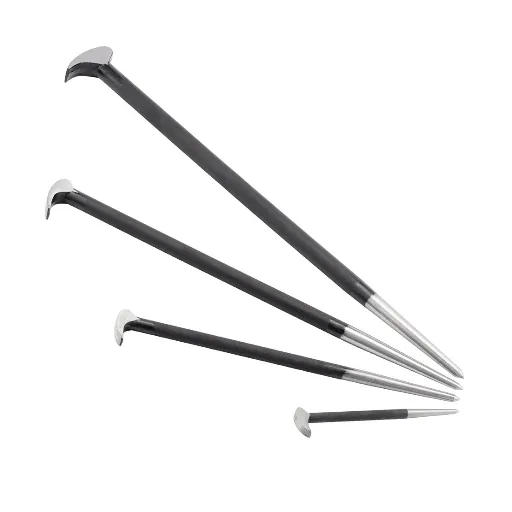
If you want the wider picture of how wrecking bars sit alongside flat bars, pinch bars, and rolling head bars, our complete guide to pry bar types maps the whole family.
Wrecking Bar vs Crowbar vs Pry Bar
This is where most buyers get confused, because retail signage uses the three terms almost interchangeably. The trade definitions are narrower.
| Wrecking bar | Crowbar | Pry bar (flat / wonder bar) | |
|---|---|---|---|
| Stock | Hexagonal or octagonal | Round or hex long stock | Flat spring steel |
| Length | 1 to 5 ft, with 12 to 36 in standard | A true crowbar is a digging bar over 4 ft | 5.5 to 18 in |
| Ends | Curved claw plus prying wedge | Pinch point or wedge point | Nail slots at both ends |
| Typical weight | 1 to 6 lb | Up to about 30 lb at full length | 0.2 to 2.5 lb |
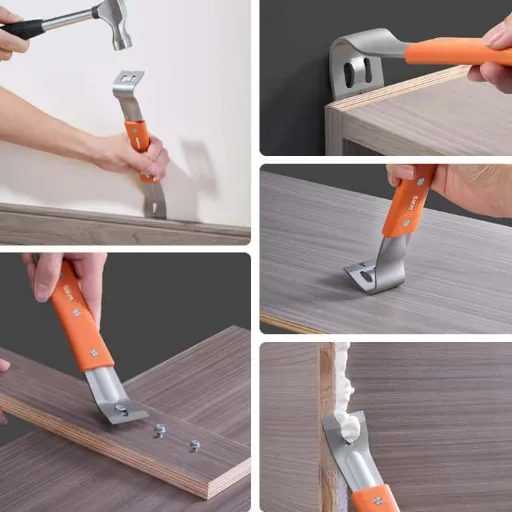
| Survives the material? | No, it’s a demolition tool | No, heaviest work only | Yes, thin and springy to protect trim |
| Best for | Form stripping, framing and deck demolition, nail pulling | Digging, lifting heavy objects by the edge | Trim, molding, baseboard, flooring salvage |
The cleanest rule comes from the trade press: a true crowbar is a digging bar over four feet long, while a wrecking bar runs one to five feet and carries a gooseneck or pig’s foot claw (JLC Online). A wedge point tapers from two sides and is built for busting concrete and stone. A pinch point tapers to one side and is built for prying heavy timbers, which is why it’s sometimes called a housebreaker’s bar.
So when a supplier quotes you on “crowbars,” confirm what they actually mean. The term is doing a lot of loose work in the market. For a full side-by-side on when each tool wins, see our comparison of pry bar vs crowbar.
Wrecking Bar Types and Bend Styles
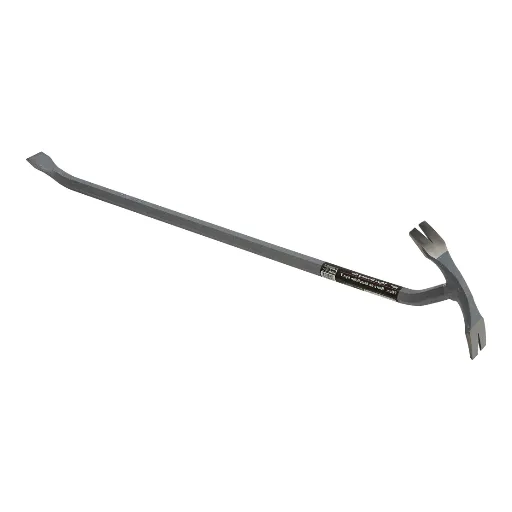
Wrecking bars are not one tool. The bend and the tip decide the job.
Full gooseneck
The most common form. The bar bends roughly 90 degrees and then curves, with the tip extending beyond the handle so it can work into a corner. Grainger notes that the gooseneck end reaches tight spaces and delivers more leverage than the claw or chisel end alone, because the curve effectively raises the fulcrum.
Ripping bar
A heavy hexagonal bar with a chisel and claw, made for tearing apart nailed assemblies. Longer versions run to 48 or 60 inches.
Pig’s foot
A curved claw with a split, hoof-like tip that grips spikes and large fasteners.
Salvage bar
A straight end carrying a notch and nail slot instead of a plain chisel. This is the variant built for pulling nails out of boards you intend to reuse, which matters if you sell into the reclaimed lumber trade.
Pinch point and wedge point tips
Tip geometry rather than bar shape. Pinch tapers to one side for prying timber. Wedge tapers from two sides for concrete and stone.
One caution worth stating plainly. Trade education material sometimes refers to three-quarter, half, and quarter bend bars as a shorthand for how much curve a bar carries. That shorthand is not codified in manufacturer catalogues or in the ASME listing, so treat it as informal language rather than a formal specification. Ask for the degree of bend and the overall length instead.
Wrecking Bar Sizes: Choosing the Right Length
There are five standard wrecking bar sizes, and Estwing lists exactly that range across its gooseneck wrecking bar line. The stock thickens as the bar lengthens, which is why weight climbs faster than length.
| Length | Metric | Stock width | Approx. weight | Best for |
|---|---|---|---|---|
| 12 in | 300 to 304 mm | 1/2 in | 0.8 to 1.25 lb | Tight spaces, detail demolition, light prying |
| 18 in | 450 to 457 mm | 1/2 to 5/8 in | 1.5 to 1.8 lb | General homeowner use, trim, light nail pulling |
| 24 in | 600 to 610 mm | 3/4 in | 1.2 to 3.6 lb | The best first wrecking bar. Decking, framing, timber frames |
| 30 in | 750 to 762 mm | 3/4 in | 2.0 to 4.5 lb | The average working size. Form stripping, sustained demolition |
| 36 in | 900 to 915 mm | 3/4 to 7/8 in | 2.6 to 5.5 lb | Large timber structures, concrete and metal demolition, formwork removal |
Beyond 36 inches you move into ripping bar and long bar territory, where a 57-inch bar can weigh 13 lb and a 60-inch pinch bar is built for landscaping rather than nail pulling.
Here is the practical guidance. A 24-inch bar is the one to buy first, because it covers most demolition jobs without exhausting the operator. A 30-inch bar is the length most professionals settle on for a full day of work. Step up to 36 inches when you are breaking large timber structures or stripping formwork, and accept the fatigue that comes with the extra reach.
For the leverage math across every bar length, including flat bars and mini bars, our pry bar sizes and leverage chart works through the mechanical advantage in detail.
Steel, Forging, and What to Look For
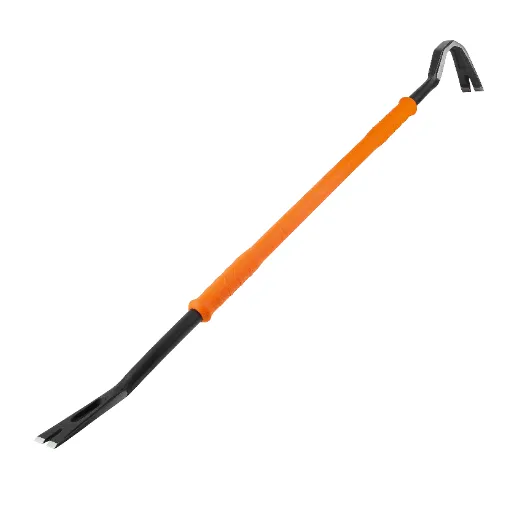
The steel determines whether a bar bends slowly or snaps without warning, and that difference decides whether you finish the job or stop to buy a replacement.
Common steels. The two grades that dominate wrecking bar manufacturing are 45# carbon steel and 65Mn manganese steel, often with alloy variants in premium lines. Manganese steel work-hardens under impact, which is why it holds up in repeated demolition cycles.
One-piece drop forging. This is the quality marker that matters most. Estwing, Bellota, and Eclipse all lead with single-piece forged construction, and for good reason. Every welded joint is a stress riser, and the neck is exactly where a bar takes its worst load. If a supplier can’t confirm that a bar is drop forged in one piece, treat the price as the only thing you are buying.
Heat-treated working ends. Working ends are hardened and tempered so the tip resists mushrooming and the claw stays sharp. Ask for the process rather than a marketing phrase. “Evenly hardened working ends” is a real specification. “Space-age strength” is not.
Stock profile. Hexagonal and octagonal profiles give grip and stop the bar rolling. I-beam stock delivers strength at lower weight. Round and flat profiles exist but are less common on heavy demolition bars.
Standard reference. The ASME B107.52 standard covers wrecking bars, and a government listing for a gooseneck bar cites it as Type 2, Class 2, at 24 inches overall with a 3/4-inch width across flats. Quote the standard when you are specifying a line, but don’t expect every bar on the shelf to carry a hardness clause from it.
Finishes. Powder coat is the most common export finish, with galvanised, enamel, and plated options for corrosion resistance and shelf appeal.
The failure mode to watch for is simple. A good bar bends slowly past its design capacity and gives you warning. A poor bar snaps. We work through the full metallurgy, including heat treatment targets and quality-control checks, in our guide to forged vs cast pry bar steel.
Buying a wrecking bar line? Request samples before you commit to a container. We supply forged and heat-treated bars in every standard length with your logo, finish, and packaging.
What a Wrecking Bar Is Used For
Wrecking bars show up in more places than most buyers expect. As a demolition tools category, manufacturer application lists converge on the same core tasks.
- Concrete formwork and shuttering stripping. The most consistently named professional use. Bellota lists formwork supports specifically, and BN Products markets a 57-inch bar with a 3-inch lifting surface for prying forms.
- Structural and framing demolition. A 36-inch bar is specified for demolishing large timber structures and dismantling concrete and metal construction. A 24-inch bar handles plasterboard and timber frames.
- Nail, screw, and spike extraction. A 36-inch bar can pull deck screws out of a joist where a hammer can’t reach.
- Lifting. Raising concrete slabs, paving slabs, timbers, and loaded structures so you can get a sling or a dolly underneath.
- Pallets and crates. Breaking down pallets for disposal or reuse.
- Flooring and shingles. Lifting boards, tiles, and roofing material in sheets.
- Landscaping and stump work. Feasible with long bars, though a reviewer reported bending a bar during stump extraction. Any bar has a limit, and stump work finds it.
- Reclaimed lumber salvage. This is where the salvage bar variant earns its place, because a notched end pulls nails without crushing the board.
For embedded or headless nails, where the head has broken off below the surface, a wrecking bar claw can’t reach. That job belongs to a cat’s paw nail puller, which bites into the wood and wrenches the shank free.
How to Use and Maintain a Wrecking Bar Safely
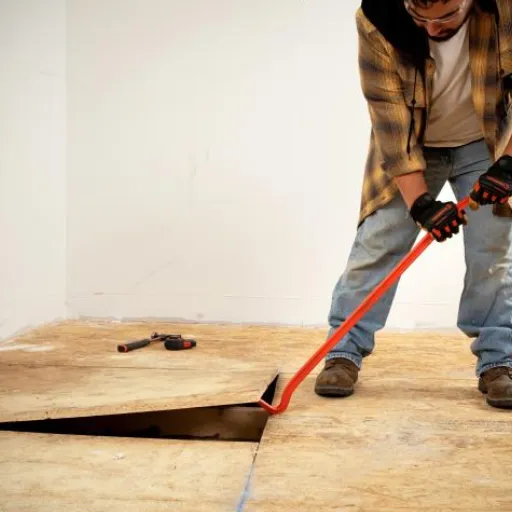
A wrecking bar stores a lot of energy and releases it fast when something slips. The safety rules are short and worth following every time.
Before you start. Inspect the bar for cracks, bends, and mushrooming at the tip. Clean off dirt and rust. Check what is behind the surface you are about to pry, because wiring and plumbing run behind baseboards and subfloor. Wear eye protection, a hard hat, and dry gloves that give you a firm grip.
While you work. Hold the bar with both hands and apply controlled force rather than jerks. Stand facing the bar with your feet shoulder-width apart, knees slightly bent, and your back straight. Bend at the knees, not the waist, and don’t lean over the bar.
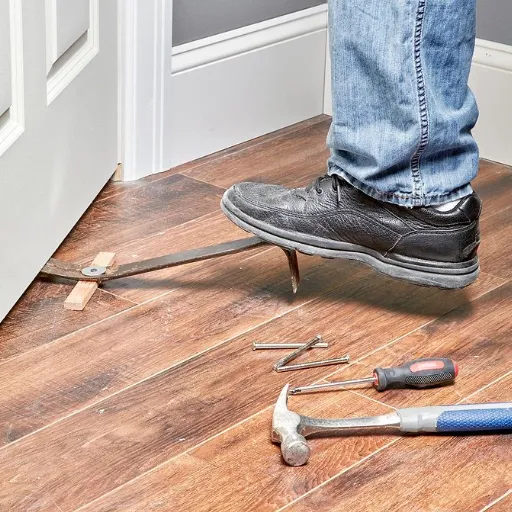
Never use a fulcrum block. Placing a block or object under the bar creates a stress point on the shaft. This is a common way to break a bar.
On striking. Some bars have a flat heel designed to take a hammer blow, which helps drive the claw under a nail head. Only strike a hardened, drop-forged bar. Never strike a bar that’s cracked, chipped, or mushroomed.
After the job. Wipe the bar down and apply a light film of oil to bare steel. For long storage, add a rust-preventive coating and keep the bar somewhere dry with the sharp ends covered. Reshape a chisel or pinch end with a file or grinder, and keep the claw filed sharp so it keeps its bite.
A bar that has bent past straight should be replaced, not straightened. The grain structure has already changed, and the next load will find the weak point.
How to Choose a Wrecking Bar
Work through these factors in order, and the decision becomes straightforward.
| Factor | What to decide |
|---|---|
| Does the material need to survive? | If yes, you want a flat bar, not a wrecking bar |
| Job length and material weight | Heavier, longer pulls need a longer bar |
| Bend and tip | Full gooseneck for corners and general demolition, salvage bar for reclaiming boards, wedge point for concrete and stone |
| Claw width | Wide claw for spikes and framing nails, fine notch for finish nails |
| One-piece forging | Non-negotiable. If it isn’t drop forged in one piece, keep looking |
| Finish and grip | Powder coat or galvanised for corrosion resistance, depending on your climate and your shelf |
For most buyers, the answer is a two-bar kit: a 24-inch gooseneck wrecking bar for demolition and a small flat bar for trim. Professionals commonly carry three tools, adding a nail puller to the pair. That combination covers the large majority of jobsite prying, and it’s the mix worth building a product line around.
OEM, Private Label, and Wholesale Wrecking Bars
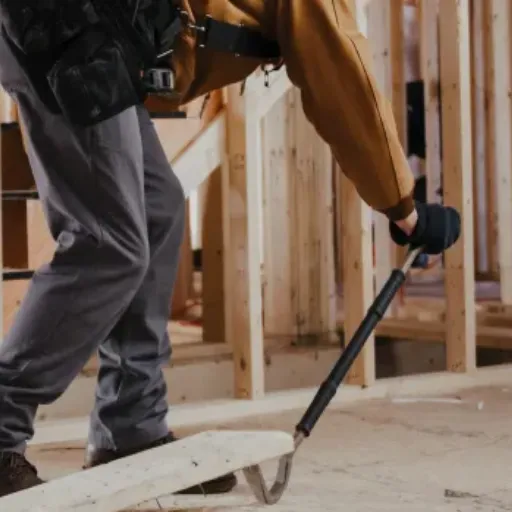
Wrecking bars are one of the highest-volume categories in the global hand tools export market, and China is the production hub. For buyers, that means real customization depth and real supplier variation.
What you can specify. Length in millimetres, hexagonal or octagonal stock, bend style, tip geometry, steel grade such as 45# or 65Mn, finish, logo marking, and retail packaging. Most established manufacturers offer OEM and ODM programs that cover all of it.
What MOQs look like. Real export listings sit between 1,200 pieces for a standard forged galvanised bar and 2,000 sets for a fully customized private-label program, with weekly capacity around 30,000 pieces. Treat those as market benchmarks, not a floor. Flexible programs exist.
What to ask for on documentation. ISO 9001, BSCI, and GS are the common baseline, with CE marking for relevant markets and third-party inspection from BV, TUV, or SGS on larger orders. Ask for material traceability and hardness test records, not just a certificate of conformity.
What to plan for on logistics. Shandong province supplies most of the world’s wrecking bars, with FOB terms commonly quoted from Qingdao. Bars are dense and heavy, so container weight limits, not volume, usually decide your loading plan.
The container math is where first orders go wrong. A single-length order of 30-inch bars can hit the weight ceiling before the container is half full, because steel bars are dense and container limits are measured in tonnes, not cubic metres. Mixing lengths and packing to the weight limit instead of the volume limit is what brings landed cost per unit down. Same supplier, same product, materially better cost.
Frequently Asked Questions
What is a wrecking bar used for?
A wrecking bar is used for demolition work: stripping concrete formwork, tearing apart framing and decking, pulling nails and spikes, lifting slabs and timbers, and breaking down pallets. It’s built for jobs where the material being removed doesn’t need to stay intact.
Is a wrecking bar the same as a crowbar?
No, though the terms are used loosely. A true crowbar is a digging bar over four feet long with a pinch or wedge point. A wrecking bar runs one to five feet and has a curved claw for pulling nails plus a prying wedge at the other end.
What size wrecking bar should I get?
A 24-inch bar is the best first purchase because it handles most demolition jobs. Step up to 30 inches for sustained professional work and 36 inches for large timber structures, concrete demolition, and formwork stripping.
How much does a wrecking bar weigh?
An 18-inch bar weighs about 1.5 to 1.8 lb, a 30-inch bar about 2 to 4.5 lb, and a 36-inch bar about 2.6 to 5.5 lb. Long bars beyond 36 inches can reach 13 lb.
Can you strike a wrecking bar with a hammer?
Yes, but only on a hardened, drop-forged bar with a flat heel designed for striking. Never strike a cracked, chipped, or mushroomed bar.
What is a wrecking bar made of?
Most are forged from 45# carbon steel or 65Mn manganese steel, with heat-treated working ends. Manganese steel work-hardens under impact, which suits repeated demolition work.
What is a salvage bar used for?
A salvage bar has a notched end with a nail slot instead of a plain chisel. It pulls nails from boards you intend to reuse, which is why it’s popular in the reclaimed lumber trade.
How do I stop a wrecking bar from rusting?
Wipe it down after every use and apply a light oil film to bare steel. For storage, coat it with a rust preventive and keep it somewhere dry with the sharp ends covered.
Is a 24-inch or 36-inch wrecking bar better for demolition?
A 24-inch bar is better for most demolition because it balances leverage against fatigue and works in tighter spaces. A 36-inch bar is better when you need maximum leverage on large timber, concrete, or formwork, and you have the room to swing it.
Conclusion
A wrecking bar is a simple tool, but the details decide whether it lasts a career or a week. Match the length to the job, confirm the bar is drop forged in one piece, check that the working ends are hardened and tempered, and buy the bend and claw that suits your work.
Here is the short version. A 24-inch gooseneck bar covers most demolition. A 30-inch bar is the professional workhorse.
A 36-inch bar brings the leverage for formwork and heavy timber. And a salvage bar earns its place the moment you need to save the boards.
Shanghai Oushike Hardware Tools manufactures forged wrecking bars in every standard length, in 45# and 65Mn steel, with hexagonal and octagonal stock, powder-coated and galvanised finishes, and full OEM and private-label programs. Request a bulk quote and we’ll send samples, specifications, and current lead times for your market.