
Best Pry Bar: Wrecking Bars, Crowbars & Pry Bar Types Compared
The best pry bar for most professional work is a 15-inch flat pry bar for trim and general prying, paired with a 36-inch wrecking bar for heavy demolition and an 11-inch cat’s paw for embedded nails. There’s no single best pry bar, because “pry bar” covers a dozen distinct tools. The right one depends on the type and the length you need for the load in front of you.
Here’s the problem most buyers run into. You need to lift a stuck door frame, so you grab the nearest bar. It bends.
Or you reach for a 36-inch wrecking bar to pull trim, and you crush the drywall you were trying to save. The tool was never the issue. The mismatch was.
This guide fixes that. You get the complete pry bar taxonomy, a size-to-leverage chart, the steel and forging specs that separate a bar that bends from one that snaps, and a procurement section for anyone buying pry bars in bulk.
We are Shanghai Oushike Hardware Tools, and we manufacture pry bars along with the rest of our hand tool range. That means we can show you how these tools are actually built, not just how they are marketed.
Key Takeaways
- A 15-inch flat pry bar covers most trim, flooring, and light demolition work, and it is the single most useful bar for most buyers.
- A 24-inch bar delivers roughly 3x the mechanical advantage of an 8-inch bar. Length is the leverage lever, and it is the specification most buyers get wrong.
- Surface hardness for forged pry bars typically lands between 45 and 52 HRC, with a 35 to 40 HRC core so the bar bends instead of shattering.
- A quality bar bends slowly past its design limit. A poor one snaps without warning, which is the most dangerous failure mode in the category.
- For distributors and brand owners, pry bars are a strong private-label category: six core types, predictable size runs, and low tooling complexity.
What Is a Pry Bar?
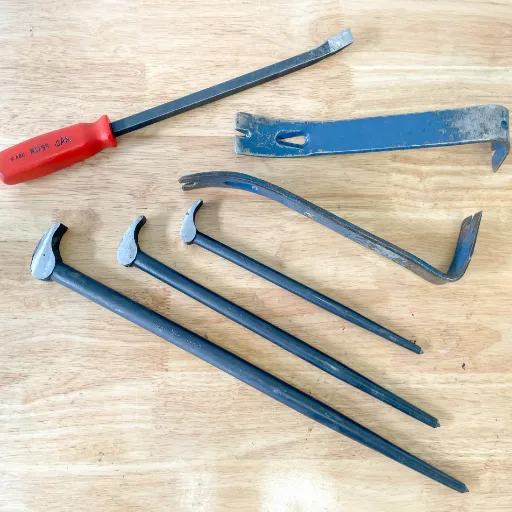
A pry bar is a lever-style hand tool that converts a small force applied at the handle into a large prying force at the tip. It’s used to separate, lift, pull, or align materials, from pulling nails out of hardwood to lifting a stone slab.
The principle is simple. The bar rests on a fulcrum, your hand supplies the effort, and the load sits at the far end. The longer the bar, the less effort you need. That single relationship explains most of what follows.
Pry bars are common across construction, renovation, automotive repair, landscaping, and rescue work. They also sit inside one of the most widely stocked hand tool categories on any store floor, because almost every trade has a use for at least one.
For the full technique walkthrough, including where to place the fulcrum and how to protect finished surfaces, see our guide on how to use a pry bar.
Types of Pry Bars: The Complete Breakdown
Most guides to demolition tools cover three to five pry bar types. That isn’t enough, because the wrong type is the most common reason a job stalls. Here is the full set.
| Type | Shaft / profile | Typical length | Primary use | Also known as |
|---|---|---|---|---|
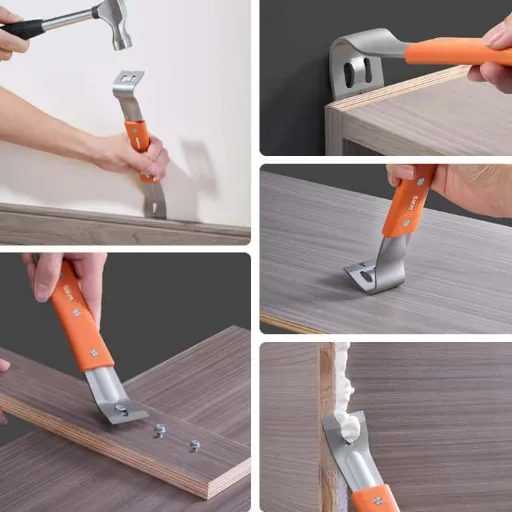
| Flat pry bar | Flat spring steel, nail slots both ends, 90-degree claw plus offset claw | 5.5″ to 18″ | Trim and molding salvage, flooring, baseboard removal | Wonder Bar, Super Bar, Handy Bar, Utility Bar |
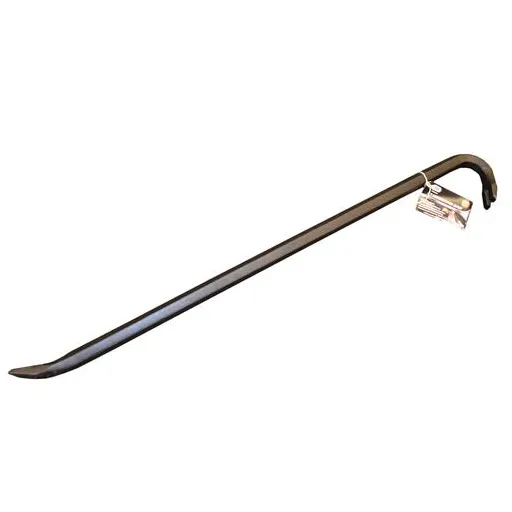
| Wrecking bar | Hexagonal or octagonal shank, flat claw end, often gooseneck | 12″ to 60″ | Heavy demolition, form stripping, framing and decking | Gooseneck bar, ripping bar, pig’s foot |
| Crowbar | Round or hex long stock. A true crowbar is a digging bar over 4 ft | 48″ to 68″ | Heavy lifting, digging, stripping concrete forms | Pinch bar, long bar, jemmy (UK) |
| Pinch bar | Round or hexagonal, chisel end plus pointed tip | Longest and second-heaviest bar made | Lifting heavy objects by their edge, aligning | Housebreaker’s bar |
| Cat’s paw | Short sharp curved claw, flat body | 6″ to 14″ | Extracting embedded and headless nails | Nail puller, gooney spoon (variant) |
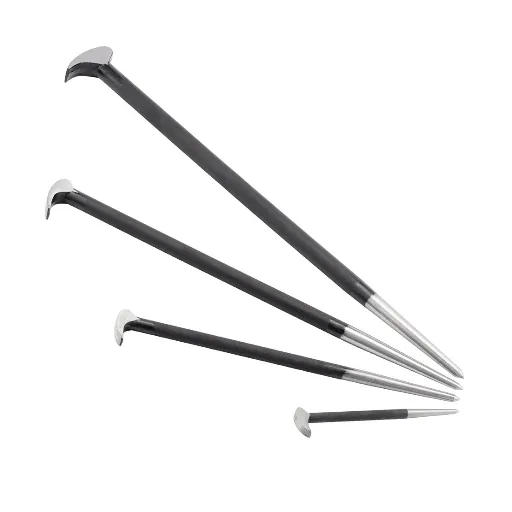
| Rolling head bar | Round shaft, pointed tip, bent claw | 16″ to 36″ | Prying, lifting, levering, aligning bolt holes | Rolling head pry bar |
| Ripping bar | Heavy hex, chisel plus claw | 24″ to 48″ | Ripping apart nailed assemblies | Salvage bar |
| Alignment bar | Long tapered round or hex, no claw | 12″ to 48″ | Aligning bolt holes in steel and machinery | Line-up pin |
| Indexing bar | Pivoting locking head, sometimes extendable shaft | 12″ to 30″ | Tight spaces, doors, floorboards, adjustable angle | Adjustable pry bar |
| Railroad bar | Hexagonal, 45-degree claw plus pointed tip | 48″ to 60″ | Track maintenance, heavy levering | Track bar |
| Molding chisel bar | Wide flat blade | 8″ to 12″ | Lifting molding and flooring without crushing the edge | Flooring chisel |
| San Angelo bar | Long round or hex, chisel plus point | 48″ to 72″ | Breaking rock and concrete, digging | Rock bar |
A quick note on naming, because it causes real confusion in search results and at the counter. “Wonder Bar” is a Stanley brand name that became generic. The same tool appears as an Action Bar (Plumb), Handy Bar (Estwing), Handi-Bar (Barco), and Super Bar (Vaughan). And a true crowbar is a digging bar over four feet long, which is different from the 24-inch bar many people call a crowbar.
Three types deserve their own deep dive, and we cover each in full: the wrecking bar as a standalone demolition tool, the flat pry bar family that handles most trim work, and the cat’s paw nail puller for embedded fasteners.
Want the full range in one place? Request our pry bar catalog and wholesale price list and compare specs side by side.
Pry Bar Sizes and Leverage: Choosing the Right Length
Length is the most consequential specification on a pry bar, and it’s the one most buyers guess at. The rule is straightforward: the heavier the object, the longer the bar.
| Length | Typical shaft stock | Approx. weight | Leverage | Best for |
|---|---|---|---|---|
| 5.5″ to 7″ | 3/16″ to 1/4″ | 0.2 to 0.5 lb | Minimal | Precision trim, delicate molding |
| 10″ to 12″ | 1/4″ to 5/16″ | 0.5 to 1.0 lb | Low | Trim, baseboard, flooring, everyday carry |
| 15″ to 18″ | 5/16″ to 1/2″ | 1.0 to 2.5 lb | Moderate | The general-purpose size. Light demolition, nail pulling |
| 24″ to 30″ | 1/2″ to 5/8″ | 2.5 to 5 lb | High | General demolition. A 24″ bar gives about 3x the advantage of an 8″ bar |
| 36″ to 48″ | 5/8″ to 3/4″ | 5 to 9 lb | Very high | Framing, decking, form stripping, heavy demolition |
| 60″ to 72″ | 3/4″ to 1″ | 9 to 15+ lb | Maximum | Landscaping, masonry, railroad, lifting stone and timber |
Two reference points are worth keeping in mind. Patent filings in this category note that below 24 inches a bar does not provide enough leverage for typical work, while above 72 inches it becomes awkward and heavy to handle. That’s the practical working window.
The trade-off is real, though. A longer bar gives more force, but it also weighs more, fatigues the user faster, and needs more room to swing. A 60-inch pinch bar is the right answer for lifting a stone and the wrong answer for a doorway.
Mike, a remodeling contractor we work with, learned this on a trim job. He had been using a 24-inch bar for baseboard removal for years, fighting crushed drywall on every pull. He switched to a 10-inch flat bar for that work and his callbacks on damaged walls dropped to almost nothing.
The 24-inch bar wasn’t failing him. It was simply the wrong tool for a finish job.
Leverage math, weights, and full size runs are covered in more detail in our pry bar sizes chart.
Pry Bar vs. Crowbar vs. Wrecking Bar
These three names get used interchangeably, and that causes buyers to purchase the wrong tool. They’re related, but they’re not the same instrument.
| Feature | Wrecking bar | Crowbar |
|---|---|---|
| Primary use | Heavy demolition | General prying, lifting, digging |
| Shape | Straight or slightly curved, chisel end, gooseneck claw | Curved hooked end, flattened or pointed tip |
| Length | 12″ to 60″ | 48″ to 68″ for a true crowbar |
| Weight | Heavier, built for force | Heaviest class, 30 lb and up at full length |
| Point style | Chisel and claw | Wedge point or pinch point |
| Best for | Framing, decks, pallets, formwork | Stripping forms, digging, moving timbers |
The cleanest way to hold the distinction comes from the trade press at JLC Online: a genuine crowbar is a digging bar over four feet long, typically with a wedge point for breaking concrete or a pinch point for prying heavy timbers. A wrecking bar runs one to five feet and carries a gooseneck or pig’s foot claw for pulling nails.
Everything else, including flat bars, cat’s paws, and pinch bars, falls under the broad “pry bar” umbrella. So all crowbars are prying tools, but not all prying tools are crowbars.
For the head-to-head breakdown, including which one to reach for in specific trades, see pry bar vs crowbar.
What to Look For: Steel, Forging, and Build Quality
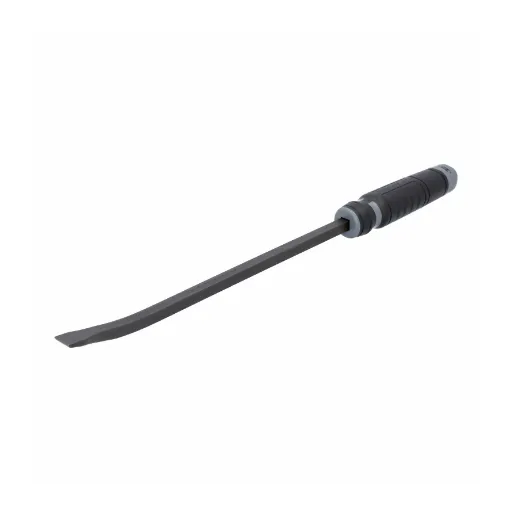
This is where a manufacturer can tell you something a review site cannot, because the difference between the best pry bar and one that fails on the first cold morning comes down to metallurgy.
Steel selection
- High-carbon steel (45#) and 65Mn are the most common bar steels. They offer a solid balance of strength, edge hardness, and cost.
- Forged manganese steel contains roughly 11% to 14% manganese and work-hardens under impact. Hit it, and the surface gets tougher.
- Chrome vanadium (Cr-V) and Mn-V alloys appear in premium bars where consistent hardness matters across a long production run.
- Boron alloy is used where deep hardening through the section is the priority.
Titanium shows up in lightweight and EDC bars, and we cover that separately in our EDC pry bar guide.
Hardness, and why it is a range and not a number
A forged pry bar typically runs 45 to 52 HRC at the surface with a 35 to 40 HRC core. That combination is deliberate. The hard surface resists wear and holds a chisel edge, while the softer core absorbs shock.
Heat a bar to uniform high hardness and it becomes brittle. It will hold an edge beautifully right up until the moment it shatters in your hand.
Standards matter here too. Market bars commonly reference ASME B107.52 for wrecking bars, with types and classes defined by end configuration. Ask any supplier for the standard their bars are built to. A supplier who cannot answer that question isn’t a manufacturer you want.
The quality test that actually matters
Gray Tools, a long-established hand tool maker, frames this well in their pry bar guide: a good quality pry bar bends slowly when stressed beyond its design capacity, while a poor quality bar snaps unexpectedly. A bend is an inconvenience. A snap sends a length of steel through whatever is in front of it.
Forging versus welding
One-piece drop forging has no joints, and joints are where bars fail. If a product listing doesn’t say “forged” or “one-piece,” assume there’s a weld in the assembly, because there usually is.
Finishes then handle corrosion: powder coat, enamel, nickel plating, phosphate, and electrophoretic coatings all extend service life, and they matter more in humid and outdoor markets.
We go deeper on steel grades, heat treatment, and factory QC auditing in pry bar material and manufacturing.
Handle, Grip, and Ergonomics
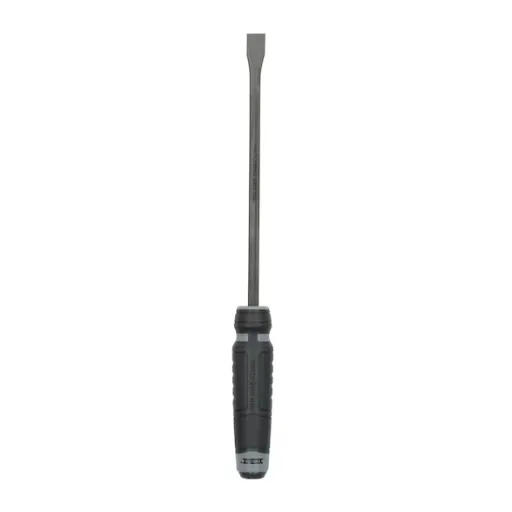
Shafts aren’t interchangeable, and the cross-section affects how the tool feels in use.
- Round shafts are easiest to grip and rotate.
- Flat shafts fit into the tightest gaps.
- Contoured shafts curve back to add leverage.
- Hexagonal shafts give six contact faces, which is why they dominate levering work.
- I-beam shafts are lighter for the strength they deliver.
Many professional bars ship with bare steel handles. They’re durable and easy to clean, which is why demolition crews prefer them. For high-frequency work, cushioned or anti-vibration grips reduce hand fatigue, and a metal striking cap lets you drive the bar with a hammer without mushrooming the end.
That last feature pairs naturally with the tools it works alongside, including our claw hammers and, for the heaviest work, sledgehammers.
Best Pry Bar Picks by Category
These picks are specification-based rather than brand-based, which is how we would advise any buyer to shop. We have noted where well-known market bars sit for context.
| Category | Type and length | Shaft stock | Weight | Steel | Best for |
|---|---|---|---|---|---|
| Best overall | 15″ flat pry bar | 5/16″ to 1/2″ | 1.5 lb | Forged high-carbon | Trim, flooring, light demolition |
| Best wrecking bar | 36″ gooseneck wrecking bar | 5/8″ to 3/4″ | 7 lb | Forged alloy, heat treated | Heavy demolition, formwork |
| Best crowbar | 24″ curved bar | 5/8″ | 4 lb | Forged carbon steel | General prying, nail pulling |
| Best for tight spaces | 11″ cat’s paw | 1/4″ | 0.9 lb | Drop-forged steel | Embedded and headless nails |
| Best for landscaping | 60″ pinch point bar | 1″ | 14 lb | Forged manganese | Stone, timber, posts |
| Best set | 4-piece demolition set | Mixed | Mixed | Forged alloy | Crews and renovation teams |
| Best EDC | 5″ titanium mini bar | 3/16″ | 1.2 oz | Titanium | Everyday carry, pocket prying |
Best overall: 15-inch flat pry bar
The 15-inch flat bar is the most versatile size for professional work. It is long enough for meaningful leverage and short enough to control, and the flat profile spreads load instead of crushing the surface.
Pros: lightweight, dual nail pullers, low surface damage, easy to carry all day
Cons: not strong enough for framing demolition, limited reach
Best wrecking bar: 36-inch gooseneck
For heavy demolition, the 36-inch wrecking bar is the workhorse. The gooseneck claw pulls large nails while the chisel end drives under boards, and a one-piece forged body survives repeated high-impact use.
Pros: excellent leverage, handles large fasteners, forged construction resists breakage
Cons: heavy for extended use, too large for finish work
Best crowbar: 24-inch curved
A 24-inch curved bar balances force and portability. It handles general construction, mechanical repair, and medium-duty demolition without the bulk of a full wrecking bar.
Pros: versatile across trades, good prying angles, manageable weight
Cons: less precision than a cat’s paw, less power than a 48-inch bar
Best for tight spaces: 11-inch cat’s paw nail puller
When a nail head is buried or broken off, the cat’s paw is the only tool that reaches it. The sharpened claw bites into the wood around the shaft and levers the fastener out with minimal surface damage.
Pros: works on headless nails, lightweight, faster than a hammer claw
Cons: leaves small marks, not built for heavy prying
Best for landscaping: 60-inch pinch point bar
Groundwork demands length. A 60-inch pinch bar lets a worker lift stone and timber without bending into a strain position, and the long handle multiplies force dramatically.
Pros: maximum leverage, useful for soil and concrete edging, reduces strain
Cons: heavy and specialized, not designed for nail pulling
Sets deserve their own treatment, since most professional kits are built around them. We compare the leading configurations and the three-bar kit most tradespeople actually carry in best pry bar set.
Buying for a crew or a store shelf? Ask for bulk pricing on our forged pry bar range, including mixed size runs and private-label options.
Best Pry Bar for Every Application
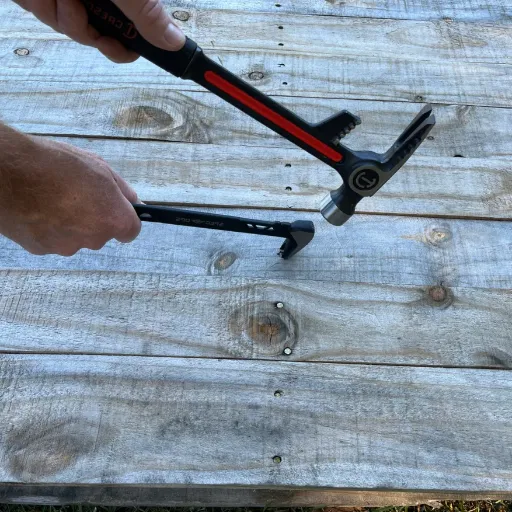
Matching the bar to the job is the fastest way to stop damaging materials. For demolition tools, that match matters more than the price tag. Across framing, formwork, and pallet work, the wrecking bar sits at the centre of our heavy-duty demolition tools range.
| Application | Recommended bar | Length | Why |
|---|---|---|---|
| Construction and demolition | Wrecking bar or crowbar | 30″ to 48″ | Length provides the leverage and the claw handles large fasteners |
| Finish carpentry | Flat pry bar | 10″ to 15″ | Flat profile protects finished surfaces and the flex absorbs shock |
| Flooring and baseboard | Flat pry bar or molding chisel | 8″ to 15″ | Thin edge slides under trim without crushing it |
| Automotive and mechanical | Rolling head or alignment bar | 16″ to 30″ | Reaches fasteners and aligns bolt holes where a claw cannot fit |
| Landscaping | Pinch point bar | 48″ to 72″ | Maximum leverage for stone, posts, and timber |
| Rescue and emergency | Forged crowbar | 36″ to 48″ | One-piece construction survives prying doors and debris |
| Everyday carry | Mini or titanium bar | 2″ to 5″ | Pockets easily and handles light prying and scraping |
How to Use a Pry Bar Correctly
A few technique points prevent most damage and injuries.
- Place a wood block under the fulcrum. It multiplies leverage and stops the bar from digging into the surface you are standing on.
- Use your body weight, not your back. Lean into the bar with your legs set, rather than pulling with your arms and shoulders.
- Protect the finish. Slide a scrap of wood or a thin pry shield between the bar and any surface you want to keep.
- Work in stages. Take a partial lift, reposition the bar further under the material, and repeat.
- Never extend a bar with a pipe. A cheater bar overloads the tool past its design limit and is the leading cause of snapping.
The full technique breakdown, including nail pulling with the claw end, is in our complete pry bar technique guide.
Pry Bar Safety and Maintenance
- Inspect before each use. Look for cracks, bends, mushroomed heads, and worn tips.
- Wear the right PPE. Safety glasses, gloves, and steel-toe boots cover the realistic injury paths.
- Keep the swing path clear. Nobody should be standing in the line of the bar or the material.
- Rack the bar correctly. Sudden slips happen most often when force is applied unevenly.
- Clean and dry before storage. Concrete dust and moisture are a rust pairing.
- Oil uncoated steel. A light coat prevents corrosion, especially in humid markets.
- Dress worn edges. A grinder restores a chisel tip, but keep the temper in mind and work slowly.
Our general hand tool safety guide covers PPE and inspection routines across the whole workshop, not just pry bars.
Customization and OEM Options for Pry Bars
For brand owners and distributors, pry bars are one of the easier categories to take private label. The tooling is well understood, the size runs are predictable, and buyers care about feel and finish more than proprietary features.
Our OEM and ODM scope on pry bars covers:
- Length: roughly 500 mm to 2,000 mm, with custom sizes on request
- Shaft cross-section: round, hexagonal, flat, contoured, or I-beam
- Tip geometry: chisel, claw, gooseneck, pinch, or pointed
- Steel grade: high-carbon, 65Mn, forged manganese, Cr-V, or boron alloy
- Finish: powder coat, enamel, nickel, phosphate, or electrophoretic
- Branding: laser marking, stamping, and handle color
- Packaging: poly bag, skin card, blister, or full retail carton
Custom logo orders typically start around 1,000 pieces on comparable lines, and MOQ flexes with the specification. Start with a single SKU, validate it in your market, then scale the size run.
A note on where we fit. We are a manufacturer, so the custom hand tools conversation is a production conversation, not a reseller one. You’re talking to the people who run the forge.
The factory-selection side of this, including what to inspect and what documents to request, is covered in pry bar manufacturer.
Procurement Guide for Bulk and Wholesale Buyers
A pry bar line is a solid category for distributors, and the assortment decision is simpler than it looks.
The assortment that sells
Six types cover almost all demand. Stock flat bars, wrecking bars, crowbars, cat’s paw nail pullers, pinch bars, and one set configuration. Within each type, offer three lengths at minimum. Buyers who cannot find their size at your store will find it somewhere else.
The same logic works across the aisle. Distributors who pair a pry bar program with adjacent cutting categories, such as bolt cutters, build a fuller jobsite tool section from a single supplier relationship.
Price tiers
Build three tiers so you can serve DIY, trade, and professional customers from one supplier relationship:
- Entry: basic flat bars, 5.5″ to 12″, for retail and DIY
- Trade: 15″ to 36″ forged bars for contractors and renovation crews
- Professional: 36″ to 60″ forged manganese bars and multi-piece sets for demolition and landscaping
For context on where retail prices sit, mass-market pry bars commonly range from roughly 12to12to130, with type, length, and branding driving most of the spread.
Certifications and documentation
Request ISO compliance documentation, material traceability records, hardness test reports, and any standard conformance certificates up front. These are the documents that protect you if a customer raises a quality claim.
Logistics
Most pry bar volume moves by sea freight, quoted FOB Shanghai or Ningbo, with container planning driven by bar length since long bars limit how efficiently a container fills. Our hand tool import guide walks through the documentation and clearance process.
Sofia runs procurement for a European distributor we supply. She built her pry bar line around six types and eighteen SKUs, dropped her per-unit cost by consolidating three suppliers into one, and cut her inbound quality claims by adding a hardness verification step to her receiving process. The category went from a nuisance item to one of her better-margin lines inside a year.
Assortment planning, margin structure, and house-brand positioning against established names are all covered in wholesale pry bars.
Frequently Asked Questions
What is a pry bar used for?
A pry bar separates, lifts, pulls, or aligns materials by mechanical advantage. Common uses include pulling nails, removing trim and flooring, lifting heavy objects, separating structural components, and aligning bolt holes during assembly.
What is the difference between a pry bar and a crowbar?
A crowbar is one type of pry bar. A true crowbar is a digging bar over four feet long with a wedge or pinch point. “Pry bar” is the umbrella term covering flat bars, wrecking bars, cat’s paws, pinch bars, and more.
Is a wrecking bar the same as a crowbar?
No. A wrecking bar runs one to five feet with a gooseneck or pig’s foot claw for pulling nails. A crowbar is longer and heavier, designed for digging and prying heavy materials. Many people use the terms loosely, which is where the confusion starts.
What size pry bar should I get?
For general home and trade use, a 15-inch flat bar handles most jobs. Add a 36-inch wrecking bar for demolition and an 11-inch cat’s paw for embedded nails. If you only buy one, buy the 15-inch flat bar.
How long should a pry bar be?
Long enough to lift the load without straining, and short enough to control. The working range is roughly 24 to 72 inches for leverage tools. Below 24 inches you lose mechanical advantage. Above 72 inches the tool becomes awkward and heavy.
What is a wonder bar used for?
A wonder bar is a flat pry bar with nail slots at both ends and a 90-degree claw. It’s used for trim and molding salvage, flooring removal, pulling nails, and light demolition where surface protection matters.
What is a pry bar made of?
Most pry bars are forged from high-carbon steel, 65Mn, chrome vanadium, or forged manganese steel. Surface hardness typically runs 45 to 52 HRC with a softer 35 to 40 HRC core, so the bar bends under overload instead of shattering.
Can you hit a pry bar with a hammer?
Only if the bar has a striking cap designed for it. Striking an unprotected handle end mushrooms the steel and can eventually crack it. Bars built for impact use carry a hardened metal cap for exactly this reason.
What is the best pry bar for demolition?
A 36-inch to 48-inch forged wrecking bar with a gooseneck claw. It combines the leverage needed for framing and formwork with a claw that removes large fasteners, and the one-piece forging survives repeated high-impact use.
How do I stop a pry bar from rusting?
Clean it after use, dry it fully, and store it in a dry location. Apply a light coat of oil to uncoated steel. If you are buying in bulk for a humid market, specify a coated finish such as powder coat, nickel plating, or electrophoretic coating.
Conclusion
The best pry bar is the one matched to your load. A 15-inch flat bar covers trim, flooring, and general prying. A 36-inch wrecking bar handles demolition. An 11-inch cat’s paw reaches the nails nothing else can.
Match the type to the job, then match the length to the load.
When you evaluate a bar, check the forging, ask about hardness, and confirm the steel grade. A bar that bends slowly is doing its job. A bar that snaps is a liability.
If you are sourcing pry bars for resale, the category rewards a clean assortment over a wide one. Six types, three lengths each, three price tiers.
Shanghai Oushike Hardware Tools manufactures forged pry bars for distributors, contractors, and brand owners across more than 30 countries. Our hand tools range covers the full pry bar family, from trim bars to demolition wrecking bars.
Request your pry bar catalog, sample, and wholesale quote and see how factory-direct supply changes your margin.