
Mechanical Testing Equipment: A Buyer’s Guide for Quality Control and Sourcing
Mechanical testing equipment is the set of instruments manufacturers use to apply controlled forces to materials and components, then measure how they respond. These machines determine properties like strength, hardness, ductility, toughness, and fatigue resistance so teams can verify quality before products reach customers.
What if the wrong testing machine is quietly increasing your defect rate? Many buyers focus on price and speed but skip the step of matching the test method to the material and standard. The result is misleading data, rejected shipments, and expensive recalls. This guide will help you avoid that trap.
We will walk through the main types of test and measurement tools, how each one fits common quality-control workflows, and what to look for when sourcing from manufacturers. You will leave with a practical framework for choosing the right machine for your application and budget. If you are new to testing, start with our overview of test and measurement tools and our guide on how to choose test and measurement tools.
Key Takeaways
- Mechanical testing equipment measures how materials react to force, helping manufacturers verify strength, hardness, and durability before shipment.
- The most common types are universal testing machines (UTMs), tensile testers, compression testers, hardness testers, impact testers, and fatigue testers.
- Choose equipment by matching the test type, load capacity, accuracy, fixtures, software, and standards to your actual application.
- China is a major manufacturing base for testing equipment, with strong suppliers in Dongguan, Jinan, Shenzhen, and Suzhou; verification of ISO 9001 and ASTM/ISO compliance is essential.
- Reliable testing supports lower defect rates, faster customer approvals, and safer products in automotive, aerospace, construction, and general manufacturing.
What Is Mechanical Testing Equipment?
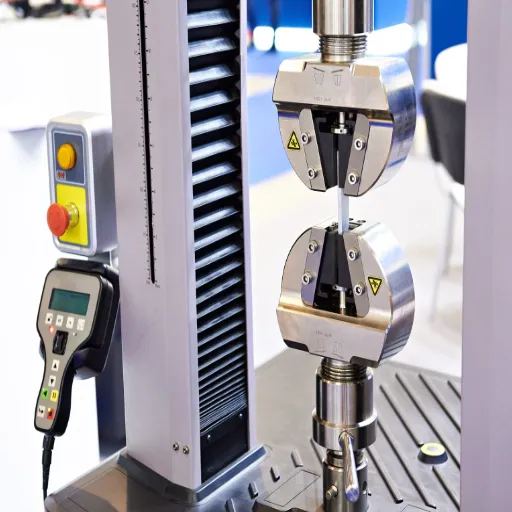
Mechanical testing equipment includes machines that apply tension, compression, bending, impact, torsion, vibration, or repeated cyclic loads to a specimen. Sensors record the material’s response, typically as load, displacement, strain, or deformation. The output tells engineers whether a material meets design requirements and safety standards.
A simple way to think about it is this: every product that carries a load, absorbs impact, or resists wear needs proof that it will perform as designed. A bolt must hold tension. A concrete block must resist compression. A spring must survive millions of cycles. Testing equipment provides that proof with numbers rather than assumptions.
The global market for these machines is substantial. According to Fortune Business Insights, the mechanical testing equipment market is projected to reach approximately USD 13.3 billion in 2026, growing at around 4% annually through the mid-2030s. Asia-Pacific leads regional demand, driven by expanding manufacturing, infrastructure, and automotive production. For buyers, this growth means more supplier options but also more need to evaluate quality and compliance carefully.
Main Types of Mechanical Testing Equipment
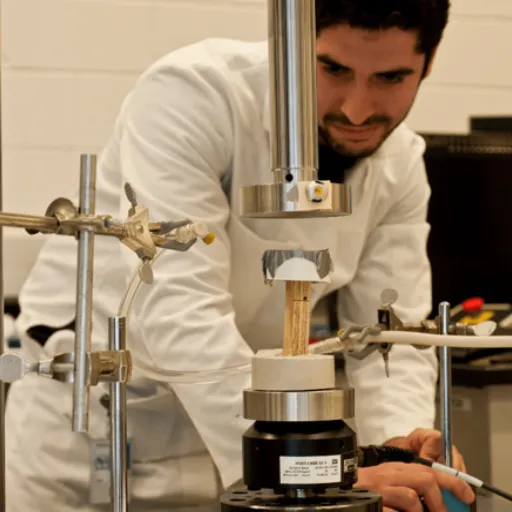
Most quality-control labs do not need every type of tester. They need the right combination for their materials, standards, and production volume. Below are the core categories used across industries.
Universal Testing Machines (UTMs)
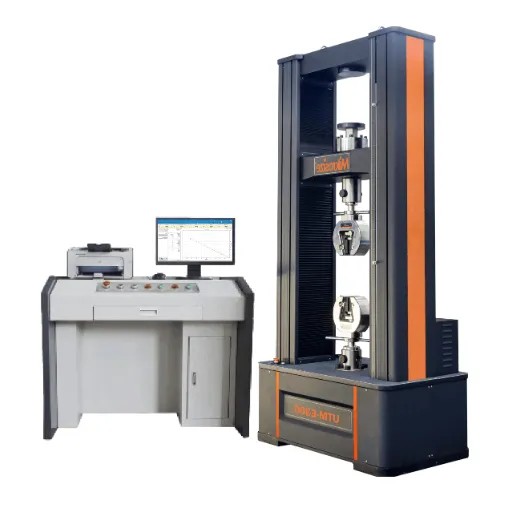
A universal testing machine, or UTM, is the most versatile piece of mechanical testing equipment. It performs tensile, compression, flexural, shear, peel, and adhesion tests on a single frame by swapping grips, fixtures, and software settings.
UTMs come in two main drive types. Electromechanical UTMs use servo motors and ball screws. They are accurate, quiet, and ideal for static tests at lower to medium forces. Servo-hydraulic UTMs use hydraulic rams and are better for high-load, dynamic, and fatigue testing.
Frame design also matters. Single-column UTMs suit plastics, rubber, textiles, and wire testing. Dual-column UTMs handle metals, composites, concrete, and other high-force applications. Load capacities range from a few hundred newtons to more than one thousand kilonewtons.
When Carlos, a quality manager at a Mexican automotive supplier, upgraded his lab in 2024, he replaced three single-purpose machines with one dual-column UTM. The change reduced his floor space by 30% and cut test setup time by half because his team no longer had to move samples between machines.
Tensile Testing Machines
Tensile testing machines stretch a specimen until it breaks. They measure tensile strength, yield strength, elongation, and Young’s modulus. These values tell engineers how a material behaves under pulling forces.
Common standards include ASTM E8/E21 for metals and ASTM D638 for plastics. Internationally, ISO 6892-1 covers tensile testing of metals, while ISO 527 covers plastics. Instron provides a detailed overview of tensile testing principles on their tensile testing guide.
Compression Testing Machines
Compression testing machines squeeze a specimen between two platens. They measure compressive strength, deformation, and modulus. These machines are essential for concrete, ceramics, rigid plastics, packaging, and foam.
Key standards include ASTM D695 and ISO 604 for rigid plastics, and ASTM C39 for concrete cylinders. A compression test is straightforward, but fixture alignment and loading rate are critical. Even a small misalignment can produce false low-strength readings.
Hardness Testers
Hardness testers measure a material’s resistance to indentation or scratching. The most common methods are:
- Rockwell: Fast and widely used for metals; follows ASTM E18 and ISO 6508-1.
- Vickers: Uses a diamond pyramid indenter; suitable for metals, ceramics, and thin sections; follows ASTM E92/E384 and ISO 6507-1.
- Brinell: Uses a hardened steel or carbide ball; common for castings and forgings; follows ASTM E10 and ISO 6506-1.
- Shore: Measures rubber, elastomers, and soft plastics; follows ASTM D2240 and ISO 7619.
Each method leaves a different size of indent and reports hardness on a different scale. The right choice depends on material type, sample thickness, and the standard you need to meet.
Impact, Fatigue, and Specialized Testers
Beyond the big three, quality programs often need specialized machines:
- Impact testers measure toughness. Charpy and Izod tests are the most common, following ASTM D256, ASTM D6110, ISO 179, and ISO 180.
- Fatigue testers apply repeated cyclic loads to predict how long a component will last under real-world stress.
- Torsion testers measure twisting strength and stiffness.
- Creep testers measure deformation under constant load over long periods.
- Peel and adhesion testers measure the bond strength of tapes, coatings, and laminates.
GlobalSpec’s mechanical testing equipment selection guide lists additional test types, including shear, drop/shock, and vibration testing. The key is to match the test to the failure mode you are trying to prevent.
Key Applications by Industry
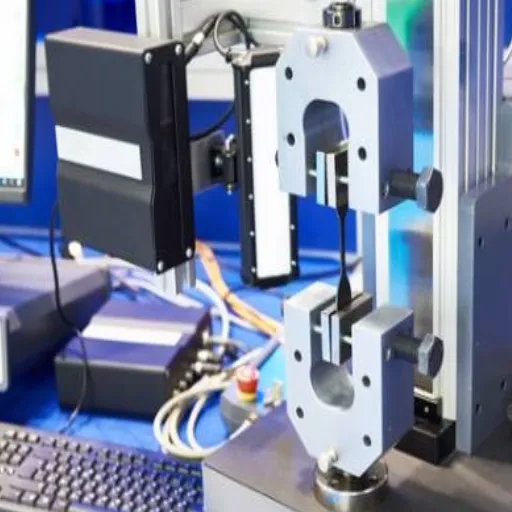
The same material can require different tests depending on the industry. A metal bolt for construction is tested differently from a metal fastener for aerospace.
Automotive
Automotive suppliers test airbags, seatbelts, dashboard materials, seals, engine mounts, and structural components. The shift to electric vehicles has increased demand for battery module testing, composite validation, and lightweight material characterization. A reliable test program reduces warranty claims and supports faster supplier qualification.
Aerospace
Aerospace demands the highest level of traceability. Components must survive extreme temperatures, vibration, and cyclic loading. Fatigue testing, impact testing, and high-temperature tensile testing are common. Compliance with NADCAP, ASTM, and ISO standards is usually mandatory.
Construction
Construction labs focus on concrete compression, steel rebar tensile testing, soil compaction, and masonry testing. These tests verify that materials meet project specifications and local building codes. Portable hardness testers and rebound hammers are also common on job sites.
Electronics and Medical Devices
Electronics manufacturers test solder joints, connectors, PCB materials, and enclosures for drop, vibration, and peel resistance. Medical device makers focus on material biocompatibility, fatigue life of implants, and packaging integrity. Small-load UTMs and specialized fixtures dominate these labs.
General Manufacturing
For most manufacturers, mechanical testing supports incoming inspection, in-process control, and final inspection. It confirms that raw materials match certificates and that finished products meet customer specs before shipment.
How to Choose Mechanical Testing Equipment
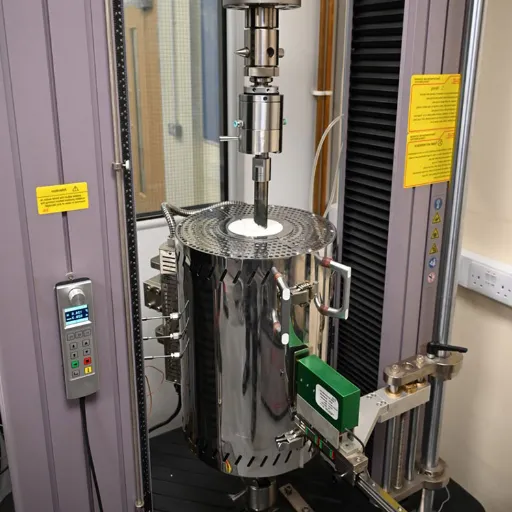
Buying the wrong machine is expensive. It wastes capital, slows quality checks, and can produce data that does not match your customers’ requirements. Follow these seven steps to make a better decision.
1. Define your test type and standards. Start with the specification you need to meet. If your customer requires ASTM D638 tensile data, you need a tensile tester with the right grips and extensometer. If you need ISO 604 compression data, a compression frame is required. Standards drive almost every other decision.
2. Match load capacity and accuracy. Choose a load cell that covers your expected maximum force but is sensitive enough at the low end. A machine rated for 100 kN will not give accurate results on a 50 N test. Accuracy is usually expressed as a percentage of reading or full scale. Look for Class 1 or better per ISO 7500-1 or ASTM E4 for most quality work.
3. Select grips, fixtures, and extensometers. The frame is only half the system. Wedge grips, pneumatic grips, compression platens, bend fixtures, and extensometers must match your specimen geometry. ADMET’s UTM buying guide emphasizes that the wrong grip can ruin test repeatability.
4. Evaluate software and data output. Modern machines include control software that sets test parameters, captures data, and generates stress-strain curves. Check whether the software exports data in formats your quality system accepts and whether it supports the calculations required by your standards.
5. Consider environmental conditions. Some materials must be tested at temperature extremes. If you test polymers, composites, or metals for aerospace or automotive use, you may need a thermal chamber or environmental cabinet.
6. Balance purchase price against total cost of ownership. A low-priced machine can become expensive if calibration, spare parts, and service support are hard to find. Ask about warranty length, calibration cost, local service availability, and lead time for consumables.
7. Verify supplier support and documentation. Request manuals, training options, and certificate samples before purchase. If the supplier cannot provide clear English documentation or traceable calibration certificates, that is a warning sign.
When Linh, a procurement manager in Vietnam, sourced a UTM for her electronics factory in early 2025, she started with the lowest quote. Then she discovered the supplier had no local service agent and could not provide ISO 17025 calibration. She switched to a manufacturer with regional support. The upfront cost was 15% higher, but her total cost over three years dropped by 25% because calibration and repairs no longer required overseas visits.
Sourcing Mechanical Testing Equipment from China
China has become one of the world’s largest production bases for mechanical testing equipment. Regions such as Dongguan, Jinan, Shenzhen, and Suzhou host hundreds of manufacturers producing UTMs, tensile testers, compression machines, hardness testers, and impact testers.
The advantages are familiar to anyone sourcing from China: competitive pricing, scalable production, and wide product variety. According to market listings on Made-in-China, universal tensile testing machines typically range from USD 2,300 to 15,000 per set, compression machines from USD 1,000 to 10,000, and impact testers around USD 2,500 to 3,000. Many suppliers offer MOQs of one set and lead times around 15 workdays for standard models.
However, not all suppliers deliver the same quality. Here is how to evaluate them:
- Verify ISO 9001 certification. A quality management system certificate is the minimum baseline. Ask for the certificate number and verify it with the issuing body.
- Check standards compliance. Confirm the machine meets ASTM, ISO, EN, or GB standards relevant to your market. Request a test certificate for a sample machine.
- Request a virtual or physical factory audit. Ask to see the production floor, calibration lab, and testing area. Real manufacturers will agree.
- Review export history. Ask for references from buyers in your region, especially if you need after-sales support.
- Confirm warranty and spare parts. A one-year warranty is standard. Ask how long spare parts remain available and how much common replacements cost.
- Test before committing. Order a sample or send your own material for testing. A reputable supplier will provide a test report and video.
If you are building a quality-control program and need guidance on sourcing, contact us for a free consultation. We can help you match the right testing approach to your product and supply chain.
Standards and Compliance to Know
Mechanical testing is only valuable if the method is recognized. Buyers should understand three layers of standards.
Test method standards define how the test is performed. ASTM standards dominate North America. ISO and EN standards are common in Europe and many international markets. GB standards apply in China. The same material tested under ASTM and ISO methods may give slightly different results, so always align with your customer’s required standard.
Machine verification standards ensure the equipment itself is accurate. ISO 7500-1 and ASTM E4 cover calibration and verification of static uniaxial testing machines. Regular calibration is essential for traceability.
Market-specific compliance affects whether you can sell the tested product. CE marking is required for the EU. UL or ETL certification is often required for electrical safety in North America. If you export finished goods, your testing documentation should support the compliance claims you make in the destination market.
Conclusion
Mechanical testing equipment is not just a capital expense. It is a quality-control investment that protects your reputation, reduces returns, and helps you win customer trust. The right machine depends on your material, your standards, your throughput, and your long-term support needs.
Start by defining the test method and standard. Then match load capacity, fixtures, software, and supplier support to that requirement. If you source from China, verify certifications, audit the factory, and test before you commit.
A well-chosen testing program gives you data you can act on. It turns “we think the material is good” into “we can prove the material meets specification.” That proof is what separates reliable suppliers from risky ones.
If you are ready to strengthen your quality control or source test and measurement tools from a verified manufacturing partner, contact us today. Shanghai Oushike Hardware Tools Co., Ltd. offers factory-direct pricing, flexible sourcing support, and practical guidance to help you build a testing program that fits your business. For a broader view of instrument categories, see our guide to the types of test and measurement tools and our framework for how to choose test and measurement tools.