
Bolt vs Screw: What’s the Difference and When to Use Each
A bolt passes through the parts it joins and is tightened with a nut. A screw threads into the material itself, or into a pre-tapped hole, and is tightened by turning its head. That difference in how the clamping force is applied settles almost every bolt vs screw question you will face on a production line or a job site.
Here is where it gets confusing. The same physical fastener can be sold as a “lag bolt” in one catalog and a “lag screw” in the next. Your supplier ships “hex bolts” that an engineer calls “hex cap screws.” None of them are wrong, and that is exactly why so many buyers and assemblers pick the wrong part.
This guide gives you the one rule that settles the difference, a comparison table you can scan in ten seconds, the strength grades behind the choice, and a worked M6 example with the exact tools each fastener needs. If you source fasteners for a product line, the final section covers what to stock and how to buy it factory-direct.
Key Takeaways
- A bolt is tightened by turning a nut and relies on the nut’s threads; a screw is tightened by its head and relies on threads in the material or a tapped hole.
- The difference is functional, not visual. Length, head shape, and drive type do not decide whether a fastener is a bolt or a screw.
- Common names are misleading: a lag bolt is technically a screw, and a machine screw is technically a bolt in the ISO sense.
- Bolts carry higher shear and tensile loads because their clamp force passes through a nut and washer, not through the parent material.
- For a single size, the distinction is concrete: an M6 hex bolt takes a 10 mm wrench and a nut, while an M6 socket head cap screw takes a 5 mm Allen key and threads into the part.
What Is the Difference Between a Bolt and a Screw?
A bolt is an externally threaded fastener that passes through the parts being joined and is tightened by turning a nut. A screw is an externally threaded fastener that mates with a pre-tapped hole or cuts its own threads in the material, and is tightened by turning its head. The difference is how the fastener is used, not how it looks.
That definition comes from Machinery’s Handbook, and it is the one Wikipedia’s bolt entry and most engineering references build on.
Bolt vs Screw at a Glance
| Feature | Bolt | Screw |
|---|---|---|
| How it is tightened | By turning the nut | By turning the head |
| What holds it in | Nut’s threads | Threads in the material or a tapped hole |
| Nut required? | Yes, or a threaded hole | No |
| Typical length | Longer than the joint, protrudes for the nut | Sits within the joint |
| Threading | Often partially threaded with an unthreaded shank | Usually threaded along the full length |
| End shape | Flat or blunt | Often tapered or pointed, but not always |
| Drive type | Commonly hex, external (wrench or socket) | Wide variety: Phillips, Torx, slot, internal hex, and hex head |
| Load path | Through nut and washer | Through the parent material |
| Best for | Structural, load-bearing, serviceable joints | Light to medium duty, fast assembly |
If you are working in metric sizes, the same logic applies across the whole range. Our metric screw sizes guide maps M2 through M24 so you can match a diameter and pitch to the joint before you choose the head.
What Is a Bolt and What Is a Screw?
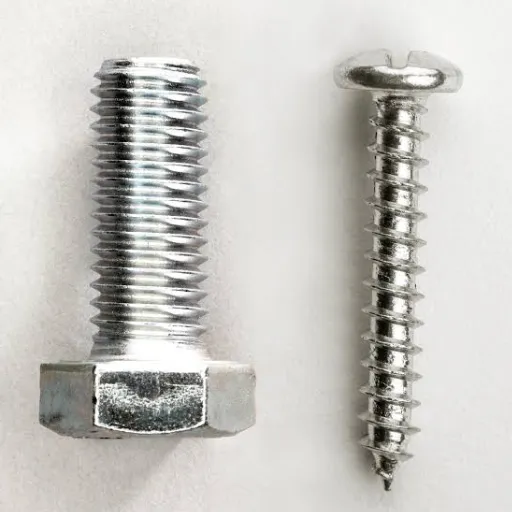
The bolt vs screw question is easier to answer once you look at each fastener on its own terms, so start with what each one does.
What Is a Bolt?
A bolt is a headed fastener with machine threads, designed to be inserted through a hole and secured with a nut. The hole in the joined parts is normally unthreaded and slightly larger than the bolt’s threads, so the bolt slides through without biting into the material.
The clamping force comes from the nut. As you torque the nut, it pulls the bolt’s threads and compresses the parts together. A washer spreads that load over a wider area and protects the surface. This is why a nut-and-bolt joint can be tightened, loosened, and re-tightened without damaging the parts, which matters for equipment that gets serviced.
What Is a Screw?
A screw is a headed fastener that holds by threading into the material itself or into a pre-formed internal thread. A wood screw cuts its own path through timber. A machine screw matches a tapped hole. A self-tapping screw forms threads in sheet metal or plastic as it goes in.
Because the screw depends on the material’s threads rather than a nut, its holding strength is capped by that material. Drive a screw into drywall with no stud behind it and it will pull straight out, no matter how much torque you apply.
The Rule That Settles the Bolt vs Screw Debate
Strip away the naming confusion and one rule does most of the work: external wrenching means bolt, head-driven means screw.
- Bolt: you tighten it by turning a separate nut, usually with a wrench or socket on both the head and the nut.
- Screw: you tighten it by turning its own head, with a screwdriver, bit, or Allen key.
Engineering catalogs describe this as external versus internal wrenching, and it is the cleanest way to classify a fastener when the name on the box is unreliable.
Now apply the rule to the names that trip people up.
Lag bolt vs lag screw
A lag bolt and a lag screw are the same fastener, and technically it is a screw. A lag screw has coarse wood threads and a gimlet point, so it cuts its own thread in timber and does not need a nut. It is driven with a wrench or socket on its hex head, which is why the trade calls it a “bolt,” but there is no nut doing the holding. Call it either name in conversation, and understand that you are buying a screw.
Why a machine screw is technically a bolt
A machine screw has machine threads and mates with a nut or a tapped hole. Under the ISO framing, that makes it a bolt, even though the name says screw, because it is not forming its own threads in the material. This is the case where trade language and engineering language drift furthest apart.
Hex cap screw vs hex bolt
In general trade use, “hex bolt” and “hex cap screw” describe the same hex-head, machine-threaded fastener. In inch standards, Bolt Depot’s fastener basics and ASME B18.2.1 draw a finer line based on small geometry differences under the head. For sourcing purposes, treat them as one product family, and specify the standard, diameter, pitch, length, and grade rather than relying on the name.
Tap bolt, carriage bolt, and set screw
- Tap bolt: a fully threaded hex bolt, driven into a tapped hole.
- Carriage bolt: passes through both parts and is held by a nut, with a square neck that bites in to stop rotation. A bolt.
- Set screw: headless, threads into the part it locks. A screw.
What does not decide it
Four popular shortcuts are wrong, and they cause real purchasing errors:
- Size. A large fastener is not automatically a bolt.
- Head shape. Hex heads appear on both bolts and screws.
- Drive tool. Using a wrench does not make something a bolt.
- A pointed tip. Many screws have flat ends, and thread-cutting bolts exist.
Trade guidance agrees on the four points above, which is why publications like Family Handyman tell readers to classify by how the fastener is used rather than how it looks.
When Marcus, a maintenance engineer at a packaging plant in Ohio, replaced a failed M8 socket head cap screw with the “same size” bolt from the parts room, he was not wrong about the diameter. He was wrong about the load path.
The tapped hole in the aluminum housing could not carry the clamp force his wrench applied, and the threads stripped within a week. The fix was not a bigger fastener. It was the right fastener for the joint.
Bolt vs Screw Strength: Why Bolts Hold More
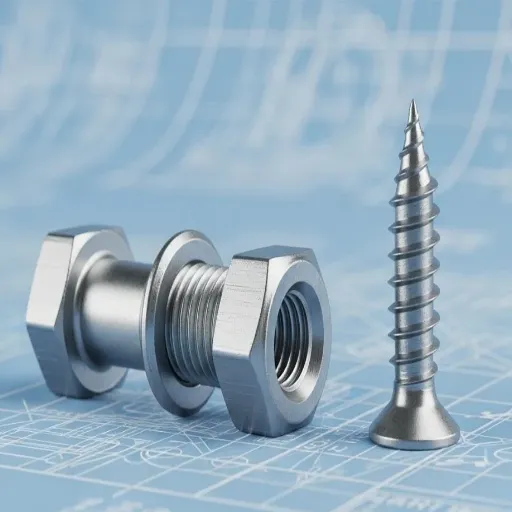
Bolts and screws fail differently, and the reason comes down to where the load travels.
A bolt’s clamp load runs through the nut and a washer, spreading force across a wide, strong contact area. That path handles high tensile loads, the force trying to pull the joint apart, and high shear loads, the force trying to slide the parts sideways. A screw’s load runs through threads cut into the parent material. It resists pull-out well, but it is a weak point in shear, and its ceiling is set by the material it sits in.
Strength is also a number, not an adjective. Steel fasteners are graded by property class under ISO 898-1: 8.8, 10.9, and 12.9, where higher numbers mean higher tensile strength. Stainless fasteners use ISO 3506 classes such as A2-70 and A4-80. Inch fasteners use SAE J429 grades 2, 5, and 8. You can verify the full standard on the ISO 898-1 page.
Two rules follow from this for anyone specifying fasteners:
- Match the grade to the load, not just the diameter. A class 8.8 bolt is not a substitute for a 12.9 in a high-stress joint.
- Never state that bolts are “always stronger.” A large, low-grade screw in dense hardwood can outperform a small, low-grade bolt in soft material. The grade and the joint decide.
Bolt vs Screw in Practice: The M6 Example
Abstract definitions are easy to nod along to and hard to apply. So let us make it concrete with one of the most common sizes in the world, M6.
The m6 bolt vs screw decision is where the definition stops being academic, because the two fasteners look nearly identical on a bench and behave very differently in a joint.
| M6 hex bolt (DIN 933) | M6 socket head cap screw (DIN 912) | M6 machine screw | |
|---|---|---|---|
| Drive | External, 10 mm wrench or socket | Internal, 5 mm Allen key | Internal bit, hex or Phillips |
| Nut required? | Yes | No, threads into a tapped hole | Yes, or a tapped hole |
| Typical use | Brackets, frames, structural joints | Machine guards, tooling, fixtures | Panels, light assemblies |
| Common class | 8.8 or 10.9 | 12.9 | 4.8 or A2-70 |
| Removal | Easy, both sides accessible | Access from one side only | Easy |
The pattern holds across the whole M-series. The diameters and pitches are covered in our M6 screw size pillar, and the socket cap family has its own breakdown in our M6 socket head cap screw guide.
If you are switching between systems, our M6 vs 1/4 comparison explains why 6 mm and 1/4 inch are not interchangeable even though the two are close in diameter.
Notice the tool consequence. Choose the bolt and you need a 10 mm wrench and clear access to both sides. Choose the socket cap screw and a single 5 mm Allen key does the job from the front. That is a real cost difference on an assembly line.
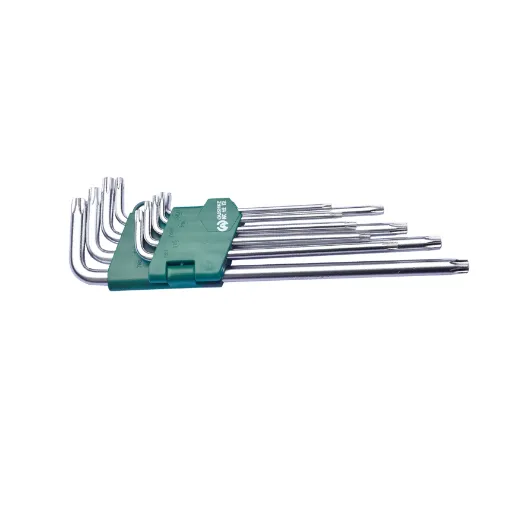
Want the full tool mapping for every metric size in one place? Our Allen wrench sizes chart pairs each socket screw size with its key, and a complete wrench set covers the external side of the job.
Which Should You Use? A Decision Guide
Work through these questions in order. Component suppliers frame the same trade-off as a set of application questions, and Essentra Components uses a similar structure built around assembly and serviceability.
1. Do you have access to both sides of the joint?
If no, you need a screw that threads into a tapped hole or the material itself. A bolt needs a nut, and a nut needs a hand.
2. Will the joint be taken apart again?
Bolted joints are designed for service. If a machine gets maintained or adjusted, a bolt and nut disassemble cleanly. Repeatedly driving screws into the same hole wears the threads out.
3. How heavy is the load?
Structural, load-bearing, or safety-critical joints call for bolts in a suitable grade. Light housings, panels, and furniture are screw territory.
4. What are you fastening into?
Timber takes lag screws and wood screws. Sheet metal takes self-tapping screws. Concrete and steel structure take bolts, often with anchors or nuts.
5. How fast does the line need to run?
Screws win on speed. One tool, one part, no loose nut to drop. If cycle time drives your cost, that matters.
Sourcing Bolts and Screws for Your Product Line
For distributors and brand owners, the bolt vs screw decision does not end at the drawing. It shapes your catalog, your stock ratio, and your margin.
Here is what separates a fastener line that sells from one that sits in the warehouse. Stock bolts and screws in matched pairs where the application demands it, keep the common metric sizes deep, and keep the tool side of the line in step with the fastener side.
A customer who buys M6 socket cap screws needs 5 mm Allen keys. A customer who buys hex bolts needs wrenches and sockets. Sell the system, not the part.
Priya, who runs a distribution business supplying maintenance contractors across the Gulf region, rebuilt her catalog around that idea in 2025. She had been stocking fasteners and tools from three different suppliers, which meant three lead times, three quality levels, and three sets of paperwork. Consolidating onto one factory-direct source cut her admin load and let her offer a consistent grade across the whole range.
That consolidation is the practical argument for sourcing from a manufacturer rather than an intermediary. Shanghai Oushike Hardware Tools Co., Ltd. produces both fasteners and the hand tools that drive them, which means one quality system, one lead time, and one point of contact.
Our OEM and private label service covers custom head markings, packaging, and branding, and our engineering team handles tool specifications to match.
If you are importing a fastener and tool line for the first time, our guide to importing hand tools walks through documentation, inspection, and logistics before you place a first order.
Bolt vs Screw FAQ
What is the difference between a bolt and a screw?
A bolt is tightened by turning a nut and holds through the nut’s threads. A screw is tightened by its head and holds through threads in the material or a tapped hole. The difference is how the fastener is used, not its size or appearance.
Is a hex bolt a screw?
In general trade use, no. A hex bolt is a hex-head, machine-threaded fastener used with a nut or in a tapped hole. In inch standards, “hex cap screw” is the more precise term, and both names describe the same product family.
When should you use a bolt instead of a screw?
Use a bolt when the joint carries heavy or structural loads, when you need to disassemble it later, or when the material cannot hold threads on its own. Use a screw for lighter loads, faster assembly, and joints with access from one side only.
Why are bolts stronger than screws?
A bolt’s clamp load passes through a nut and washer, spreading force across a large, strong area. A screw’s load passes through threads cut in the parent material, so its strength is limited by that material. Grade and diameter still matter more than the category.
Is a lag bolt a screw or a bolt?
Technically a screw. A lag screw cuts its own threads into timber and needs no nut, which makes it a screw by definition. The trade calls it a lag bolt because it has a hex head driven with a wrench.
Does a bolt need a nut?
A bolt needs either a nut or a tapped hole to develop clamp load. Without one of those, it is just a threaded pin and cannot hold the joint together.
What is the difference between a bolt and a machine screw?
The bolt vs machine screw question comes down to function. A machine screw mates with a nut or a tapped hole, which is the same job a bolt does, so engineered references often classify it as a bolt. The name “screw” persists because of the head drive and trade convention, and functionally there is very little difference between the two.
Conclusion
The bolt vs screw question has one clean answer: a bolt is held by a nut, and a screw is held by the material. Everything else, the names, the head shapes, the pointed tips, is trade convention layered on top of that rule.
Keep three points in mind. First, classify by function, not appearance, and you will stop misreading catalog names. Second, check the grade. Class 8.8, 10.9, and 12.9 tell you far more about whether a fastener will hold than the word on the box. Third, match the fastener to the material and the access you actually have, especially on metric sizes like M6 where a 6 mm bolt and a 1/4 inch screw are close enough in diameter to look interchangeable and far enough apart to fail.
For a distributor, this knowledge turns into a better catalog: the right fasteners, the right grades, and the screwdrivers and wrenches to go with them, all from one factory-direct source.
Ready to build or expand a fastener and fastening-tool line? Contact our team for a catalog, a quote, or an OEM and private label discussion. We will help you match the specification to the application before you place the order.