
Pry Bar Manufacturer: How to Source Quality Pry Bars
The cheapest pry bar quote you receive will look identical to the best one on a price sheet, because a price sheet cannot show you a heat-treatment curve. Two suppliers can quote the same forged bar at 1,000 pieces, print the same “45 HRC” on the spec line, and ship two completely different tools. One bends and returns. The other takes a permanent set on the first cold morning of a demolition job.
Sourcing a pry bar manufacturer is not a price comparison. It’s a decision about which factory you trust with a process you will never see.
This guide walks through how a pry bar manufacturer actually forges and heat-treats a bar. It shows how to tell a real factory from a trading company, which quality control numbers to write into your RFQ, and what MOQ and lead times are realistic in 2026. It ends with how to put your own brand on a custom-length, custom-finish bar. It’s written from the factory side, by a team that forges forged hand tools. If you want the full product taxonomy first, start with our best pry bar guide, then come back here for the sourcing layer.
Key Takeaways
- A pry bar manufacturer controls the forging line and the heat treatment. A trading company does neither, which is why it cannot answer a batch-hardness claim.
- The industry quality band is 45–52 HRC at the surface with a tougher 35–40 HRC core. Below 45 HRC the tip dulls and the bar bends; above 52 HRC it chips or snaps.
- Demand four pieces of evidence: material test reports (MTRs) traceable to heat lots, in-house hardness data, a 150 lb handle pull test, and AQL 2.5 / 4.0 pre-shipment sampling.
- Realistic MOQ starts around 1,000–1,200 pieces for plain standard SKUs and rises to 1,200–2,000 sets once you add logo and custom packaging.
- Export prices for forged wrecking and crow bars ran roughly US$1.44–1.53 per piece at 1,200–9,600 pieces in 2026 listings, against retail equivalents near US$17.59.
What Does a Pry Bar Manufacturer Do?
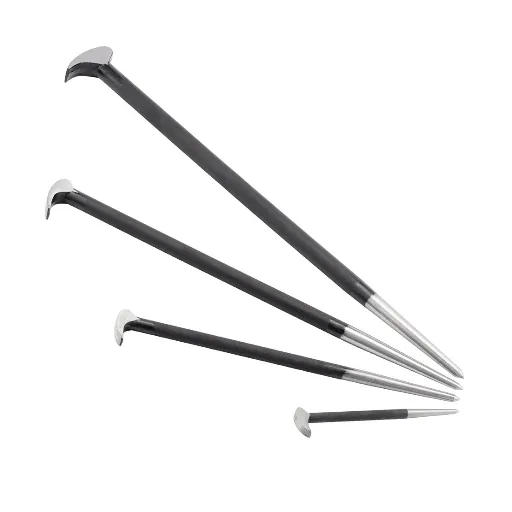
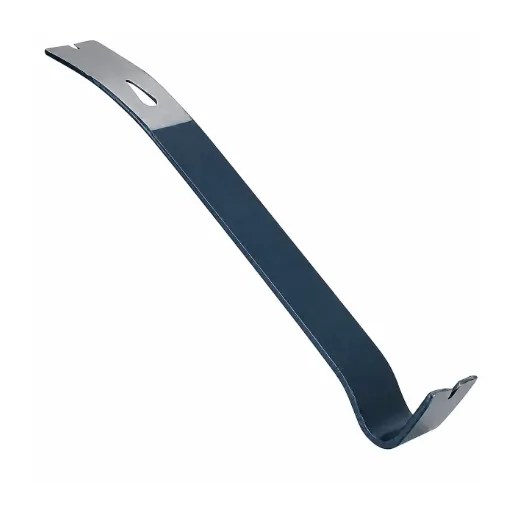
A pry bar manufacturer forges steel bars, including flat and wonder bars, wrecking and gooseneck bars, crowbars, pinch bars and nail pullers, from bar stock. The factory shapes them in dies, heat-treats the working ends for hardness, then finishes and marks them to a standard. A factory controls forging, heat treatment and QC. A trading company only resells someone else’s output.
That distinction matters more in this category than in almost any other. Hardness consistency is a heat-treatment outcome, and heat treatment happens inside the factory. When a container of bars arrives with bent shafts, the question is which furnace setting drifted, which quench bath was too warm, and which operator skipped the temper. A trader cannot answer that. A trader can only forward your complaint.
Pry Bar Manufacturer vs Trading Company: Which Are You Buying From?
The marketplaces blend the two deliberately. The same salesperson may front three factory names, and the certificate you are shown often belongs to a factory the seller does not operate. Use this table as a filter before you discuss price.
| Direct manufacturer / factory | Trading company | |
|---|---|---|
| Owns the forging line | Yes: in-house dies, hammers or presses, trimming presses | No |
| Controls heat treatment | Yes: furnace, quench, temper, hardness verification | No, inherited from a supplier |
| Can answer a batch-hardness or bent-shaft claim | Yes, with process records | Rarely |
| Custom forging dies or new profiles | Possible, with tooling lead time and cost | No |
| Certification evidence | Factory-level ISO 9001, social audits, in-house lab data | Certificate often belongs to the upstream factory |
| Price level | Factory-direct, one margin | Factory price plus trader margin |
| Product focus | Narrow and deep: bars, striking tools, adjacent forged lines | Wide and shallow across unrelated categories |
| Accountability endpoint | The factory itself | A third party |
How to check, in four steps. First, ask for a live, unrehearsed video walkthrough of the forging shop on a call you schedule, not a pre-recorded clip. Second, ask which in-house hardness-testing equipment they run and for a sample hardness report. Third, take the 18-digit Unified Social Credit Code off the business license and check it against China’s official disclosure system, then confirm the license name, the invoicing entity and the receiving bank account all match. Fourth, watch for the tell: one sales front listing several unrelated factory names.
We’re a factory-direct tools manufacturer based in Shanghai, and the checks above are the same ones we expect a serious buyer to run on us. You can read more about our facility and history on the about page.
Want to see what a verified factory quote looks like? Send us your target bar type, length and order quantity, and we will return a factory-direct price with the QC evidence attached. Request a bulk quote →
How a Pry Bar Is Forged and Heat Treated
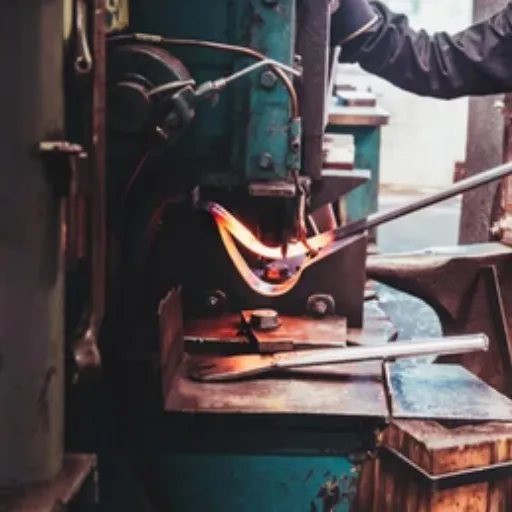
A typical forging sequence runs like this, and it is worth memorising because it gives you the vocabulary to interrogate any supplier.
Bar stock is sheared into billets, heated, then broken down and shaped through drop-hammer passes. The flash is trimmed in a press, the bar is finish-forged, stamped with size and branding, slow-cooled, shot-blasted, and finally heat-treated. Artisan forges publish similar sequences; Svedbro Smide, for example, describes hand-forging near 1,200 °C and hardening by heating to roughly 860 °C and quenching in cold water, followed by tumbling and hardness verification. Treat those temperatures as one manufacturer’s process, not a universal standard, but the shape of the sequence is universal.
Hardening works in two steps that buyers often conflate. The quench locks in hardness. The temper that follows deliberately trades a little of that hardness back for toughness.
Skip the temper, or rush it, and you get a bar that is hard but brittle. Over-temper it and you get a bar that is tough but soft.
One-piece drop forging is the quality marker. A forged bar shows grain flow that follows the tool’s shape and smooth tapered transitions between sections. A bar stamped from flat sheet shows abrupt thickness changes, and any welded joint is a failure point waiting for a cold morning. That’s why “one-piece forging, no welds” belongs in your spec line, and why the deeper materials science sits in our pry bar material guide.
What Steel and Hardness Should You Specify?
You don’t need to be a metallurgist, but you do need one line in your RFQ that a factory cannot fudge. Here is the specification table worth copying.
| Parameter | Common values | Why you care |
|---|---|---|
| Steel grades | 45# carbon, 65Mn, high-carbon (0.60–1.00% C), Cr-Mo 4140/4340, Mn-V tool steel, manganese (11–14% Mn) | Drives cost and the achievable hardness-to-toughness balance |
| Construction | One-piece drop forging, no welds | The weld is the failure point |
| Target hardness | 45–52 HRC surface, roughly 35–40 HRC core | The band where a bar resists bending without becoming brittle |
| Selective hardening | Working ends only: e.g. 25–36 HRC shaft with 45–53 HRC at the nails | A partially hardened bar is more forgiving; a fully hardened bar is stiffer |
| Finish | Powder coat, black oxide, painted, galvanised, plating | The most visible QC tell and the most common complaint source |
| Test reference | ANSI/ASME hand tool performance standards; ASME B107.52 is the market reference for pry bars | Gives you a standard to write into the RFQ |
The 45–52 HRC band is not arbitrary. Editorial analysis of pry bar quality places the failure modes squarely on either side. Below 45 HRC the tip rolls over and the bar takes a set. Above 52 HRC the steel chips or snaps instead of yielding. A bar that bends slowly is telling you the process ran hot. A bar that breaks unexpectedly is telling you it ran brittle.
Manganese steel deserves one sentence of its own: in the 11–14% range it work-hardens, meaning the surface gets harder under impact. That’s why it holds up under heavy prying. For the full comparison of grades and forging methods, see the pry bar material guide.
Your RFQ spec line: “One-piece drop-forged pry bar, no welds, 65Mn or equivalent, hardness 45–52 HRC at working ends, surface finish black oxide or powder coat, marked per approved proof. MTRs and hardness report required with shipment. ANSI/ASME hand tool performance standards apply.”
How to Verify a Pry Bar Factory: Buyer’s Checklist
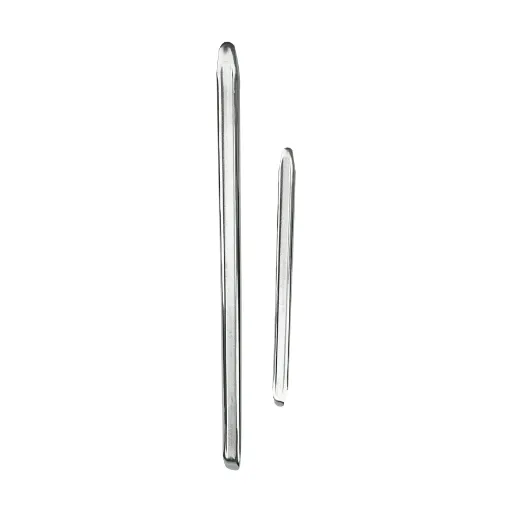
Certification logos are marketing. Certification numbers are evidence. Ask for the number and verify it against the issuing body’s register.
- ISO 9001 is the baseline quality-management certificate. Request the number and certificate scope, not the JPG.
- ISO 14001 for environmental management, BSCI or SEDEX for social compliance where your market or retail customer requires it.
- GS and CE where the destination market demands them, plus RoHS and REACH declarations for coating and material compliance.
- MTRs traceable to specific heat lots, so a shipment can be tied back to the steel it was made from.
- Third-party inspection badges (SGS, TÜV, Bureau Veritas) are stronger than a paid marketplace supplier tier, because an auditor physically visited the line.
Red flags. Watch for these warning signs:
- The supplier cannot produce certificate numbers, or offers only a single-sample inspection report.
- The factory refuses a live walkthrough.
- One sales front spans unrelated product categories.
- The price sits far below material plus process reality.
- The business license, the invoicing entity and the receiving account do not match.
- The seller insists on full prepayment to a personal account.
The sample-first rule. Order samples from two or three shortlisted factories, measure the actual hardness at the working ends, flex the bar and watch whether it returns, and ask explicitly whether the sample cost is credited against your bulk order. A factory confident in its heat treatment will credit it.
Pry Bar Quality Control: The Numbers to Demand
A serious buyer-side inspection standard tracks the bar from incoming steel to packed carton. These are the gates to demand, and the reference figures to hold a supplier to.
| QC gate | What is checked | Reference figure |
|---|---|---|
| Incoming material | Steel grade verification, MTRs traceable to heat lots, bar-stock dimensions | MTRs on request |
| In-process | Forging temperature, die condition, flash removal, straightness, bend angle, tip geometry | Per drawing |
| Heat treatment | Hardness at working ends and shaft, quench and temper records, spot checks for uneven hardness | 45–52 HRC surface |
| Handle / grip | Bond integrity, pull test, flex test | 150 lb pull; 500 flex cycles |
| Marking | CE, RoHS, brand logo and size engraving match the approved proof | Per proof |
| Packaging | Double-wall corrugated, moisture barrier, label accuracy | Per carton spec |
| Pre-shipment | Two-gate inspection: factory check at roughly 100% produced / 80% packed, then a spot re-check at the consolidation warehouse | AQL 2.5 major / 4.0 minor |
AQL 2.5 covers major defects such as bent shafts, loose grips and misaligned nail notches. AQL 4.0 covers minors such as light coating scratches. Write in that failed lots are sorted 100% at the factory’s cost, not discounted and shipped.
The two-gate structure exists for a practical reason: damage and substitution can happen after the factory gate, during inland transit or at the consolidation warehouse. If your order consolidates from more than one supplier, insist on it.
Three visual tells you can use on incoming goods, no lab required. Discoloration patches on the shaft suggest uneven heating or a rushed quench. A tip that rolls over instead of holding an edge means under-hardness. A bar that takes a permanent set after a moderate flex means the temper was wrong or absent. Any of the three justifies a full-lot claim.
Ready to test the difference? Ask us for sample pry bars with the hardness report attached, then compare them against your current supplier under the same load. Request samples →
MOQ, Lead Times and Pricing for Pry Bars
Pry bar MOQ scales with how far your order departs from a stock SKU. If you only change the logo and the carton, you pay a small uplift. If you change the die, you pay for the die.
| Order type | Typical MOQ | Typical lead time | Price direction |
|---|---|---|---|
| Stock standard SKU, plain | ~1,000–1,200 pcs | Days from stock; ~15–30 days to order | Baseline, lowest |
| Standard SKU with custom logo and packaging | ~1,200–2,000 sets | ~25–40 days | Small uplift |
| Custom length, cross-section or finish colour | Often 2,000 pcs+ per size | ~30–45 days | Moderate uplift; tooling may apply |
| Custom die or new tip geometry | Highest, with tooling amortisation | ~45 days and up, including tooling | Highest; agree tooling cost and ownership in writing |
| Trial / sample order | Sample quantities of standard SKUs | ~7–15 days | Sample cost; ask if it credits against bulk |
For market context: 2026 marketplace listings placed forged wrecking and crow bar export prices around US$1.44–1.53 per piece at 1,200–9,600 pieces, with lows near US$0.90–1.20 on 65Mn mini and flat bars and 1,000-piece railway crowbars at US$1.00–1.10. Retail equivalents listed by suppliers run to roughly US$17.59, which is where the category’s distributor margin comes from. Treat every figure as a dated reference range, not a quote.
Compare total landed cost, not unit price. Unit price plus freight plus duty plus expected rework and returns is the number that decides whether an order made money. A supplier quoting ten cents higher but shipping 99% conforming bars usually wins.
Payment and terms. A 30% T/T deposit with the balance before shipment is common; letters of credit suit larger orders. On Incoterms, FOB puts the main freight in your hands, CIF lands it in your port, and DDP hands you a delivered price. Each shifts risk differently, so pick deliberately rather than by default.
Assortment planning, SKU mix and house-brand margin structure are a separate discipline. Our wholesale pry bars guide covers that side of the order.
OEM and Private Label Pry Bars: What a Factory Can Customize
“OEM available” is a slogan on most supplier pages. Here is what it actually means in specification terms, lever by lever.
| Lever | Options a real factory can hold | Notes |
|---|---|---|
| Length | Custom in mm; market practice quoted around 500–2,000 mm, imperial ladders 6″–36″ standard | Non-standard lengths usually trigger tooling or a higher MOQ |
| Cross-section | Flat, hexagonal, octagonal, round, I-beam | Drives weight, grip and resistance to rolling |
| Tip / end geometry | Pinch point, wedge point, flat chisel, V-notch claw, nail slot, cat’s-paw claw | Custom geometry means a new die |
| Bend style | Full gooseneck, part-bend, ripping, straight | |
| Steel grade | 45#, 65Mn, high-carbon, Cr-Mo, Mn-V, manganese | Drives cost and hardness ceiling |
| Finish | Powder coat, black oxide, painted, galvanised, plating, custom colour | The most cost-effective customization |
| Branding | Logo marking per approved proof by laser, stamp or print, plus size engraving | Cheap to add, high perceived value |
| Packaging | Custom carton, blister, blister-on-card, set packaging, private label | The most common OEM/ODM request |
| Sets | Custom 3-, 4- or 5-piece composition with matched finishes | Raises average order value |
The cost logic is simple. Finish colour, logo marking and packaging are cheap levers that change almost nothing in the tool and a great deal in how it sells. Custom dies and new tip geometry are expensive levers, and the tooling has to be paid for. Agree in writing who owns the tooling after the order. A die you paid for should not become leverage over you two years later.
If length is your main variable, our pry bar sizes guide maps the standard length and leverage ladders so you can decide what to stock versus what to customise. For the full private-label scope, including design support and packaging development, see our OEM and private label services.
Red Flags and Risk: Why the Lowest Quote Costs the Most
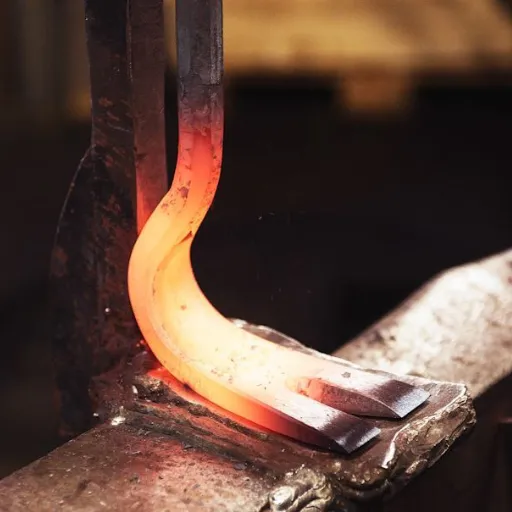
Both ends of the hardness range end in the same place: returns, warranty claims and a lost account. A soft bar bends and dulls, so the end user blames the brand. A brittle bar snaps, which is worse, because a snapped pry bar under load is an injury risk.
Mike ran a rental fleet in the Midwest and switched suppliers to save eleven cents per bar on a 4,000-piece order. The bars arrived on time and looked correct.
Six weeks later, three had snapped at the tip during routine prying, and the fleet’s safety officer pulled the entire batch. Mike spent the next quarter rebuilding trust with a contractor who had banned the brand. The eleven cents per bar saved about $440, against a reorder, a recall shipment and a lost account worth five figures a year. The cheap quote was the expensive one.
The same math applies to certificates that belong to an upstream factory. It applies to suppliers who cannot support one-off tooling, and to agents who require full-container recurring orders before they will run a custom profile. None of those is necessarily fraud. All of them shift risk onto you.
Downstream, a soft bar is also the root cause of the cheater-bar failure, where an operator slips a pipe over the handle to gain leverage and the overloaded bar breaks. The technique and safety side of that belongs in our how to use a pry bar guide.
Pry Bar Manufacturer FAQ
What does a pry bar manufacturer do?
A pry bar manufacturer forges steel bars from bar stock, shapes them in dies, heat-treats the working ends for hardness, and finishes and marks them to a standard. It controls forging, heat treatment and quality control in-house. A trading company resells a factory’s output without controlling any of those processes.
How do I find a reliable pry bar manufacturer?
Verify the business license and credit code, request a live factory walkthrough, confirm in-house hardness testing, ask for MTRs and certificate numbers, and order paid samples from two or three shortlisted factories. Check that the license name, invoicing entity and receiving account all match before you send a deposit.
What is the difference between a pry bar manufacturer and a trading company?
A manufacturer owns the forging line and the heat-treatment furnace, so it can trace and correct a batch problem. A trading company buys finished bars and resells them, so it inherits quality it cannot control and adds a margin. Hardness is a heat-treatment outcome, which is why the distinction decides your claim rights.
What is the minimum order quantity for pry bars?
Plain standard SKUs typically start around 1,000–1,200 pieces. Adding a custom logo and packaging usually pushes the MOQ to roughly 1,200–2,000 sets. Custom lengths, cross-sections or dies run higher, often 2,000 pieces and up per size, because tooling has to be amortised. Confirm the tier with each supplier.
What hardness should a quality pry bar be?
The industry quality band is 45–52 HRC at the surface with a tougher core around 35–40 HRC. Below 45 HRC the tip dulls and the bar bends under load. Above 52 HRC the steel chips or snaps instead of yielding. Some bars are hardened only at the working ends, which is more forgiving than a fully hardened shaft.
What certifications should a pry bar supplier have?
ISO 9001 is the baseline. Add ISO 14001, BSCI or SEDEX social audits, GS and CE where your market requires them, and RoHS or REACH declarations for coatings. Ask for certificate numbers and verify them against the issuing body rather than accepting a logo, and request MTRs traceable to heat lots.
Can I get pry bars made with my own logo, length and packaging?
Yes, within limits. Finish colour, logo marking and packaging are the cheapest levers. Custom length, cross-section, tip geometry and steel grade are possible but may trigger tooling and a higher MOQ. Agree tooling cost and ownership in writing before the order starts.
Are Chinese pry bar manufacturers reliable?
The reliable ones are very reliable, and the marketplaces make them hard to distinguish from resellers. Verify the license and credit code, demand a live factory walkthrough and in-house hardness data, order samples, and run pre-shipment inspection. A factory that offers all of those is a low-risk supplier; one that avoids any of them is not.
Conclusion
Sourcing pry bars comes down to five decisions. Verify the factory rather than the sales front, using the license check and the manufacturer-versus-trader table. Demand the hardness and QC numbers, from 45–52 HRC at the working ends to MTRs, the 150 lb pull test and AQL 2.5 sampling.
Then get realistic MOQ and lead-time expectations before you design your first order. Specify exactly which customization levers you are pulling and who owns the tooling. And protect the order with two-gate pre-shipment inspection.
Do those five things and the cheapest price sheet stops being the deciding document, because you will be comparing evidence rather than paper.
As a pry bar manufacturer working factory-direct, we’d rather show you the heat-treatment records than the marketing badge on the certificate. Send us your target bar type, length, finish and order quantity, and we’ll return a factory-direct quote, a spec sheet and the QC documentation that goes with it. Start with our best pry bar guide if you are still defining the product, or request your bulk quote and let us quote the order.