
Bent Nose Pliers: Types, Uses & Buying Guide
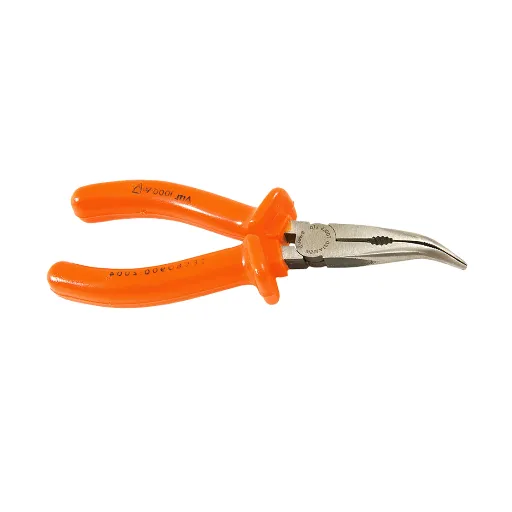
Bent nose pliers are long-nose pliers with a curved tip, typically angled 45° or 90°, built to reach into tight spaces that straight tools can’t. They give you a clear view of the workpiece, a more natural hand position, and access around obstructions, which is why mechanics, electricians, jewelers, and electronics technicians keep them in every kit.
Dan, a mechanic in Ohio, spent ten minutes fighting a straight long-nose plier against a fuel-line clamp wedged under his intake manifold. When a co-worker passed him a 90° bent nose plier, the clamp released in a single squeeze. The angle did what the force couldn’t.
If you’ve ever twisted your wrist to reach a wiring harness or craned your neck to see a jump ring, you already know why the bend matters. This guide covers what bent nose pliers are, how the angles compare, what each trade actually uses them for, and how to choose the right pair, whether you’re stocking a toolbox or planning a product line. It’s part of our broader needle nose pliers guide, and you’ll also get a straight-vs-bent comparison, quality specs to verify, and sourcing guidance for wholesale buyers.
Key Takeaways
- Bent nose pliers are long-nose pliers with a curved tip, usually 45° or 90°, that reach around obstructions and improve visibility and ergonomics.
- The 45° bend is the general-purpose default; the 90° bend is the specialist for hose clamps, spring clips, and deep recesses.
- Mechanics, electricians, jewelers, and electronics techs each use a specific angle and length, so match the tool to the trade.
- A 3-piece set (straight + 45° + 90°) covers the most jobs, and the bent and straight pairs are best kept together.
- Buy on forged steel, HRC 55-65 hardness, and clean jaw alignment; the bent tips must meet without gaps.
What Are Bent Nose Pliers?
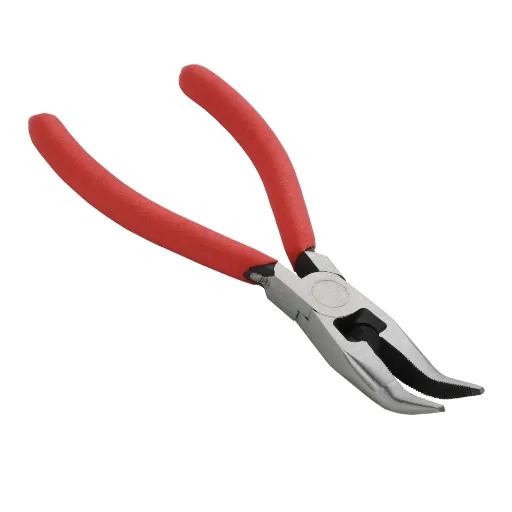
Bent nose pliers are a type of long-nose pliers with a curved or angled tip, typically set at 45° or 90° from the handle. The angle lets the tool reach into confined or obstructed spaces while keeping the user’s hand and line of sight clear of the work area.
The jaws themselves are the same long, slender, tapering design you find on needle-nose pliers. Only the tip is bent. That single change shifts the gripping point away from your hand, so you can work around fixed components instead of fighting them.
The tool goes by several names depending on the market. In jewelry work it’s usually a bent chain-nose plier. Product catalogs often list it as a bent head plier or angled plier. KNIPEX calls its version a long nose bent plier. Wikipedia simply notes that these pliers “have a curved beak,” which is why the curved tip is the defining feature across every name (source).
Types and Angles of Bent Nose Pliers
Bend angle is the main specification to understand, because it decides reach and leverage. The most common angles are 45° and 90°, but you’ll also find 25°, 70°, and 80° variants.
| Angle | Character | Leverage | Best for |
|---|---|---|---|
| 25° | Slight offset, close to straight | High | Modest clearance with minimal control trade-off |
| 45° | Moderate offset, general-purpose default | Good | Improved visibility, reaching around modest obstructions, light bending |
| 70° | Middle path | Moderate | Obstructions where 45° isn’t quite enough |
| 90° | Right-angle bend, specialist | Low | Deep confined spaces, hose clamps, spring clips, panels |
Practically, the 45° bend is the more-used, more versatile angle. It balances access with leverage for everyday work. The 90° bend is the specialist: it lines your hand up with the fastener instead of against it, which makes it unbeatable for hose clamps and spring clips, but it gives up leverage and needs more clearance behind the work.
Most manufacturers sell bent nose pliers in 3-piece sets that include straight, 45°, and 90° versions, because each angle serves a different access scenario. For a first purchase, that set is usually the smartest buy.
What Are Bent Nose Pliers Used For?
Bent nose pliers are used for gripping, bending, and repositioning small parts, wires, and fasteners in spaces that are awkward, confined, or hard to see. The bent tip keeps the handle out of the way so you can actually see what you’re working on.
Here’s how each trade uses them:
| Trade / application | Recommended angle | Length | Why |
|---|---|---|---|
| Automotive / mechanics | 45° general, 90° for clamps | 8″–11″ | Reach wiring-harness clips, fuel-line clamps, cotter pins around the block and under dashboards |
| Electrical work | 45° (VDE-insulated) | 6″–8″ | Junction boxes, panels, terminal work with hands clear of enclosure edges |
| Jewelry making | 45° (bent chain-nose) | 4.3″–6″ | Jump rings, wrapped loops, bead tips with a straight wrist |
| Electronics / ESD | 45° precision | 5″–6″ | PCB and SMD handling, component leads, often used instead of tweezers |
| General repair / DIY | 45° | 6″–8″ | Plumbing fittings, appliance internals, model building, fishing |
Automotive. A 90° bent nose plier with serrated jaws is the tool for hose clamps and spring-loaded tension clips. It reaches into engine bays where a straight tool can’t line up, and it lets you retrieve dropped screws, washers, and cotter pins without scraping your knuckles on surrounding machinery.
Electrical. Electricians use a 45° insulated bent nose plier inside junction boxes and control panels. The angle keeps the handle and the user’s hand away from the enclosure edge while they position wires into terminals. For live work, the tool must be rated for the voltage, which we cover below.
Jewelry making. The bent tip is a favorite for opening and closing jump rings because it keeps the ring opening visible while you work. A bent chain-nose plier also reduces wrist strain during long bench sessions. If you’re building a jewelry kit, our jewelry making pliers guide covers the full set of tools for the craft.
Electronics. Precision and ESD-safe bent nose pliers handle small components on populated circuit boards where a straight tip would foul neighboring parts. Electronics techs often reach for them in place of tweezers.
Bent Nose vs Straight Needle Nose Pliers
The only real difference between bent nose pliers and straight needle nose pliers is the angle of the tip. The jaws, the length, and the general construction are otherwise the same. But that difference changes which jobs each tool handles best.
A straight plier gives you better control because there’s no offset. It’s the right tool whenever you can approach the work squarely. A bent plier introduces a small handle-to-tip offset that is a control trade-off, worth it only when straight access isn’t possible. That’s the rule most professionals use: pick straight when the workspace is open, reach for the bend when it isn’t.
Many mechanics keep both, and the common advice is that they’re a pair, not a duplicate. A 45° or 90° bent plier handles the awkward angles, and the straight pair handles clean, square access. If you’re comparing the broader family of long-nose tools, our needle nose vs long nose pliers guide explains where each fits.
45° or 90°: How to Choose the Right Bend Angle
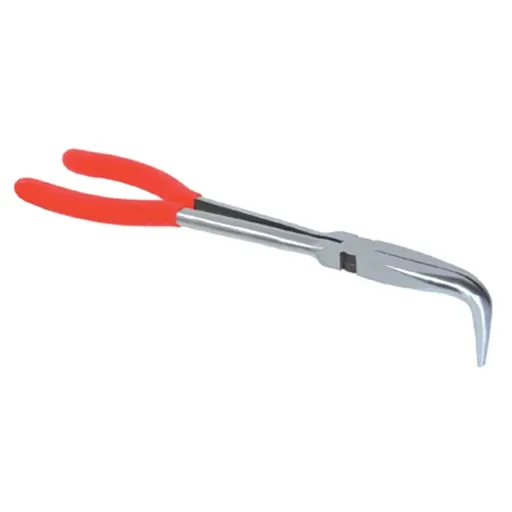
Pick the smallest angle that reaches the work. That rule alone will solve most selection problems, because a shallower bend keeps more leverage and control.
- Choose 45° for general access, improved visibility, light bending, and moderate gripping. It’s the everyday default for most trades.
- Choose 90° for hose clamps, spring clips, and deep recesses where the work is badly obstructed and a straight approach is impossible.
- Choose 70° when 45° doesn’t quite clear the obstruction and you don’t need the full right-angle reach.
- Buy a set if you work across several of these situations. The straight + 45° + 90° set is the standard combination.
A useful signal from the field: on professional tool forums, users consistently report that the 45° pair gets far more use than the 90°. One mechanic put it plainly: “When I think I need to use a 90, I try and fail, then end up using the 45s.” If you buy only one angled pair, make it 45°. If you work on clamps and deep bays, add the 90°.
Quality and Materials to Look For
A bent nose plier is only as good as its steel and its jaw alignment. Since the tip is angled, the two halves must meet cleanly with no gaps. Poor alignment is the most common defect on budget pliers, and it’s hard to fix after the fact.
Check these specs before you buy:
- Steel grade. Look for chrome vanadium (Cr-V) or high-carbon drop-forged steel. Entry-level tools use 45# carbon steel.
- Hardness. Professional pliers run around HRC 55-65. Harder jaws hold their edge and resist deformation.
- Jaw alignment. The bent tips must close flush. Test this in the store or inspect on arrival.
- Cutting edges. If the plier has an integrated side cutter, the edge should be induction-hardened, roughly 60-62 HRC.
- Joint construction. A box-joint or hot-riveted pivot stays smooth and free of lateral play.
- Jaw surface. Serrated interiors grip slippery parts; smooth interiors protect delicate materials in jewelry and electronics.
When you’re sourcing pliers in volume, these same specs are the ones to put in writing with your supplier. Our guide to verifying a pliers factory walks through the QC points that separate consistent batches from returns.
Insulated and ESD Bent Nose Pliers
Electrical work introduces a certification layer that many buyers overlook. If you’re working near live circuits, the plier should be insulated to the IEC 60900 standard, commonly marked VDE, and rated for the working voltage you’ll face.
Insulated bent nose pliers are tested at 10,000 volts in the factory and rated for 1,000 volts AC working voltage. The multi-layer, color-coded insulation covers the handles and part of the jaws. It’s not a coating you can add later, so buy the right rating up front.
For electronics, look for ESD-safe bent nose pliers with conductive handles that prevent static discharge from damaging sensitive components. Precision and ESD variants pair with the fine-tip and box-joint construction we described above.
Building an Angled-Variant Line for Wholesale Buyers
For distributors and brand owners, bent nose pliers are a useful addition to a pliers product line because they solve a problem straight tools can’t. If you’re planning an assortment, here’s the mix that sells.
- Stock the angles. Straight, 45°, and 90° cover the buying patterns we’ve described. The 45° moves the most volume; the 90° serves the clamp and deep-access niche.
- Cover the lengths. A spread across 130-250 mm (roughly 5″ to 10″) lets customers match reach to the job.
- Add the variants. Insulated (VDE/IEC 60900) and ESD-safe bent nose pliers serve electrical and electronics buyers who won’t compromise on certification.
- Decide set vs single. 3-piece sets (straight + 45° + 90°) drive higher order value and are a proven seller for both retail and tool-bag purchases.
Factory-direct sourcing makes this practical. You can order one angle and size to test the market, then scale the full range once it moves, with flexible MOQs and private-label packaging available. If you’d like a quote on an angled-plier range, contact our team with your target sizes and quantities.
Bent Nose Pliers FAQs
What are bent nose pliers used for?
Bent nose pliers are used to grip, bend, and reposition small parts, wires, and fasteners in confined or obstructed spaces. The angled tip improves visibility and keeps the user’s hand out of the way, which makes them useful for automotive clamps, electrical terminals, jewelry making, and electronics work.
What is the difference between bent nose and straight nose pliers?
Straight nose pliers have jaws in line with the handles and give better control when the workspace is open. Bent nose pliers have a tip angled at 45° to 90°, which lets them reach around obstructions and into tight spaces where a straight tool can’t align.
Are 45° or 90° bent nose pliers more useful?
For most people, 45° is more useful because it balances access with leverage and covers more everyday situations. The 90° bend is a specialist tool for hose clamps, spring clips, and deep recesses where maximum clearance is required.
What are bent chain nose pliers used for?
Bent chain nose pliers are the jewelry-making version of bent nose pliers. They open and close jump rings, form wrapped loops, and handle beads and findings while keeping the work visible and the wrist straight.
Do bent nose pliers cut wire?
Many bent nose pliers include an integrated side cutter near the pivot, letting them cut soft and medium-hard wire. The cutting capacity varies by model, so check the specification, especially on precision and ESD variants.
Conclusion
Bent nose pliers are a small addition to a toolbox that solve a big problem: reaching work a straight tool can’t. Choose 45° for general use and 90° for clamps and deep access, keep a straight pair alongside them, and buy on forged steel, HRC 55-65 hardness, and clean jaw alignment. For electrical and electronics work, add the VDE or ESD rating that the job requires. For the full rundown on the long-nose family, start with our needle nose pliers guide.
If you’re a distributor or brand owner, the same guidance applies to your product line: stock straight, 45°, and 90° across 130-250 mm, with insulated and ESD variants for specialist buyers.
Ready to build an angled-plier line at factory-direct prices? Request a quote and tell us your target sizes, angles, and quantities. Our team will help you plan an assortment that moves.