

How to Choose a Grease Fitting Manufacturer: A Buyer’s Evaluation Guide (2026)
The best grease fitting company would hold a true ISO 9001 certificate, which conforms with the SAE J534 or DIN 71412 standards. The company will be on-hand to carry out all of their pressure and thread testing in-house and will also be able to trace their materials for complete peace of mind for customers, and it’s not just about having the lowest price per piece. Most buyers get this wrong because they treat grease fittings as a commodity instead of a precision component that protects expensive machinery.
One little defective fitting may be only a few cents in cost, but it may result in thousands of dollars in the cost of equipment tied up in warranty claims, customer relations, and downtime. After changing over to the ISO-certified grease-fitting maker out of the area for Houston-based tool distributor Marcus, his warranty returns fell off by about 60 percent in a 4-week quarter. Those little ‘savings’ were being eaten away and causing margin erosion for two years.
There is a factory assessment model that is used by professional purchasing teams. You can see the relevance of certifications in various contexts, which include the manufacturer must have in real test equipment, identifying danger signals before orders, and ensuring a long-term supply relationship for the protection of your business. For a broader overview of fitting types, sizes, and applications, see our complete guide to grease gun fittings.
Key Takeaways
- The minimum baseline will be the ISO 9001:2015 standard – and original certificates, not photocopies, will be required.
- Thread-deformed fittings are stronger than thread-cut, so be sure to check the manufacturing method.
- Also, spectrometry, pressure testers, and GO/NO-GO thread gauges must be present in the legitimate grease fitting manufacturer’s factory.
- The price per piece is not the right measure of the item, rather the total cost of ownership with defect rates and delivery reliability.
- Before payment, you must verify the business license, export license, and factory video of the supplier in China.
Why Choosing the Right Grease Fitting Manufacturer Matters More Than Price
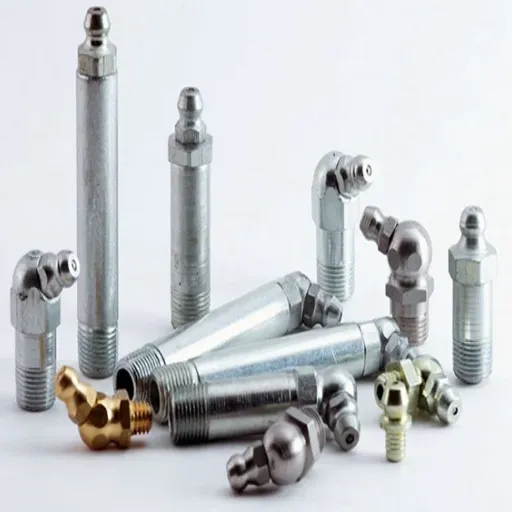
Grease fittings are small. They hide inside machinery, out of sight and out of mind. That is exactly why a failure is so expensive.
When a fitting leaks or strips under pressure, grease escapes instead of reaching the bearing or joint it was meant to protect. Friction builds. Heat builds. Components wear prematurely. In heavy industries like mining and construction, one failed fitting can shut down a machine that earns $5,000 per day. The fitting itself might cost $0.03.
Elena, a procurement manager for a construction equipment fleet in Alberta, learned this the hard way. She awarded a bulk grease fitting order to the lowest bidder from a B2B directory. Within eight months, her field teams reported 14% of the fittings were leaking at the threads or failing to hold pressure. The replacement labor alone costs 40 times the original purchase price. She resourced a certified grease fitting manufacturer with batch testing protocols. Defects fell below 0.5%, and her total cost dropped even though the unit price was 15% higher.
The real cost of a grease fitting is not the invoice line item. It is the total cost of ownership: unit price plus defect rate, warranty exposure, replacement labor, and delivery reliability. A reliable grease fitting manufacturer saves money by reducing everything except the line-item price.
Essential Certifications and Standards to Demand
A credible grease fitting manufacturer should be able to produce original certification documents on request. Not photocopies. Not translated summaries. Original certificates with verifiable registration numbers.
ISO 9001:2015 (Baseline Quality Management)
ISO 9001:2015 (Baseline Quality Management) is the minimum standard for any contractor claiming to have a quality management system. It implies that the factory is regulated, having been reported as having documented processes for production control, corrective action, and continuous improvement. But, having ISO 9001 alone doesn’t mean quality production from the factory. It means they have a system. It is still required to find out what this system actually produces.
SAE J534 (U.S. Automotive Standard)
SAE J534 is the primary North American standard for grease fittings. It regiments what will entail the thread forms of the fittings, the design of the overall dimensions, and even the materials making it up, and the performance requirements. SAE J534 compliance verification is also required if the grease fitting manufacturer involved wishes to serve American automotive and industrial markets. Demand evidence or test reports that assign one’s product with a specific accord reference, not just through nicely worded “automotive grade” claims.
DIN 71412 (European Metric Standard)
DIN 71412. This European metric standard deals with the metric grease fittings applied in Europe and additionally serves many export markets. The standard agrees on the thread profile, head dimensions, and angles toward tolerances for 0 degrees, 45 degrees, and 90 degrees in grease fittings. If the device being manufactured is meant to reach the whole world, it definitely has to go for both SAE and DIN agreements.
AS9100D (Aerospace and Defense)
For a company applying in aerospace, military, or defense, an AS9100D certification provides an advantage. The certification standard requires one to follow some steps, including validation considerations, large amounts of documentation, sampling protocol with a control structure, dimensional inspection, and full material traceability. AS9100D certified aerospace fittings reviewed by SAE Products necessitate DFAR-compliance and full lot traceability for each part. A select minority of grease fitting producers rise to that level.
RoHS and REACH (Environmental Compliance)
If your market includes the European Union, demand RoHS and REACH compliance. These rules ban certain harmful agents, such as heavy metals in plating and surface coating. For non-conformant parts, getting rejected furthers the producers’ products seized from customs, resulting in time and money losses in their export business.
| Standard | Region/Market | What It Covers | When to Demand It |
|---|---|---|---|
| ISO 9001:2015 | Global | Quality management system | Always (minimum baseline) |
| SAE J534 | North America | Thread, material, performance specs | U.S. automotive/industrial |
| DIN 71412 | Europe | Metric thread and dimension specs | European markets |
| AS9100D | Aerospace/Defense | Full traceability and testing | Aerospace, military, high-risk |
| RoHS / REACH | European Union | Hazardous substance limits | All EU-bound products |
Manufacturing Capabilities Every Professional Grease Fitting Manufacturer Must Have
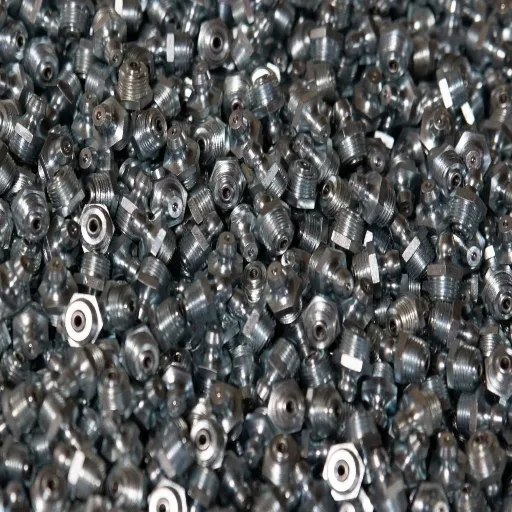
Certifications are important, but capabilities are what produce the part. A factory can hold ISO 9001 paperwork while cutting threads on outdated lathes with no testing protocol. Here is what to look for during a factory audit or capability review.
In-House Testing Equipment
As a professional grease fitting manufacturer, you must keep your testing equipment within your production facility, and you should not outsource it elsewhere, as you cannot verify it. You must have critical equipment such as:
- Optical Emission Spectrometry (OES) or XRF: Alloy composition verification. So, you are buying 304 stainless steel, and this machine tells you it actually has about 8% nickel, 18% chromium-not a cheap substitute.
- Hydraulic Pressure Test Stations: Batch testing against working pressures. High-pressure levels in industrial fittings should withstand a realistic actual WP of 10,000 + psi. Batch tests would be applied to 5,000 psi or to x WP rates by engineers.
- GO/NO-GO Thread Gauges: Valuates whether the thread meets the proper standards like ISO 724 (metric) or ASME B1.1 (imperial).
- Coordinate Measuring Machine (CMM): Checks whether there is correctness between the dimensional facts about complex or unique parts.
- Salt Spray Testing Chamber: Validation of the corrosion resistance of plated or stainless steel fittings.
When a plant can’t exhibit these tools, then it is a trader or, even more likely, a poor producer who’s not a good choice for a long-term partnership.
Thread Rolling vs. Thread Cutting
This distinction matters more than most buyers realize. Thread rolling forms threads by pressing the metal between dies, which work-hardens the surface and creates stronger, more fatigue-resistant threads. Thread cutting removes material with a tool, leaving sharp edges and a more brittle thread structure.
Rolled threads are standard for high-quality grease fittings. Cut threads are a cost shortcut. Ask your grease fitting manufacturer which process they use. If they cut threads on standard products, that is a warning sign.
The Factory Audit Checklist: 12 Questions Every Buyer Should Ask
Use this checklist during your first serious conversation with a potential grease fitting manufacturer. A professional supplier will answer every question without hesitation.
- Can you provide the original ISO 9001:2015 certificate with a verifiable registration number?
- Which thread standards do you manufacture to — SAE J534, DIN 71412, or both?
- Do you use thread rolling or thread cutting for your standard fittings?
- What in-house testing equipment do you operate? Can you show photos or a video?
- What is your typical batch pressure testing protocol and pass criteria?
- Can you provide material test certificates (MTC) with chemical composition data?
- Do you mark production lots on the fittings for full traceability?
- What is your documented defect rate over the last 12 months?
- Can you supply custom threading, materials, or packaging for OEM orders?
- What is your standard MOQ, and how does it change for customized products?
- Do you have export experience to my target market? Can you provide references?
- Are you willing to accept a third-party inspection before shipment?
A supplier that evades any of these questions — or claims the information is “confidential” — is not a manufacturer you should trust with your supply chain.
Red Flags: Warning Signs of an Unreliable Supplier
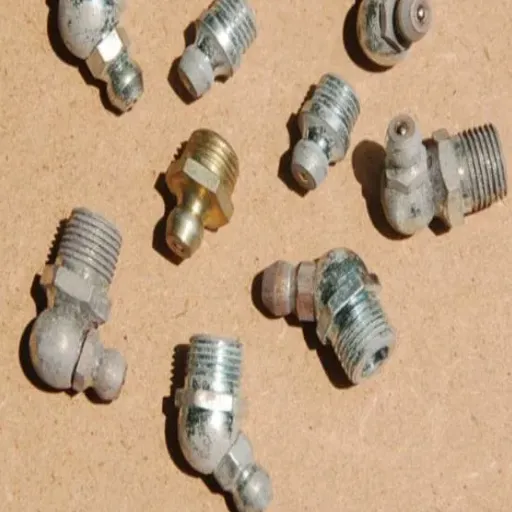
Some warning signs are obvious. Others only appear after you know what to look for. Here are the most common red flags our team sees when evaluating a grease fitting manufacturer or supplier.
- Cannot provide original certification documents. Photocopies, expired certificates, or vague claims of “ISO compliant” without a registration number are unacceptable.
- No material test certificates or lot traceability. Without an MTC, you have no proof of what alloy was used. Without lot markings, you cannot trace a failure back to its source.
- Cut threads instead of rolled threads. This indicates cost-cutting at the expense of structural integrity.
- No pressure testing protocol or unwillingness to share test data. Every batch should be tested. If a factory treats pressure testing as optional, its quality is unpredictable.
- Inconsistent plating or visible machining defects on samples. Surface defects on samples almost always indicate worse problems in bulk production.
- Unwillingness to allow third-party inspection. A confident manufacturer welcomes inspection. A reluctant one has something to hide.
- Extremely low prices with no clear explanation. If a quote is 30% below the market average, the savings are coming from somewhere — usually material quality, plating thickness, or skipped testing.
Sourcing from China: What Buyers Need to Know
Most of the grease fittings across the world are produced in China, and with reference to import data, over 189 active Chinese suppliers export grease fittings only to the USA. This density generates opportunities and risks: namely, competitive pricing and huge production capacity, the opportunity; the downside is inconsistencies in quality and supplier verification issues.
Why China Dominates Global Production
The manufacturers in China, whether it’s carbon steel, brass, or stainless steel, benefit from an integrated supply chain. Factories in the region, like Zhejiang and Jiangsu, have acquired expertise in tooling and machining over the past years of fastener and fitting production. A Chinese grease fitting manufacturer that is well-managed can bring in ISO-certified products straight from the plant at a low cost, almost hard to beat other places.
Verifying a Chinese Manufacturer
Before you remit a deposit, confirm the following four:
- Business License: Make a request and compare the copy of the business license to understand whether the actual situation exists for production, not only a trading range.
- Export License: Kindly ensure that the supplier has the export right, and be aware that some small workshops might work through a third-party export agent, which adds communication Risk.
- Factory Photos and Video: A walk-through video of the production floor and the testing area should be requested. Nonetheless, all authentic manufacturers followed this readily.
- Reference Check: Ask for references of two to three customers in your region or industry and make a courtesy call to them.
Communication and Sample Evaluation
Order samples before placing any bulk order. Test them thoroughly using the evaluation steps in the next section. Pay attention to how the supplier communicates during the sample phase. Slow responses, vague answers, or resistance to technical questions will only get worse after you have paid in full.
How to Evaluate Samples from a Grease Fitting Manufacturer Before You Commit
Samples are your best defense against a bad supplier relationship. Do not skip this step, even if the manufacturer claims urgency or offers a discount for skipping samples. Here is how to evaluate grease fitting samples like a professional buyer.
Visual and Dimensional Inspection
Inspect under good light. Ensure a uniform plating color on the fittings, smooth surfaces without visible machining marks, and uniform head dimensions. Use a pair of digital calipers to check and verify overall length, ball diameter, and thread length against the specification sheet.
Thread Accuracy Testing
Use GO/NO-GO sizes to segment the thread, whether it is in line with ISO 724 (metric) or ASME B1.1 (imperial) thickness limit frame. Defective thread accuracy is the most common flaw that leads to leakages or stripped threads and affects the fittings of low quality.
Ball Check Valve Functionality
Depress the ball with a precision pin. It should move smoothly with consistent spring resistance and return fully to the sealed position. A weak or sticky ball valve will leak grease or allow contaminants to enter the lubrication point.
Pressure Testing
Subject samples to 1.5x their rated working pressure using a hydraulic test rig. For standard industrial fittings, this typically is between 5,000 and 10,000 psi with the specifications noted previously. They should not leak, deform, or crack in the fitting.
Material Verification
For critical applications, send samples to an independent lab for optical emission spectrometry. This checks for the proper thickness of alloy to match your order. If you ordered 304 stainless steel, the analysis should show about 18% chromium 8% nickel.
OEM and Custom Manufacturing: What to Expect
If you are a brand owner or distributor, OEM customization can differentiate your product line. A capable grease fitting manufacturer should offer flexible customization without forcing unrealistic volumes.
Common Customization Options
- Custom threading: Different sizes or unique pitch requirements, such as a dual-threaded design.
- Material upgrades: such as cases the marine environment, thus the use of 316 stainless steel, corrosion resistance properties of brass, or heavy exposure conditions, Monel provides.
- Private labeling: For example, utilizing laser marking or etched logos would also allow for custom head shapes.
- Packaging: There are blister packs, branded boxes, and bulk bags, which have custom labels.
MOQ and Lead Time Realities
Standard carbon steel fittings in common sizes typically carry low MOQs because they are produced in high volumes. Custom threading or materials usually require higher volumes to justify the tooling setup. Lead times for standard products range from two to four weeks. Custom products may require four to eight weeks, including prototyping approval. A reasonable manufacturer will quote both MOQ and lead time transparently before you commit.
James, a tool brand owner in the UK, worked with a manufacturer to develop a private-label grease fitting kit for the agricultural market. The manufacturer produced custom blister packaging and laser-marked fittings at an MOQ of 3,000 units — low enough to test the market without overcommitting inventory. The kit launched in six weeks and became one of his top-selling maintenance products within the first year.
Ready to explore OEM options for your tool line? See our OEM and custom grease fittings guide for detailed MOQs, lead times, and customization options.
Building a Long-Term Supplier Relationship

Choosing one grease fitting manufacturer is not a one-time decision. Instead, it is a long gestation that includes growing, while tactics like clear communication, aligned metrics, and mutual investments re-echo during the period.
Performance Metrics to Track
Quarterly, four metrics are to be monitored:
- Defect rate: A standard product should have a minimum defect rate below 0.5%, while a critical application product has to achieve less than 0.2%.
- On-time delivery rate: The performance target is 95% or more against confirmed ship dates.
- Price stability: The best provider tells you ahead of time that the price of goods has changed, rather than surprising you on the next bill.
- Problem resolution time: How quickly does the supplier respond to and resolve quality complaints?
When to Re-Evaluate or Switch
If the defect rates exceeded 1% for two quarters in a row, if delivery delays are becoming routine, or if the communication quality is sinking, it might be time to reevaluate the vendor. It’s always better to switch earlier, rather than let them accumulate, to cause damage to your customer relations.
The Value of a Backup Manufacturer
Every provider, though the best, could face interruptions — be it a shortage in raw materials or equipment breaking down, or shipping delays. To this effect, establish a counterpart in the business of manning spare parts at such times of emergency when there could urgently be huge orders. This redundancy serves to cover your supply chain needs without forcing you to allocate volume equally between the two suppliers involved.
Conclusion
Choosing the right manufacturer for grease fittings requires thinking beyond the price only, its capability, certification, and consistency. Starting with the ISO 9001, but not stopping at it, will get you the quality from in-house testing equipment, thread rolling processes, batch pressure tests, and clear documentation.
The winner will actually be the long-term buyer who audits before making a purchase decision and undertakes tests before entering into such commitments, and then follows up on performance after delivery. It must be appreciated that a reliable manufacturer is not just a vendor, but instead, it turns out to be a partner for better product quality and customer satisfaction.
To recap the essentials:
- Demand original certifications and verify them independently.
- Inspect manufacturing capabilities, not just product photos.
- Test samples for thread accuracy, ball valve function, and pressure integrity.
- Track defect rates and delivery performance over time.
- Maintain a backup supplier to protect against disruptions.
Looking for a grease fitting manufacturer with verified certifications, in-house testing, and flexible OEM services? Request a sample kit and factory audit documentation from our team. We supply distributors and brand owners across 30+ countries with standard and custom grease fittings built to SAE, DIN, and ISO standards.