
Metric Grease Fittings: DIN 71412 Sizes, Standards, and Sourcing Guide
Metric grease fittings are threaded nipples built to lubrication standards such as DIN 71412 and ISO 3799 that use millimeter-based threads like M6x1.0 and M10x1.0 to introduce grease into bearings and joints. These styles of grease fittings are the standard on both European and Asian equipment, and are not interchangeable with those of the SAE imperial fittings.
Based out of Hamburg, Klaus operates a service station for German forklifts, Italian compactors, and a few older American loaders. In early fall, one of his mechanics put in a 1/4″ -28 UNC fitting into an M8 *1 . 0 hole in a STILL forklift, aiming it is “pretty much the same”. The hole was completely cross-threaded. Klaus’s effort and half a day were wasted on finding another boss and fitting for that one to be an exact match. That cheapness cost him EUR 340 just in labor and repairs.
It is easy to find the experience Klaus had in many other people. Metric fittings may look similar to the imperial fittings without examining the details. They, however, have different thread forms, diameters, and pitches. The use of the wrong fitting damages the appliance, causes leaks and leads to service arrest.
This guide discusses metric grease fittings in regard to the definition of DIN 71412, the identification and measurement of the right size, and the requirements when seeking to purchase from the manufacturers.
Key Takeaways
- Standards of DIN 71412 and ISO 3799 are followed by metric grease fittings and come with thread sizes ranging from M6 to M16.
- The most commonly found sizes in industrial maintenance and automotive uses are M8x1.0, M6x1.0, and M10x1.0.
- Thread sizes of metric and imperial fittings are not interchangeable; when cross-threaded, it destroys the bore and cause grease leaks.
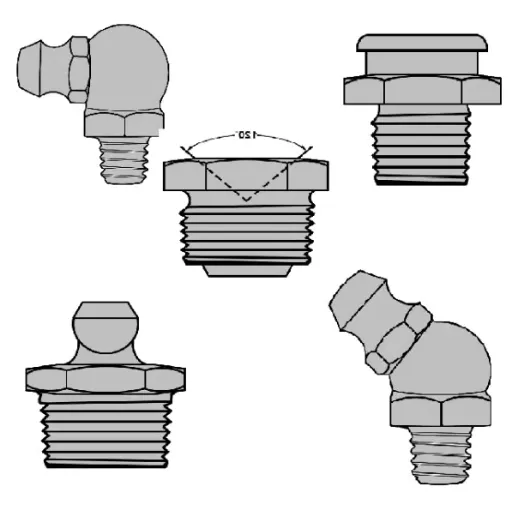
- Three shapes are defined according to DIN 71412: Body Form A (straight), Body Form B (at 45°), and Body Form C (90°).
- Sourcing directly from a DIN-certified manufacturer will entail thread tolerance to be the same, plating to be reliable, and competitive bulk pricing.
What Are Metric Grease Fittings?
Metric grease fittings are spring-loaded lubrication nipples that use metric threads to create a sealed connection between a grease gun and a machine’s lubrication point. They contain a ball check valve that opens under pressure from the grease coupler, allows grease to flow into the bearing or joint, and seals shut when pressure is removed.
These fittings are also called metric grease nipples, metric Zerk fittings, or hydraulic grease fittings. The name varies by region, but the function is the same. They keep bearings, bushings, and pivot points properly lubricated so equipment runs longer and fails less often.
The key difference between metric and imperial fittings is the thread. Metric fittings use ISO metric threads measured in millimeters. Imperial fittings use UNF or NPT threads measured in inches and threads per inch. A metric M6x1.0 fitting measures exactly 6.0 mm in diameter. A common 1/4″-28 UNF fitting measures 6.35 mm. That 0.35 mm difference is enough to destroy threads if forced.
DIN 71412 and ISO 3799 Standards Explained
DIN 71412 specifies dimensions, thread, material, and performance parameters for those Grease nipples mostly used in metric dimensions; ordinary to all constructions, motor vehicles, and plant applications.
ISO 3799 pertains to a specific type of standardism by which the manufacture of any fitting conforms to a specification that can be used interchangeably between producers. Any fitting meeting these standards will enable you the ability to purchase components with identical threads, head diameters, and pressure ratings from different suppliers.
Form Designations
DIN 71412 categorizes fittings by body angle:
| Form | Common Name | Angle | Typical Use |
|---|---|---|---|
| Form A (H1) | Straight | 180° | Open, easily accessible lubrication points |
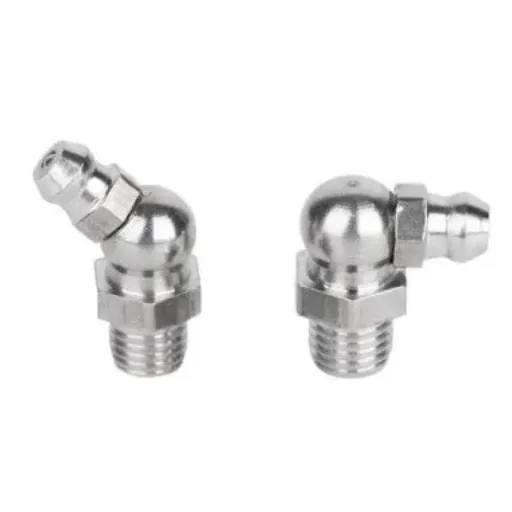
| Form B (H2) | 45° Angled | 45° | Semi-confined spaces |
| Form C (H3) | 90° Angled | 90° | Tight spaces, right-angle access |
Form B and Form C fittings typically have hexagon or square bodies for wrench tightening. Form A straight fittings often have a round or hex body, depending on the manufacturer.
Thread Tolerance
DIN 71412 fittings use ISO metric threads with a standard tolerance of 6g for the external thread and 6H for the internal bore. This tolerance class ensures a reliable seal and proper fit across different manufacturers. When you source from a DIN-certified factory, you get fittings that install correctly without binding or leaking.
Need help choosing the right grease fitting for your application? See our complete guide to grease gun fittings for a broader selection framework covering all thread standards and fitting types.
Metric Grease Fitting Sizes and Types
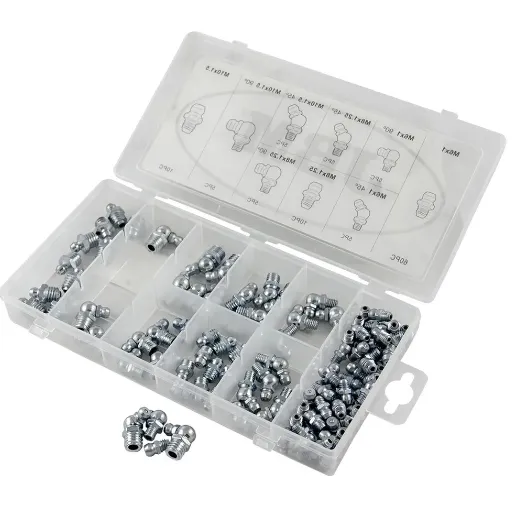
The DIN 71412 standard covers metric thread sizes from M5 to M16. Most industrial and automotive applications use the smaller sizes. Here is the practical size chart that maintenance teams and buyers reference most often.
| Thread Size | Pitch | Hex (mm) | Overall Length (mm) | Typical Application |
|---|---|---|---|---|
| M6 x 1.0 | 1.0 mm | 7 | 15 | Light machinery, motorcycles, small vehicles |
| M8 x 1.0 | 1.0 mm | 9 | 15 | General industrial, agricultural equipment |
| M8 x 1.25 | 1.25 mm | 9 | 15 | Automotive, larger European machinery |
| M10 x 1.0 | 1.0 mm | 11 | 16 | Heavy machinery, conveyors, pumps |
| M10 x 1.5 | 1.5 mm | 11 | 16 | Industrial motors, hydraulic systems |
| M12 x 1.5 | 1.5 mm | 14 | 18 | Large industrial applications |
M6x1.0, M8x1.0, and M10x1.0 are the three sizes found in nearly every metric grease fitting assortment kit. If you maintain European or Asian equipment, these sizes cover most of your needs.
Angle Selection
Choose the body angle based on physical access to the lubrication point. Straight fittings work when space is open. A 45° fitting helps when a hose or frame partially blocks access. A 90° fitting is necessary when the lubrication point faces a wall or deck and the grease gun must approach from the side.
Button Head and Flush Variants
Beyond the standard DIN 71412 hydraulic type, metric button head fittings follow DIN 3404. These have a larger head diameter and accept high-pressure grease couplers. They are common in mining, construction, and heavy earth-moving equipment. Flush and drive-type metric fittings are also available for applications where the fitting must sit below the surface or press into a plain bore.
For a full breakdown of all grease fitting head styles and pressure ratings, read our guide to the types of grease fittings explained.
Metric vs. Imperial Grease Fittings: Key Differences
Understanding the difference between metric and imperial grease fittings prevents costly mistakes. The two systems are not interchangeable.
| Feature | Metric (DIN) | Imperial (SAE) |
|---|---|---|
| Standard | DIN 71412, ISO 3799 | SAE J534 |
| Measurement | Millimeters | Inches |
| Common Threads | M6x1.0, M8x1.0, M10x1.0 | 1/4″-28 UNF, 1/8″-27 NPT |
| Typical Body | Hex or square on angled types | Usually round |
| Regional Use | Europe, Asia, global OEM | North America |
Why They Are Not Interchangeable
A metric M6x1.0 fitting has a major diameter of 6.0 mm. A 1/4″-28 UNF fitting has a major diameter of around 6.35 mm. There is also a difference in the threads per inch. A Metric M6 uses a pitch of 1.0 mm, one full orbit of 360 degrees. UNF 1/4″ has 28 threads per inch or about 0.907 mm pitch per turn.
Subtle differences become significant problems: forcing an imperial fitting into a metric hole cross-threads the hole. It leaves the hole stripped and leaking from the seal, with metal debris all inside the lubrication passage. In a worst-case scenario, a destroyed fitting leaks under no pressure and causes the bearing to run dry.
Quick Identification Tip
Measure the OD with metric calipers. If any one of the results comes out to be 6.0 mm, 8.0 mm, or 10.0 mm clean, it belongs to a fitting metric. However, if fractional inch measurements are seen in the result, such as 0.250″ or 0.315″, it is an imperial fitting. Confirm with the thread pitch gauge before ordering replacement.
Want a complete cross-reference of all grease fitting thread sizes? Our grease fitting sizes guide includes metric, SAE, NPT, and BSP charts in one place.
How to Identify and Measure Metric Grease Fittings
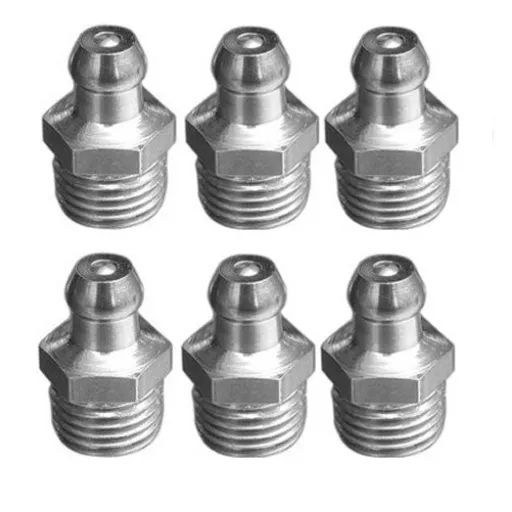
Accurate measurement takes three minutes and saves hours of downtime. You need a digital caliper with metric readout and a metric thread pitch gauge.
Step 1: Check Equipment Origin
European-made machinery almost exclusively uses metric fittings. Asian equipment from Japan, China, South Korea, and India typically uses metric as well. North American equipment generally uses SAE imperial threads. If you know the equipment manufacturer, you can narrow down the thread standard quickly.
Step 2: Measure Outer Diameter
Clean the fitting thoroughly. Use metric calipers to measure the major diameter of the threaded shank. Common results are approximately 6 mm, 8 mm, or 10 mm.
Step 3: Verify Thread Pitch
Place a metric thread pitch gauge against the fitting threads. The gauge teeth should seat cleanly into the thread grooves. Most DIN 71412 grease fittings use 1.0 mm pitch for M6, M8, and M10 sizes. Larger sizes such as M12 and M14, often use a 1.5 mm pitch.
Step 4: Measure Threaded Length and Overall Height
Measure the threaded portion to ensure the replacement does not bottom out in the bore. Measure overall height to confirm clearance against nearby hoses, guards, or frame members.
Step 5: Record the Angle
Note whether the fitting is straight, 45°, or 90°. This determines how the grease gun coupler will approach the lubrication point.
Maria runs a small parts distribution business in São Paulo. She receives frequent orders from local workshops that repair imported European and Chinese construction equipment. Last year, she started stocking a 110-piece metric grease fitting assortment kit covering M6, M8, and M10 in straight, 45°, and 90° angles. Her metric kit sales now outpace her standard SAE kits by 40 percent. Workshops come back to her because she stocks the sizes they actually need.
Materials, Finishes, and Pressure Ratings
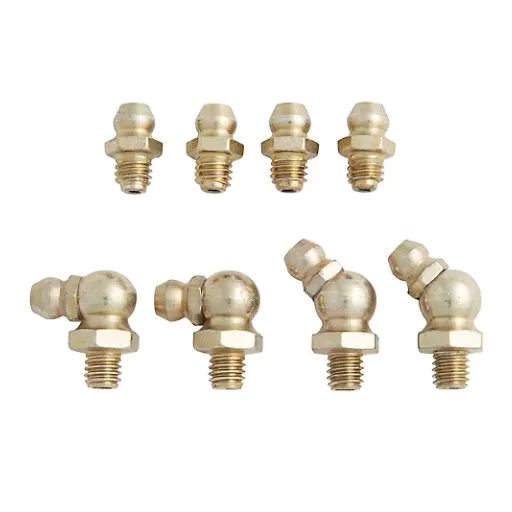
The type of material employed greatly impacts the appropriateness of sharpness, resistance, and longevity against the working environment. The most commonly used materials are zinc-plated carbon steel, stainless steel, and brass.
Zinc-Plated Carbon Steel
This is the standard material for most industrial applications. Steel is capable of giving integrity of sorts at a very low price. It is ideal and kept safe with clear or yellow trivalent passivation zinc plating against common corrosion in typical indoor environments and outdoors. By standard steel metric, fittings are rated at 8,000 to 10,000 psi working pressures.
Stainless Steel
Stainless steel AISI 304 and 316: resist corrosion due to seawater, chemicals, food processing, and pharmaceuticals. While it is an order of magnitude more expensive than plated steel, rust and snatch-proof devices constitute another considerable improvement because equipment and maintenance must be taken care of in a seriously corrosive setting. The temperature may be from -60 degree C to +200 degrees C.
Brass
Unlike steel, brass fittings are excellent at preventing sparks and better at withstanding some chemicals. Brass fittings are widely used in applications such as mining, gas handling, and explosive atmospheres, in which sparks need to be prevented.
Pressure and Temperature Summary
| Material | Working Pressure | Temperature Range |
|---|---|---|
| Zinc-plated steel | 8,000–10,000 PSI | -40°C to +120°C |
| Stainless steel 304/316 | 8,000–10,000 PSI | -60°C to +200°C |
| Brass | 6,000–8,000 PSI | -20°C to +150°C |
Looking for a manufacturer that can supply metric fittings in multiple materials with consistent quality? Contact us to discuss material specs, DIN compliance, and factory-direct pricing for your order volume.
Common Applications and Industries
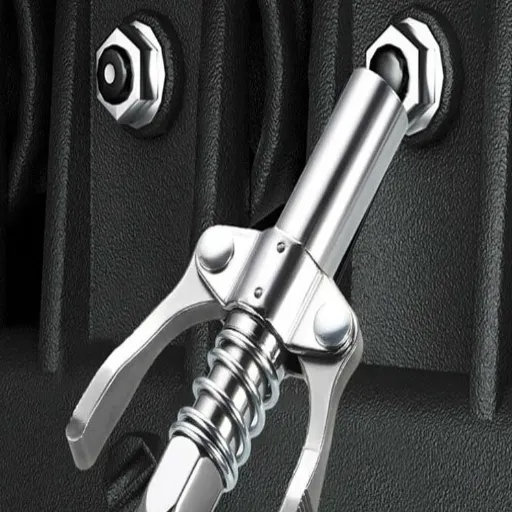
Metric grease fittings appear wherever European or Asian machinery operates. Understanding these applications helps distributors and maintenance managers stock the right inventory.
European Automotive and Commercial Vehicles
Commercial vehicles often make use of entire hardware that is mostly metric. All three chassis, driveline, and hydraulic systems of vehicles are produced by the German, French, and Italian auto manufacturers. For service garages that deal with such Mercedes-Benz, MAN, or Iveco vehicles, it is necessary to have metric fittings like M8 and M10 in stock.
Asian Motorcycles and Compact Machinery
Japanese and Chinese motorcycle manufacturers usually tend to use metric fittings like M6 and M8, as do compact excavator and loader manufacturers. Compact sizes ramp up to very small frames with a fairly good pressure rating.
Agricultural Equipment Imports
European and Asian machines normally have all their tools – tractors, harvesters – based on metric fittings of pivot pins, PTO bearings, and hydraulic lines. Importers and servicers of such tools would do well to keep assortment metric kit inventories on hand.
Industrial Machinery and Conveyors
European and Asian Original Equipment Manufacturers have machine tool bases, metric fittings, such as bearing housings, gearboxes, and chains. Service department teams usually have mixed fleets of both metric and imperial systems that must be fitted.
Construction Equipment
Such machines as excavators, compactors, and loaders convert European and Asian companies to metric fittings. Besides, material selection is critical in the extremely rough environment of construction sites. For example, most often zinc-plated steel is the usual form; however, stainless steel is preferable for extreme coastal or wet situation fleets.
A mixed fleet distributor has a better chance of emerging successful when it keeps assembly of metric grease fitting assortment kits. A single kit is made with M6, M8, and M10 in many angles, which tends to cover almost all European and the majority of Far Eastern lubrication parts.
Sourcing Metric Grease Fittings: What Buyers Should Know
If you wish to buy metric grease fittings in bulk, you must give attention to the compliance of standards, the tolerance of threads, the certification of material, and the reliability of the vendor. Now, let’s discuss the process that the experienced purchaser may be going through before issuing an order.
Factory-Direct vs. Distributor
Factory-direct ordering lowers unit cost, especially above 1,000 units. Typical costs for standard zinc-plated carbon steel metric fittings from a qualified Chinese manufacturer range from $. 01 to $. 05 at bulk; the distributor must add in their overhead for storing, packing, and delivering to your door, so factory-direct sourcing holds greater appeal among heavier users like big maintenance departments, brand owners, or resellers, whereas the lighter users, such as small shops would perhaps be a bit more amenable to taking on temporary inventory through distributors as their immediate requirements come about small in nature.
Verify DIN 71412 Compliance
Not all suppliers are actually manufacturing to DIN 71412 tolerance. Ensure you get the actual dimensions inspection or otherwise, a certificate of conformity. Important checks involve the thread tolerance class, head diameter, and plating thickness. DIN compliant M8x1.0 should be 8.0mm major diameter of pitch of 1.0mm, and 6g as external tolerances.
MOQs and Assortment Kits
Standard factory MOQs for individual metric sizes typically start at 1,000 to 5,000 pieces. However, many factories offer pre-packaged metric assortment kits containing M6, M8, and M10 in 0°, 45°, and 90° configurations. These kits are loved by distributors and maintenance shops as this one purchase covers multiple applications.
OEM and Private Label Options
Ask for private label packaging and laser marking if you want to serve under your own brand. It is because there are OEM types of factories out there that can produce all perfect original metric fittings stamped with your logo, custom packaging, and all necessary labeling. This serves added value for the company, the e-commerce sellers, and the distributors who want their brand differentiation.
Lead Times and Logistics
With usual items, lead times for Chinese makers for their mainstream metric fittings are usually 15 to 30 days, according to the size offered. Lead times for t-shirt size fittings would be extended to 45 to 60 days for possible private label packaging. Do fill up inventory, especially during construction season or end-of-year fleet maintenance cycles.
When persons are searching for new suppliers, they need to make sure that the plating thickness, ball-seat precision, and batch consistency are manually verified by seasoned buyers.
Conclusion
Metric grease fittings are designed and used to service equipment that is manufactured in regions of Europe and Asia. The fitting designation and its manufacturer outline certain criteria, such as Chinese thread equivalents and body approvals, and therefore can be made to different sizes. Three such can be as follows: 6 mm with 1 mm thread, 8 mm with 1 mm, and 10 mm with 1 mm, to name a few.
The best way to prevent breakdowns is by proper identification. Measure the diameter in millimeters. Use a gauge to check the pitch. Turn the head to suit the intended surface. Do not screw a non-metric fitting into any metric hole.
As a purchasing agent, it’s advisable to buy a fitting from the factory that complies with DIN standards to ensure consistency in thread fitting, plating, and cost effectiveness, especially in large quantities. This is done regardless if it’s a regular size or something made according to the market’s specifications. There is no quality issue or extra costs when manufacturers are involved from the very beginning.
Need reliable metric grease fittings for your fleet, distribution line, or brand? Contact Shanghai Oushike Hardware Tools Co., Ltd. for factory-direct DIN 71412 fittings with flexible MOQs, custom specifications, and stable supply.