
High Pressure Grease Gun Couplers: Types, PSI Ratings, and Buyer’s Guide
A high pressure grease gun coupler is kinda the threaded tip that locks onto a Zerk fitting, to push grease under pressure. The right coupler stops leaks and helps shield the fittings, so the maintenance team stays moving instead of fighting with equipment. A mismatched coupler, however, ends up wasting time, wasting grease, and can even scuff up the same parts it’s supposed to guard.
Jorge runs fleet maintenance for a construction rental company here in Phoenix. Every Tuesday morning, his crew services twelve Caterpillar excavators before they go out on weekly rental contracts. Last spring, Jorge realized his lead mechanic was burning about twenty extra minutes per machine. The issue wasn’t the grease gun, and it wasn’t the Zerk fittings either. It was the plain friction grip coupler. Every single time the mechanic ran into a stiff fitting on a pivot pin, the coupler popped off—then it sprayed grease across the undercarriage. Jorge moved the crew to 10,000 PSI locking couplers. Service time went back to normal, and grease use dropped by almost thirty percent.
That one switch saved hours each week. Most coupler problems are not really equipment failures. They’re more like mismatches between coupler style, the PSI rating, and the actual work environment. This guide sort of walks through how high pressure grease gun couplers function, what PSI level you really need, what coupler type to pick, how to handle common headaches, and the best way to source them in bulk.
Key Takeaways
- Standard friction-grip couplers work for light use but pop off under pressure above 3,000–6,000 PSI.
- Locking couplers rated 8,000–12,000 PSI grip Zerk fittings with hardened jaws and release cleanly via thumb lever.
- Match coupler PSI to your grease gun output, and match coupler type to your Zerk fitting style.
- Rebuildable couplers with replaceable jaws and seals last three to five times longer than disposable units.
- Factory-direct sourcing at 500+ piece MOQ cuts unit cost by fifty to seventy percent versus retail pricing.
What Is a High Pressure Grease Gun Coupler?
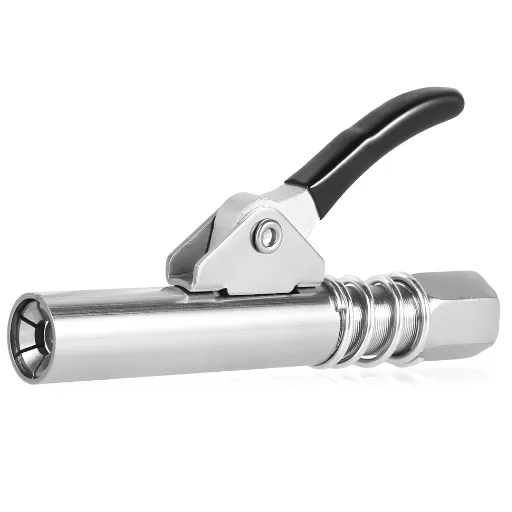
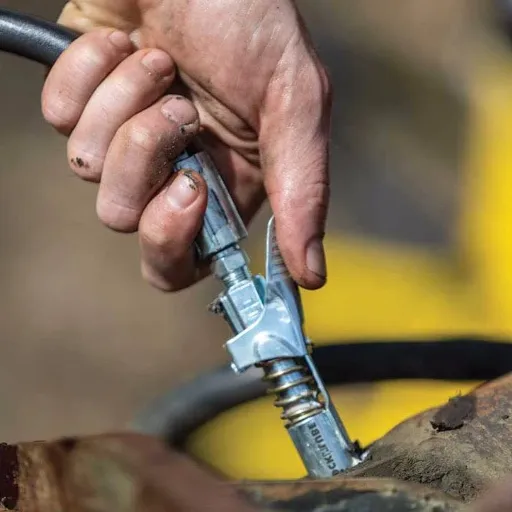
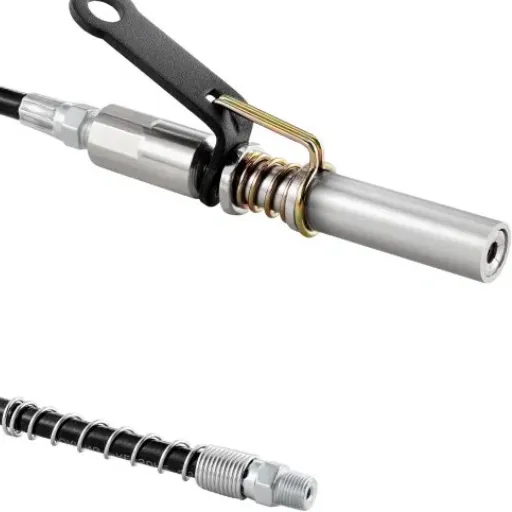
A high pressure grease gun coupler is a kind of metal connector at the end of a grease gun hose, and it makes a sealed connection with a Zerk fitting. Inside it, there are hardened jaws that actually grab the fitting, plus a spring-loaded sleeve that keeps the clamping force steady. Then there’s usually a nitrile or Viton seal, meant to stop the grease from escaping sideways while you’re pumping it in.
These couplers are also called grease gun tips, grease gun ends, or grease gun nozzles. The phrase “high pressure” matters because today’s battery and pneumatic grease guns often push something like 6,000 to 10,000 PSI. A regular friction coupler can’t really keep hold at that level. It will slip, leak, or sometimes it just comes off the Zerk fitting entirely, like it decided to leave early. That’s why high-pressure couplers have tougher jaws, tighter tolerances, and better seals so the connection stays put when pressure climbs.
Most of these couplers screw onto the hose using the common 1/8″ NPT hookup, and that lines up with SAE J534. The body is typically hardened carbon steel or stainless steel, and the jaws are heat-treated spring steel. In the middle, there’s a sliding sleeve, or a thumb lever style, that lets you control whether the jaws are held locked open, clamped onto the fitting, or released again. If you understand those parts, it becomes easier to pick a coupler that matches your equipment, rather than fighting it every time you try to lube something.
Need a broader view of how couplers fit into the complete grease fitting ecosystem? See our complete guide to grease gun fittings for a full overview of threads, standards, and applications.
Standard vs. Locking vs. Quick-Release Couplers
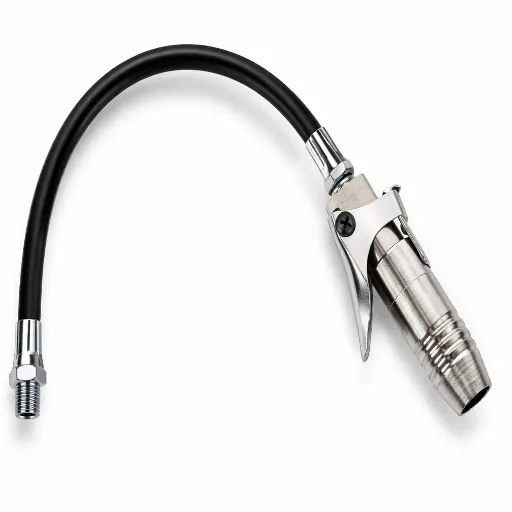
Grease gun coupler types fall into three main categories, plus several specialty variants for non-standard fittings. Choosing the right category is the first step to eliminating leaks and downtime.
Standard Hydraulic Coupler
This is one of the most standard and one of the cheapest available hydraulic couplers. This uses a straightforward spring-jaw mechanism that keeps the Zerk fit securely in place by pressure. The operator keeps the coupler in place both by pressing it up against the fitting and holding it that way or by resting the grease gun on it. These are also good for access to fitting points, properties usually known as the working environment with little to moderate use, which costs like 3,000 to 6,000 psi concerning the peak limit.
Locking Coupler
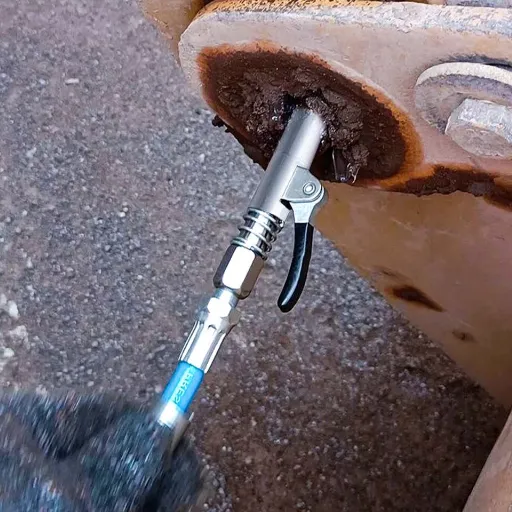
A locking grease coupler uses a positive mechanical lock. When you push the coupler onto a Zerk fitting and slide the sleeve forward, hardened jaws clamp down and hold the coupler rigidly in place. You can pump with both hands free. When you finish, a thumb lever releases the jaws instantly, even if the fitting is pressurized or recessed. Locking couplers are rated from 8,000 to 12,000 PSI, depending on the model. The tradeoff is bulk. Locking heads are larger than standard tips, so they do not fit into every tight space.
Quick-Release Coupler
Quick-release couplings just click on a single stroke and are released by using a button or lever. The couplers are faster than standard ones when sticking to and releasing from a fitting. You’ve got to service a lot of fittings during a single shift. Many quick-release models are made with a locking jaw design, similar to locking couplers on the high end, so they have the same PSI ratings and bulk constraints.
Specialty Variants
Beyond the three main types, several specialty couplers match non-standard fittings. Button head couplers fit over the large flat heads of button head Zerk fittings common in mining equipment. Pin-type couplers engage cross-pin fittings found on some European machinery. Needle nose couplers use a slim metal tube to reach fittings in deep recesses where no standard or locking head will fit. Flush couplers seat against flat-surface fittings that have no raised nipple.
For a deeper breakdown of each fitting style and when to use it, read our guide to the types of grease fittings explained.
| Coupler Type | Mechanism | PSI Range | Best For | Main Drawback |
|---|---|---|---|---|
| Standard hydraulic | Spring-jaw friction | 3,000–6,000 PSI | Light maintenance, DIY | Pops off and leaks under pressure |
| Locking | Hardened jaws + sliding sleeve | 8,000–12,000 PSI | Industrial, fleet, construction | Larger head, tight-space limits |
| Quick-release | Snap-on button/lever | 8,000–10,000 PSI | High-volume service | Bulk similar to locking couplers |
| Button head | Slot-over flat head | 10,000–15,000 PSI | Mining, heavy earth-moving | Fits only button head fittings |
| Needle nose | Slim metal tube | 3,000–5,000 PSI | Recessed, hard-to-reach fittings | Lower PSI, no locking feature |
For a complete look at all grease gun coupler types and accessories, read our grease gun coupler guide.
PSI Ratings and What They Mean
PSI rating is the single most important specification when choosing a grease gun coupler. It tells you how much pressure the coupler can withstand before the seal fails or the jaws lose grip.
Working Pressure vs. Burst Pressure
Working pressure is the safe operating range where the coupler performs as designed. Burst pressure is the point at which the body, seal, or jaws fail structurally. A well-built coupler has a burst pressure roughly fifty percent above its working pressure. That margin protects against sudden pressure spikes from clogged fittings or over-enthusiastic pumping.
PSI Tiers and Applications
| PSI Tier | Typical Use | Grease Gun Type |
|---|---|---|
| 3,000–5,000 PSI | Light maintenance, DIY, home workshop | Manual lever |
| 6,000–8,000 PSI | Automotive service, light commercial | Pistol-grip manual |
| 8,000–10,000 PSI | Industrial, agricultural, and construction fleet | Battery-powered, pneumatic |
| 10,000–12,000 PSI | Heavy equipment, mining, stiff fittings | High-output pneumatic |
| 12,000–15,000 PSI | Severely clogged fittings, specialty applications | Premium pneumatic with pressure relief |
Modern pneumatic grease guns operate at 6,000 to 10,000 PSI, with premium models reaching 15,000 PSI. If your grease gun outputs 8,000 PSI and your coupler is only rated to 5,000 PSI, the coupler will fail before the gun reaches full pressure. That mismatch is why so many mechanics experience popping couplers. The coupler is not defective. It is simply underspecified for the tool.
Choosing a coupler with a higher PSI rating than your grease gun provides a safety margin. It also extends service life because the jaws and seals are not operating at their limit on every pump stroke.
How to Choose the Right Coupler
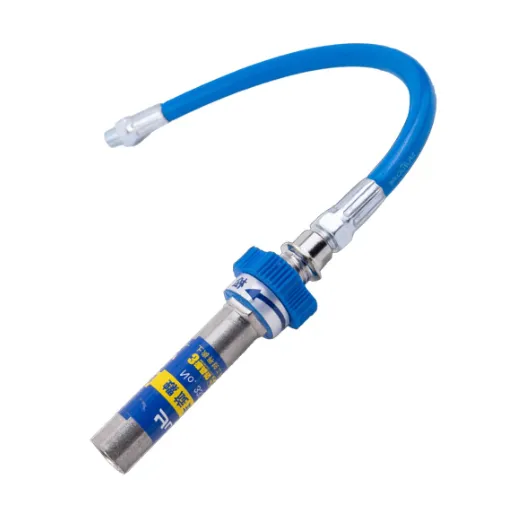
Selecting the right coupler takes about two minutes if you know what to check. Run through these five questions before ordering.
1. What type of Zerk fitting are you servicing?
Standard hydraulic Zerks accept standard or locking couplers. Button head, pin-type, and flush fittings need matching specialty couplers. If you are not sure what fitting type you have, measure the thread diameter and pitch with a caliper or thread gauge before ordering.
2. What is the maximum PSI output of your grease gun?
Check the grease gun rating plate or manual. Choose a coupler rated at least twenty percent above that number. If your gun outputs 8,000 PSI, choose a 10,000 PSI coupler.
3. How accessible are the fittings?
Open, easily reached fittings can use any coupler type. Recessed fittings inside frames or behind guards may need a needle nose or a flexible whip hose. Deeply shrouded fittings may require an extended-nose locking coupler.
4. Do you need hands-free operation?
If you pump grease alone and need both hands for stability, a locking coupler is worth the extra cost. If you work in a shop with an assistant holding the grease gun, a standard coupler may be sufficient.
5. What environment will the coupler face?
Indoor workshops with clean conditions can use zinc-plated carbon steel. Marine, food processing, or chemical environments need stainless steel bodies and Viton or PTFE seals. High-temperature applications above 120 degrees Celsius also require Viton instead of standard nitrile.
If your equipment uses metric threads, verify the thread pitch against DIN 71412 specifications to ensure the correct coupler and fitting combination.
How to Use a High Pressure Grease Gun Coupler
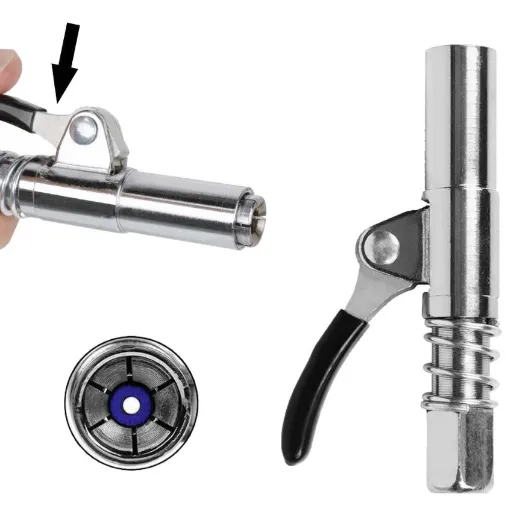
Using a high pressure grease gun coupler correctly takes less time than cleaning up after a leak. Follow these four steps.
Step 1: Clean the fitting. With a clean shop rag, wipe the Zerk fitting nipple. Dirt and grit on the nipple will enter the coupler jaws and wear out faster.
Step 2: Connect the coupler. Push straight onto the fitting until the jaws seat with a standard coupler. To lock a coupler, you push it onto the fitting and slide the sleeve forward to engage the lock-in feel or sound. Give a little gentle tug to check the connection.
Step 3: Pump grease. Apply steady, even strokes to the pump handle. Keep a careful eye on the boot around the fitting and around the pressure-relief vessel on the coupler. If all the grease comes out from the sides of the coupler in place of going into the fitting, it isn’t sealed. Stop, disconnect, and reconnect.
Step 4: Disconnect cleanly. For locking couplers, press the thumb lever and pull straight back. For standard couplers, pull straight back without twisting. Twisting a standard coupler while pulling can round off the Zerk fitting head. Wipe excess grease from the fitting and the coupler before moving to the next point.
Safety note: A burst high-pressure grease hose can inject grease through the skin at pressures as low as 100 PSI, a serious occupational hazard per OSHA guidelines. This is a surgical emergency. Inspect hoses before every use and seek immediate medical attention if grease penetrates the skin.
Common Problems and How to Fix Them
Even the right coupler causes headaches when something else is wrong. Here are the four problems mechanics encounter most often, and the fixes that actually work.
Problem 1: Coupler Pops Off Under Pressure
Cause: The coupler PSI rating is not high enough for a high-pressure grease gun output, or worn and loosened-up jaws have a misaligned Zerk fitting obstructed by dried grease, causing some grease build-up to spike backward because of high pressure.
Fix: Get a locking coupler with more pressure-rated PSI, then check the Zerk fitting for the right angle. The slightest leaning, even, will push a basic coupler sideways until it slips off. Replace a clogged fitting, but not wrestle with a coupler.
Problem 2: Coupler Stuck on the Zerk Fitting
Cause: Grease left and compacted in the chamber behind the Zerk ball check would pressurize and lock the coupler in position. There is a chance that the ball check itself is bent or hurt. Moreover, sometimes by using the wrong type of coupler for a particular style of fitting profile, a mechanical jam occurs.
Fix: On locking couplers, press the release thumb lever first. If this doesn’t work, you should rock the coupler a little, then slide it side-to-side while pulling. Never strike the grease gun or hose. Make sure the coupler is the proper type to match the fitting profile before attempting to reconnect it.
Problem 3: Grease Leaks During Pumping
Cause: There is a defective or cracked internal seal. One or more jaws may be chipped or rounded, and the head of the Zerk fitting itself may be damaged, so that it no longer makes a smooth fit on its mating surface.
Fix: Change the seal and jaw set with a rebuild set. Typically, top-quality locking couplers are designed for rebuild. If the Zerk fitting head is gouged or out of round, replace the component. Certainly, a new coupler will do just as poorly on a damaged fitting as it would on the same old fitting.
Problem 4: Coupler Will Not Fit in Tight Spaces
Cause: Locking coupler heads are two to three times larger than standard tips. They simply will not fit between frame rails, inside guards, or near closely packed linkage arms.
Fix: Keep a needle-nose coupler or a flexible whip hose on a second grease gun for tight spots. Some maintenance departments run a locking coupler on their primary pneumatic gun and a standard or needle nose on a backup manual gun. That combination covers every access angle without constantly swapping tips.
Brad runs a parts distribution business in Iowa that supplies agricultural equipment dealers across the Midwest. Two years ago, he started stocking both locking couplers and needle nose extensions after hearing the same complaint from three different customers: their PTO shaft Zerks were destroying standard couplers, but locking couplers would not fit between the shaft and the shield. By offering both options, Brad cut his return rate on couplers by sixty percent and built a reputation as the supplier who actually stocks what farmers need.
Materials, Seals, and Build Quality
The difference between a coupler that lasts one season and one that lasts five years comes down to materials and manufacturing quality.
Body Material
Standard coupler bodies are carbon steel and come with a zinc or nickel plating for the prevention of corrosion. They are made from 304/316 stainless steel ones for marine, food processing, or chemical environments. They need to be hardened to bear up when the jaws clamp down under pressure.
Jaw Hardness
Jaw material is cut from spring steel, heat-treated to 50 HRC or above. Soft jaws round off with a few dozen uses and cease to grip. An informal way to find the quality of jaws is pressing them edge against the jaw on the side of the file. A well-hardened jaw will resist making scratches.
Seal Compound
Nitrile rubber NBR is the standard seal material for general industrial use. They handle temperatures from an impressive minus twenty degrees to plus one hundred twenty degrees Celsius. Protective seals resist petroleum-based grease. Viton FKM costs more but withstands temperatures up to two hundred degrees Celsius and resists synthetic greases and aggressive chemicals. PTFE seals are installed in food-grade applications in hygiene-critical areas.
Spring and Sleeve
The return spring and sliding sleeve are typically stainless steel or zinc-plated music wire. A weak spring will not maintain clamping force, and a sleeve with poor surface finish will bind instead of sliding smoothly.
Rebuildability
Rebuildable couplings are quality units. For rebuilding, a jaw and seal kit is $5 to $10, and then service life can be extended three to five times compared to buying a new coupler. One of the first things experienced buyers check is the rebuildable design in competing suppliers.
Quality Red Flags
Watch for couplers with soft jaws that deform under finger pressure, seals that leak at pressures below 1,000 PSI, or 1/8″ NPT threads that strip during the first installation. These are signs of poor heat treatment, incorrect seal material, or undersized thread machining.
Sourcing High-Pressure Grease Couplers in Bulk
For maintenance departments, distributors, and private label brands, buying grease couplers in bulk changes the economics entirely.
Factory-Direct vs. Retail Pricing
Retail locking couplers from major brands sell for twenty-five to forty dollars each. Factory-direct standard couplers at volumes above one thousand pieces typically cost eighty cents to three dollars fifty per unit. Premium locking couplers at the same volume run four to twelve dollars per piece, depending on jaw count, seal material, and plating specification. The margin difference is substantial for resellers and fleet operators who need dozens or hundreds of units.
Minimum Order Quantities
Standard hydraulic couplers usually carry a factory MOQ of five hundred to one thousand pieces. Locking couplers with higher complexity start at three hundred to five hundred pieces. Custom branded couplers with laser marking and blister packaging typically require one thousand to three thousand pieces per order.
OEM and Private Label
Factories with OEM capability can produce couplers with your logo laser-marked on the body, custom color sleeves, branded packaging, and regional language instruction inserts. This adds value for distributors who want brand differentiation and for e-commerce sellers building a tool line.
Quality Verification
Before committing to a supplier, request dimensional inspection reports, PSI burst-test data, and jaw hardness certificates. Salt-spray testing confirms corrosion resistance for the plating you specify. A reliable factory will provide these documents without hesitation.
Lead Times
Standard couplers from certified factories typically ship within fifteen to thirty days. Custom sizes, special materials, or private label packaging extend lead times to forty-five to sixty days. Plan inventory ahead of construction season and end-of-year fleet maintenance cycles.
Experienced buyers also verify batch consistency, ball-seat precision in the jaws, and seal compound certification before placing repeat orders. The cheapest coupler is never the least expensive if it fails in the field and creates downtime.
Conclusion
The proper high pressure grease gun coupler is also the least expensive, and the one that fits your grease gun’s output, your Zerk fitting type, and the environment you work in. Standard friction couplers are useful for light use, needing only commercial use. The 8,000-12,000 PSI locked coupler can stand up to the demands of industrial fleet maintenance. A needle-nose and button-head version of a specialty solves access and fitting compatibility issues that normal products would not even reach.
Match the PSI rating on the grease gun. Match the coupler type to your fitting. Select your material for your environment. Fix it instead of replacing. There is always factory-direct sourcing for volume purchases of thread tolerance, which permits consistent hide plating and still allows considerable pricing to support of your margins.
Need reliable high pressure grease gun couplers for your fleet, distribution line, or private label brand? Contact Shanghai Oushike Hardware Tools Co., Ltd. for factory-direct couplers with flexible MOQs, custom specifications, and stable supply.