

Grease Gun Coupler: A Buyer’s Guide for Distributors and Industrial Buyers
A grease gun coupler is a small, threaded connector that joins a grease gun to a Zerk connector, causing the wrong selection to result in leakage, loss of time, and equipment damage. The most suitable coupler for your work will depend on the size of the thread, the amount of pressure to be countered, the jaw type, and the type of grease fittings in your tools.
The coupler is treated as an afterthought by most purchasers. They are too engrossed with the grease gun that they look for the cheapest is the coupler for the grease gun. The cost of that thinking is, however, much higher than most people imagine.
Marcus is the head of a construction company’s fleet maintenance outside of Houston. At 6:15 a.m. on Tuesday, one of the operators called in and explained about the excavator boom that got stuck. The reason behind it was a faulty grease gun coupler, which had been leaking for many days. The greased bush pin was not possible. And by the time Marcus found the correct replacement coupler in stock, there was a $200 per hour machine sitting for four hours because of a $2 piece.
This tutorial presents a guideline on how to choose, source, and store grease gun coupler alternatives that allow you to have functioning equipment with minimal cost. It will enlighten you more on coupler types and why they differ, what thread types determine compatibility, what the meaning of pressure ratings is, what their use is, and how to assess suppliers in order to ensure reliability over a long time span.
Key Takeaways
- A grease gun coupler, when screwed on the end of a hose, locks into a Zerk fitting for distributing pressurized lubricant with a spring-loaded jaw-locking mechanism.
- On North American grease guns, the standard thread is 1/8-inch NPT, but in other areas, usually, BSPP or metric threads serve as a standard.
- Four-jawed couplers handle pressures beyond 6,000 PSI better than three-jawed couplings, as well as longer lives in industrial settings.
- They’re very cheap, with direct-from-factory purchasing in the Chinese range being about $0.08 for unit-prescribed coupled ones and about $1.59 for quick-release coupler models.
- When suppliers can sell the best combination of couplers, they can cut down on returns by the customer and build up repeat business.
What Is a Grease Gun Coupler?
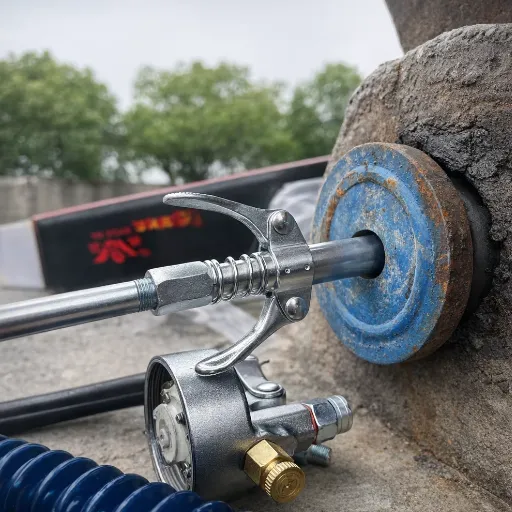
A grease gun coupler is a small metal fitting that screws onto a hose or a grease gun extension; it has a spring-loaded jaw mechanism, a gripless head of a grease fitting, also known as a Zerk fitting, to establish a close seal for pouring high-pressure grease inside the fitting.
Upon the pump action of the grease gun, the lubricant flows through the coupler into the fitting. The internal jaws of the coupler grab firmly against the head of the fitting, while a rubber or leather gasket prevents grease from oozing around that opening. Lubrication is concluded by loosening one’s grip on the jaws and removing the coupler after it is used.
The weak link in most grease supply systems lies with the coupler. A stray or ill-fitting coupler spews grease, forces waste of lubricant, and requires the operator to hold the gun by hand to maintain pressure. Over time, that extra handling results in fatigue and inconsistent greasing. For most of the suppliers, an incorrect coupler mix also means return, complaints, and a lack of repeat orders. Knowing how your stock can solve the real problems of your customers is actually more practical. An overall look at how couplers fit into a lubrication system, check out our inclusive grease gun fittings complete guide.
Types of Grease Gun Couplers

Using the same grease gun coupler across all applications will prove impossible. The explanation of these six major types could assist in addressing industrial, automotive, and agricultural customers. Most firms will merely sell what’s on their shelf instead of looking into what really matches the customer.
Standard Hydraulic Couplers
Standard hydraulic couplers are generally the most common among all other types. There are either three-jaw or four-jaw grippers. Fit standard zerk fittings for all of them. The four-jaw style will grip tighter overall and line up better under pressure. Three-jaw couplers cost less but generally tend to leak on high-pressure systems or because of fitting wear.
Standard couplers will handle about 3,000 to 6,000 PSI. They are enough for the hand-operated grease gun and most automotive maintenance. It serves as a good starting point with the four-jaw standard coupler for the industry buyer, who will use the pneumatic or battery-powered grease gun.
Locking Couplers
Locking couplers use a spring-loaded sleeve or thumb lever that locks the jaws onto the fitting. The operator does not need to hold the coupler in place during greasing. This is a major advantage for high-pressure applications and hard-to-reach fittings.
Most locking couplers are rated for 10,000 PSI or higher. They include an internal pressure relief valve that prevents hydraulic lock, making removal easy even under residual pressure. The tradeoff is cost. Locking couplers wholesale for $0.78 to $1.59 per unit from Chinese manufacturers, compared to $0.08 to $0.20 for standard four-jaw models.
Quick-Release and Quick-Connect Couplers
Quick-release couplers allow the operator to swap tips or adapters without unscrewing the entire coupler from the grease gun. This is useful for maintenance teams that service multiple fitting types with one gun. A mechanic can switch from a standard hydraulic tip to a needle nozzle in seconds.
These couplers add convenience but introduce more moving parts. Distributors should stock quick-release models for professional users and standard couplers for general-purpose buyers.
Needle Nose and Angled Couplers
Needle point couplings bring a very long and narrow nose to the access of what is otherwise impossible for a normal line worker to reach, not limited to only the closed, flush, or rejected fittings. Angled connectors, such as the 90-degree adapters, handle clearance issues around the steering components, suspension links, and guarded machinery, among others.
These constitute relatively low-volume products. Smaller demands must maintain high margins and carry a good amount of repeat patronage with professional mechanics who won’t complete their jobs without them.
Button Head Couplers
Button head couplers are designed for large 5/8 inch diameter button head grease fittings common on heavy mining and construction equipment. They use a different thread standard, typically 7/16 inch-27, rather than the 1/8 inch NPT found on standard couplers.
Stocking a few button head couplers signals to industrial buyers that you understand their equipment. It also opens conversations about larger lubrication tool orders.
Specialty Couplers
Specialty options include swivel couplers that rotate 360 degrees, pin-type couplers for older machinery, and slide-on adapters for European DIN fittings. These address niche applications but are worth carrying if your customer base includes fleet maintenance departments or agricultural operators.
| Coupler Type | Best For | Typical PSI | Wholesale Price Range |
|---|---|---|---|
| Standard 3-jaw | Light automotive, DIY | 3,000-4,500 | $0.05−$0.12 |
| Standard 4-jaw | General industrial | 6,000-10,000 | $0.08−$0.20 |
| Locking | High-pressure, hands-free | 10,000+ | $0.78−$1.59 |
| Quick-release | Multi-fitting service | 6,000-10,000 | $0.90−$2.50 |
| Needle nose | Recessed/flush fittings | 4,000-7,000 | $0.50−$1.20 |
| Button head | Heavy mining/construction | 6,000-10,000 | $0.80-$1.80 |
Thread Sizes and Compatibility Standards
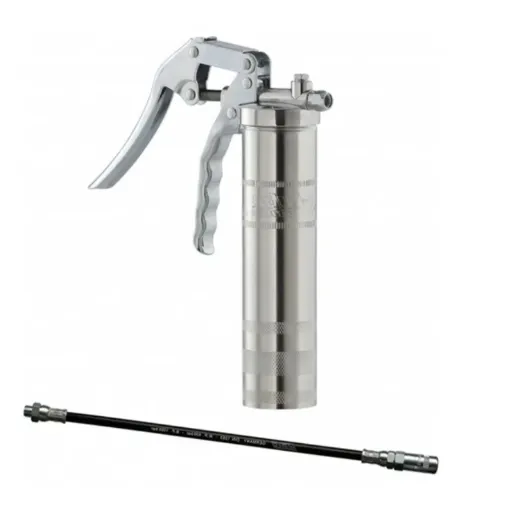
Thread mismatch is one of the most common reasons a grease gun coupler fails to work. Buyers assume all couplers fit all guns, but three major thread standards dominate global markets.
1/8 Inch NPT: The North American Standard
The National Pipe Thread (NPT) thread standard for about 70% of grease guns and couplers in North America. The coupler has 1/8-inch female NPT threads screwed onto the male 1/8-inch NPT thread of the grease gun hose or extension. Its tapes slope toward each of its ends to prevent the elements from creeping in while at the same time fortifying the threaded connection.
If your customers are in the United States or Canada, 1/8 should be your safe default. Always verifying this spec when sourcing couplers for North American distribution.
1/8 Inch BSP: Common in the UK, Australia, and Commonwealth Markets
British Standard Pipe (BSP) threads look similar to NPT but are not interchangeable. The thread angle and pitch differ. A BSP coupler threaded onto an NPT hose will cross-thread, leak, or strip.
Distributors selling into the UK, Australian, or New Zealand markets need BSP-threaded couplers. Some manufacturers offer dual-compatible adapters, but dedicated BSP stock is more reliable.
Metric Threads: M10x1 and M14x1.5
European and Asian equipment often uses metric threads. M10x1 is the most common metric grease coupler thread, followed by M14x1.5 on larger industrial guns. Chinese manufacturers typically produce both NPT and metric variants from the same tooling with minimal cost difference.
Quick Reference: Regional Thread Standards
| Region | Standard Thread | Compatibility Notes |
|---|---|---|
| North America | 1/8 inch NPT | Do not mix with BSP |
| UK, Australia | 1/8 inch BSP | Do not mix with NPT |
| Europe, Asia | M10x1, M14x1.5 | Check the equipment manual |
| Heavy mining | 7/16 inch-27 | Button head couplers only |
When in doubt, ask your customer to check the thread stamped on their existing coupler or measure the hose end with a thread gauge. Stocking the wrong thread standard is an expensive mistake that leads to immediate returns.
Pressure Ratings and Performance Standards
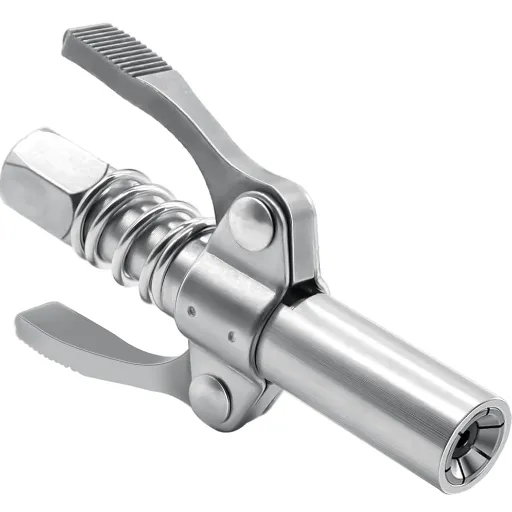
Pressure ratings on a grease gun coupler tell you how much force the component can handle before failure. There are two numbers to understand: operating pressure and burst pressure.
Operating pressure is the maximum pressure the coupler can handle during normal use. Burst pressure is the point at which the coupler body or seal fails catastrophically. A well-designed coupler has a burst pressure at least twice its operating pressure.
Standard-duty couplers handle 3,000 to 4,500 PSI. Heavy-duty four-jaw models reach 6,000 to 10,000 PSI. Industrial locking couplers often exceed 10,000 PSI, with some specialty models rated to 15,000 or even 20,000 PSI. For detailed guidance on extreme-pressure applications, fitting selection, and safety protocols, see our high-pressure grease fittings guide.
Matching the coupler to the grease gun is critical. A battery-powered grease gun generating 10,000 PSI will destroy a 3,000 PSI standard coupler. The jaws will spread, the seal will blow out, and grease will spray in every direction except into the fitting.
Safety Warning: High-Pressure Grease Injection
High-pressure grease injection injuries are serious and often underestimated. A grease gun operating at 10,000 PSI can force lubricant through the skin and into the underlying tissue. This causes tissue damage, infection, and potential amputation if not treated immediately. The National Institute for Occupational Safety and Health identifies pressurized lubrication equipment as a significant injury risk in industrial settings.
Always recommend couplers with pressure relief features for high-pressure applications. Train operators to wear safety glasses and never point a pressurized grease gun at themselves or others.
Materials and Durability: What Drives Quality
The quality of anything mostly depends on the material and manufacturing processes, and how well it maintains sealing efficiency for a good run. Any distributor who is good at these things could tell quality apart from disposable grease gun couplers.
Carbon Steel Construction
Carbon steel is usually dominant in terms of application as well as the structure of a professional-grade coupler, and jaws are always made from carbon steel. With its strength, carbon steel applies to high-pressure applications in the intended settings, yet remains cost-effective to process. The best quality couplers can have case-hardened steel jaws. In this way, with the case hardening process, the jaws are hardened in surface while maintaining a softer core. Hence, they create wear-resistant jaws by avoiding further cracks under repeated clamping cycles.
Heat Treatment and Case Hardening
Heat treatment is what many low-grade couplings do not maintain. Correct case hardening requires a controlled heat that is increased to a temperature of about 1,600 degrees Fahrenheit and, afterwards, shall be quenched rapidly. This could develop hardness of the outer layer at approximately 0.05 inches. Several cheap firms will omit such steps and may employ variable temperatures. Their jaws wear out quickly, losing their grip, which starts leaking within some weeks of use.
Zinc Plating and Corrosion Resistance
Carbon steel falters when it comes into contact with moisture, grease, and industrial environments. The quality of carburisation should be treated by zincing or a protective box. Ideal plating reaches a thickness ranging between 10 and 15 microns, whereas the inadequate and poorly applied surface does not meet the strength requirements. Such plating is thick and unevenly applied, so it tends to peel away and expose the bolt and jaw portions of the system to corrosion.
Jaw Design: Four-Jaw vs. Three-Jaw
Four-jaw couplers distribute clamping force more evenly around the Zerk fitting head. This creates a better seal and reduces the chance of the coupler slipping off during pumping. Three-jaw designs concentrate force at three points. They work adequately on new fittings and low-pressure systems but struggle on worn fittings or under high pressure.
For distributors, the message is simple. Four-jaw couplers cost pennies more to manufacture but deliver significantly better performance. Your customers will notice the difference in fewer leaks, less waste, and longer service life.
Sarah runs a regional tool distribution business in Ohio. Two years ago, she switched her house-brand grease coupler line from a generic three-jaw design to a four-jaw model with case-hardened jaws and 10-micron zinc plating. Her unit cost increased by $0.04 per coupler. Returns dropped by 60% in the first year. Repeat orders from fleet customers increased because mechanics noticed the couplers held pressure longer and did not slip off worn fittings.
Quality Control Checks
Reliable manufacturers perform three core quality checks on every coupler batch. First, dimensional tolerance testing verifies that threads, jaw openings, and body lengths match specifications. Second, pressure testing subjects sample units to 150% of the rated operating pressure to verify seal integrity. Third, thread fit gauges confirm that couplers mate correctly with standard grease gun hoses without binding or cross-threading.
Ask your supplier for inspection reports. A manufacturer with nothing to hide will provide them.
How to Choose the Right Grease Gun Coupler
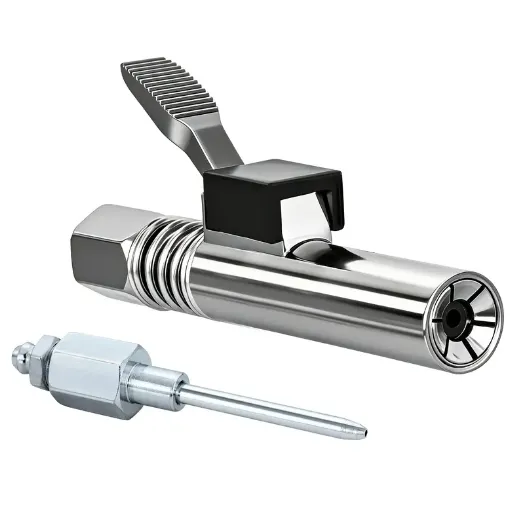
Selecting the correct grease gun coupler comes down to five practical steps. Skip any one of them, and you risk a mismatch that causes leaks, equipment damage, or customer complaints.
Step 1: Identify the Fitting Type on the Equipment
Start with the grease fitting, not the gun. Standard Zerk fittings use a hydraulic coupler. Button head fittings need a button head coupler. Flush or recessed fittings require needle-nose or angled adapters. If you need help identifying fitting types, our guide to types of grease fittings your coupler must match covers the nine most common varieties. For a full decision framework covering application matching, material selection, and coupler compatibility, see our guide on how to choose grease gun fittings.
Step 2: Verify Grease Gun Thread and Output Pressure
Check the thread of the grease gun hose, which is almost always 1/8 inch NPT, at least in North America. Also, check the maximum output pressure of the gun: Hand-operated lever guns usually put out 3,000 to 6,000 PSI. Then, there are air and battery-operated units out there that may provide even more than 10,000 PSI. The coupler must surpass the maximum working pressure of the gun used.
Step 3: Match Access Constraints
Having considered the location of the access, you will be able to determine that a fitting would require a 90-degree adapter or a narrow-nose coupler if it were to be fitted in limited spaces near the steering linkages or some guarded machinery. On the other hand, open-type fittings in agricultural equipment can be best facilitated with simple, straight couplers.
Step 4: Evaluate Duty Cycle and Environment
High-frequency greasing operations increase wear on the couplers. They are provided with heavy-duty four-jaw or locking couplers with case-hardened jaws for busy fleet operations and mining activities, and working lines at manufacturing machines. A standard variant of the three-jaw model is fine for non-professional applications or, say, light car use.
Other harsh environments, like food processing, chemical industry or marine applications, use stainless steel well-protected couplers against corrosion.
Step 5: Consider Total Cost, Not Just Unit Price
Usually, the cheapest coupler is not the most profitable one either. A $0.08 coupler at the standard rate that leaks and is given back should not be considered definitely less valuable compared to a four-jaw model, which, although slightly at $0.15 per unit, may be able to keep working for months. In counting the return rates, customer satisfaction, and repeat order potential one must take care of all these variables while forming the stocking strategy.
Sourcing Grease Gun Couplers at Scale: A B2B Guide

The global lubrication equipment market was valued at approximately $32.12 billion in 2025 and is projected to reach $54.35 billion by 2035, according to industry research. Grease gun couplers represent a small slice of that total, but they are high-turnover consumables with steady demand. Distributors who source wisely can capture strong margins while building loyal customer relationships.
Understanding Price Tiers and Cost Drivers
China is the dominant manufacturing hub for grease gun couplers, with major production clusters in Zhejiang Province. Factory-direct pricing breaks down into clear tiers. Standard three-jaw couplers wholesale for $0.05 to $0.12 per unit. Four-jaw standard models run $0.08 to $0.20. Locking and quick-release couplers cost $0.78 to $1.59. Heavy-duty specialty models with stainless steel bodies or extra-high pressure ratings reach $2.50 to $9.00.
The main cost drivers are material grade, heat treatment quality, plating thickness, and jaw complexity. A manufacturer using untreated carbon steel and thin flash plating can hit the bottom of each price range. A factory using case-hardened steel, multi-stage quality control, and consistent 10-micron zinc plating sits at the top. The difference is visible in performance and return rates.
MOQs and Packaging Options
Products and manufacturers have varying minimum order quantities. An average, standard coupler consists of about half to a thousand pieces. In some cases, locking and quick-release coupler models will have a minimum order quantity of less than 500 pieces. On numerous occasions in the past, customers have required 500 units according to standard manufacture, while at least 100 sets were likely in regard to customer-specific heavy-duty coupling requirements, a volume founder had to attend to in his office in the old days.
Packaging alternatives are available as bulk carton packs for industrial distribution, blister packs for retail display, and custom-branded boxes for private label brands. The two packaging options, blister and box packaging, would count for an additional $0.02 to $0.08 per piece but would boost shelf appeal and perceived value.
OEM and Private Label Opportunities
Among brand owners in the e-commerce business, the grease gun couplers serve as the fastest means to enter the general market. They are small, lightweight, and cost-effective to ship. Facilities include laser-engraved logos, color coding on sleeves for size identification, custom packages with instruction cards, and a brand-carrying case for multi-piece kits.
David started his private-labeled tools under the Amazon private label in 2024. His product was a six-pack grease coupler package. It included one four-jaw standard coupler, one locking coupler, one needle nozzle, one 90-degree adapter, and two additional rubber seals. The custom logo printing needed on a blister card was 1000 units, manufactured at a Chinese plant at $1.25. The landing cost for this package was at $1.85. He would be costing the item at $12.99. This product is now the source of 15 percent of his income every month by driving return sales of his branded grease guns.
What to Look for in a Manufacturing Partner
The right manufacturing partner does more than hit a price point. Look for these four indicators of reliability. First, production capacity that can scale with your growth. A factory with 20 workers and 760 square meters may struggle to fulfill a 50,000-piece order on time. Second, documented quality control processes including incoming material inspection, in-process checks, and final testing. Third, export experience with proper documentation, including certificates of origin, material test reports, and packing lists. Fourth, communication responsiveness. Suppliers who answer technical questions within 24 hours reduce your risk of specification errors.
Need factory-direct grease gun couplers with custom branding options? Contact our team to discuss your specifications, request samples, and receive competitive bulk pricing tailored to your order volume.
Sample Evaluation Checklist
Before placing a large order, evaluate samples against this checklist. Verify thread fit by screwing the coupler onto a standard grease gun hose. It should thread smoothly without wobble or binding. Test jaw grip by attaching the coupler to a worn Zerk fitting and pumping at maximum pressure. The coupler should hold without slipping. Inspect plating coverage under bright light. Bare spots, thin edges, or discoloration indicate poor plating. Check seal quality by verifying that the rubber or leather seal seats evenly and compresses properly.
Maintenance, Replacement, and Safety
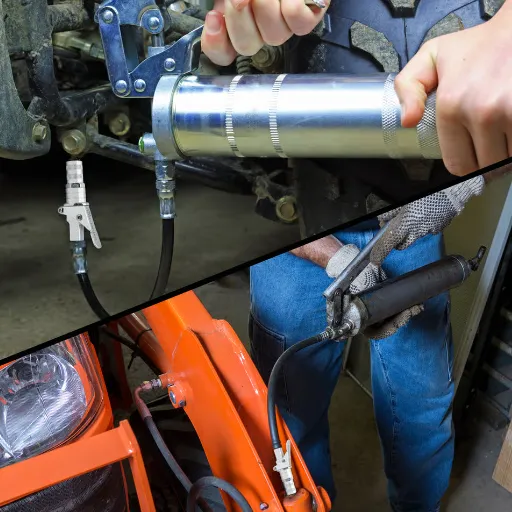
Even the best grease gun coupler wears out. Teaching your customers when and how to replace couplers builds trust and creates additional sales opportunities. For step-by-step troubleshooting of clogged fittings, air locks, and pressure failures, see our grease fitting troubleshooting guide.
Signs a Coupler Needs Replacement
Be sure to change the connection if you observe men from among the following. Leakage of grease next to the assembly fitting during pumping. The jaws are no longer clamping, but the connection slips under pressure. Cracked or chipped jaws. Cracked and hardened rubber seals. The thread damage is preventing smooth attachment to the hose.
An inspection of couplers should be done on a monthly basis for major industrial applications and every three to six months for replacements. Under light use in automotive or agricultural purposes, on an annual basis, it should be replaced.
Cleaning and Storage
Clean the quick couplers every time you finish the job. Usually, contaminants are moved through the couplers to the bearing and possible connection parts with a great likelihood of internal wear of important elements. Store couplers in a dry place. If the coupler will be sitting unused for a longer time, give the threads and jaws a thin coat of oil.
Replacement Intervals by Application
| Application | Duty Cycle | Recommended Replacement |
|---|---|---|
| Heavy industrial, mining | Daily use | Every 1-3 months |
| Fleet maintenance, construction | Weekly use | Every 3-6 months |
| Agricultural equipment | Seasonal use | Every 6-12 months |
| Automotive repair | As needed | Annually or when worn |
| DIY, home use | Occasional | When performance degrades |
Conclusion
A small grease gun coupler can have an enormous impact on the life of equipment and the efficiency of maintenance. It marks a real difference between plain commodity trading and professional-grade distribution when one chooses the right type of coupler, considers the thread standards to fit the market, understands the pressure rating, and is served by manufacturers whose quality control is so real.
There are five points to remember: first, the coupler type should be selected according to the fitting and application. Second is that all thread standards should be proven before you buy. Third is to apply the four-jaw and locking designs for reliability in industrial buyers. Fourth is to assess suppliers by quality systems and export experience, not just price. Fifth is to consider couplers as consumables with specified replacement intervals.
The market for lubricating tools is gradually rising. Grease gun couplers are one of those high-movement accessories that people need time and time again. The correct assortment in the inventory of the distributor with products from loyal manufacturers is intended to create customers who are going to be back in the future when items like grease guns, fittings, and maintenance supplies are required.
Ready to source grease gun couplers for your product line? Reach out to Shanghai Oushike Hardware Tools Co., Ltd. for factory-direct pricing, OEM customization, and samples you can evaluate before you commit to volume orders. We produce standard and locking couplers with consistent quality, flexible MOQs, and branding options that help you stand out in your market.