
Grease Fitting Sizes Chart: Imperial & Metric Thread Guide | 2026
Ordering the wrong grease fitting sizes costs more than a replacement part. A mismatched thread can strip a port, crack a housing, and shut down equipment while you wait for the right size. For distributors, maintenance teams, and procurement buyers, knowing how to identify a fitting quickly protects both machinery and margins.
The most common grease fitting sizes in North America are 1/4″-28 UNF and 1/8″-27 NPT. European and Asian equipment more often uses M6 x 1.0 and M8 x 1.25. These standards are not interchangeable. Each uses different diameters, pitch measurements, and sealing methods. In this guide, we break down the four major thread families, provide a complete grease fitting sizes chart, show how to measure a fitting in three steps, and explain what buyers should know when sourcing in bulk.
Key Takeaways:
- Four major thread families exist: UNF/SAE-LT, NPT/PTF, Metric, and BSP.
- UNF 1/4″-28 dominates roughly 60–70% of North American grease points.
- NPT fittings seal through metal-to-metal thread engagement and require sealant.
- A digital caliper and thread pitch gauge are the fastest way to confirm grease fitting thread sizes.
- M6 (6.0 mm) and 1/4″-28 (6.35 mm) look close but are not interchangeable.
What Are Grease Fitting Sizes and Why Do They Matter
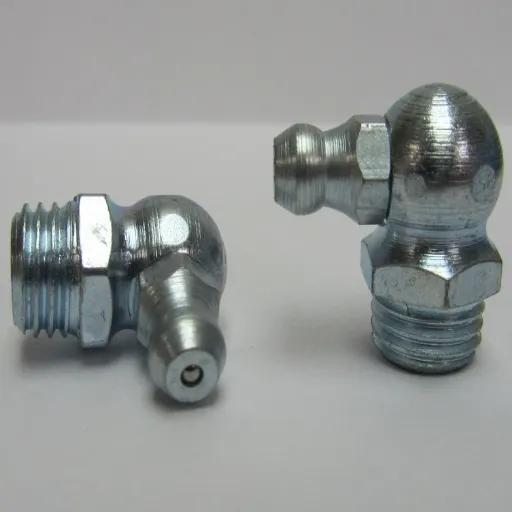
Grease fitting sizes describe the thread dimensions that connect a fitting to a machine housing. These dimensions include major diameter, thread pitch, thread angle, and whether the thread is straight or tapered. A correct match lets grease flow into a bearing or joint under pressure. A wrong match leaks, strips threads, or forces contamination into the lubrication path.
For maintenance teams, the stakes are downtime and repair cost. For buyers and distributors, the stakes are returned orders and lost customer trust. One Ohio maintenance team learned this when 500 metric M6 fittings arrived for equipment that used 1/4″-28 UNF ports. The 0.35 mm diameter difference made every unit unusable.
Fitting size also affects coupler compatibility. Standard hydraulic couplers work with common 1/8-inch ball check fittings. Button head and flush fittings need specialized adapters. When the head style and thread size do not match the grease gun setup, even a correct thread size will not deliver grease reliably.
Grease Fitting Thread Sizes and Standards Explained
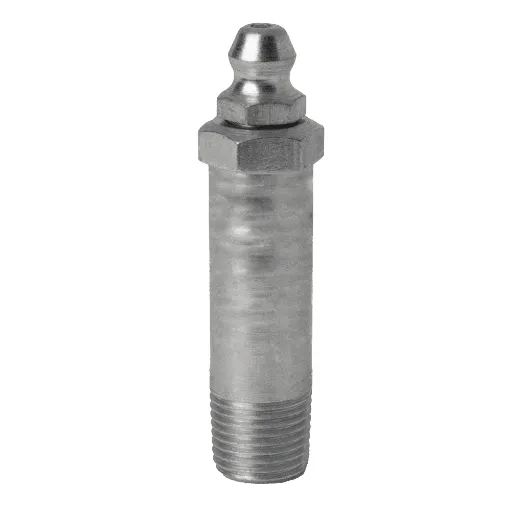
Four main families cover most industrial and automotive applications. Understanding how each seals helps you choose the right replacement or specify the right part for production.
UNF and SAE-LT (North American Straight and Taper)
SAE-J534 defines these threads. 1/4″-28 UNF is the most common grease fitting thread size in North America.
- UNF-2A is straight and seals with an O-ring or washer against a machined shoulder.
- SAE-LT shares the same 1/4″-28 diameter and pitch but is tapered and seals metal-to-metal.
Because UNF and SAE-LT share the same callout diameter, they are often confused. The thread form determines whether an O-ring or taper seal is required.
NPT and PTF (Tapered Pipe Thread)
NPT and PTF are tapered pipe threads common in hydraulic and high-pressure equipment. The taper rate is 1 degree 47 minutes, which creates a wedge seal as the fitting tightens.
- 1/8″-27 NPT has an actual major diameter of about 0.405 inches, not 0.125 inches.
- These threads usually require thread sealant or PTFE tape.
- NPTF (National Pipe Thread Fuel) is a dry-seal variant that does not need sealant.
Metric (DIN 71412 and ISO 3799)
Metric grease fittings are defined by DIN 71412 and ISO 3799. Common sizes include M6 x 1.0, M8 x 1.0, M8 x 1.25, M10 x 1.0, M10 x 1.5, and M12 x 1.5.
- Nominal diameter usually matches the measured major diameter.
- Most metric fittings use straight threads and seal with an O-ring or washer.
- M8 x 1.25 is widely used in European machinery built to DIN 71412.
BSP and BSPT (British Standard)
BSP threads appear on older British equipment and some Asian machinery.
- 1/8″-28 BSPT is the most common BSP grease fitting size.
- BSPT has a 55-degree thread angle, while NPT uses 60 degrees.
- A BSPT fitting may start into an NPT port but will not seal correctly and risks damage.
Complete Grease Fitting Sizes Chart
Use the tables below as a quick reference for grease fitting sizes across imperial, metric, and British standards. For a version you can save or send to a supplier, see the printable chart section at the end of this guide.
Imperial (SAE) Thread Sizes
| Thread Size | Major Diameter | Pitch/TPI | Thread Type | Seal Method | Common Applications |
|---|---|---|---|---|---|
| 1/4″-28 UNF | 0.250″ (6.35 mm) | 28 | Straight | O-ring or washer | Automotive, machinery, trailers |
| 1/4″-28 SAE-LT | 0.250″ (6.35 mm) | 28 | Taper | Metal-to-metal | Automotive, centralized lube systems |
| 5/16″-24 UNF | 0.3125″ (7.94 mm) | 24 | Straight | O-ring or washer | Construction, high-vibration machinery |
| 3/8″-24 UNF | 0.375″ (9.53 mm) | 24 | Straight | O-ring or washer | Heavy industrial, high-load bearings |
| 1/8″-27 NPT | 0.405″ (10.3 mm) | 27 | Taper | Thread sealant | Hydraulic systems, lawn equipment, power tools |
| 1/4″-18 NPT | 0.540″ (13.7 mm) | 18 | Taper | Thread sealant | High-flow industrial, heavy hydraulics |
Metric Thread Sizes
| Thread Size | Major Diameter | Pitch | Thread Type | Seal Method | Common Applications |
|---|---|---|---|---|---|
| M6 x 1.0 | 6.0 mm | 1.0 mm | Straight | O-ring or washer | Light-duty European equipment |
| M8 x 1.0 | 8.0 mm | 1.0 mm | Straight | O-ring or washer | Industrial machinery |
| M8 x 1.25 | 8.0 mm | 1.25 mm | Straight | O-ring or washer | European machinery, DIN 71412 |
| M10 x 1.0 | 10.0 mm | 1.0 mm | Straight | O-ring or washer | Trucks, industrial pivot points |
| M10 x 1.5 | 10.0 mm | 1.5 mm | Straight | O-ring or washer | Coarse pitch industrial |
| M12 x 1.5 | 12.0 mm | 1.5 mm | Straight | O-ring or washer | Heavy machinery |
British Standard Thread Sizes
| Thread Size | Major Diameter | Pitch/TPI | Thread Angle | Compatibility Warning |
|---|---|---|---|---|
| 1/8″-28 BSPT | 9.7 mm (0.383″) | 28 | 55° | Will partially thread into 1/8″-27 NPT but will not seal |
Grease Fitting Head and Ball Size Reference
| Fitting Style | Typical Thread Sizes | Ball Check Diameter | Required Coupler |
|---|---|---|---|
| Standard Zerk (straight) | 1/4″-28, M6 x 1.0, 1/8″ NPT | 1/8″ (3.17 mm) | Standard hydraulic coupler |
| 45-degree angle | 1/4″-28, M6 x 1.0 | 1/8″ (3.17 mm) | Standard hydraulic coupler |
| 90-degree angle | 1/4″-28, M6 x 1.0 | 1/8″ (3.17 mm) | Standard hydraulic coupler |
| Button head | 1/8″-27 NPT, 3/8″ NPTF | 3/16″ (4.76 mm) | Button head adapter |
| Flush / recessed | 5/16″-24, M8 x 1.25 | 1/4″ (6.35 mm) | Needle-nose adapter |
For a deeper look at how head styles match different applications, see our guide to the types of grease fittings explained.
How to Measure Grease Fitting Thread Size in 3 Steps
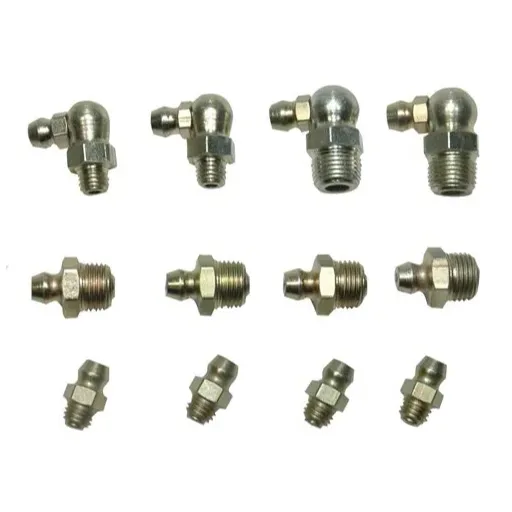
You only need two inexpensive tools to identify most grease fitting thread sizes: a digital caliper and a thread pitch gauge. Here is the fastest three-step process.
Step 1: Check for Taper
Inspect the threads to see if they narrow toward the tip. Measure the diameter at the first full thread and again near the shoulder. If the difference is more than 0.005 inches, the thread is tapered. Tapered threads such as NPT and BSPT seal by wedge engagement. Straight threads such as UNF and metric rely on an O-ring or washer.
Step 2: Measure the Thread Pitch
Hold a thread pitch gauge against the threads until a blade matches perfectly.
- For imperial threads, record threads per inch (TPI). Common values include 28 TPI for 1/4″-28 and 27 TPI for 1/8″ NPT.
- For metric threads, record pitch in millimeters. Common values include 1.0 mm for M6 and M8 fine threads, and 1.25 mm or 1.5 mm for coarse metric fittings.
Step 3: Measure the Major Diameter
Use the digital caliper to measure across the thread crests. Do not measure the root. For pipe threads, remember that the nominal size does not match the measured diameter. A 1/8″ NPT fitting measures about 0.405 inches, not 0.125 inches.
Once you have taper, pitch, and major diameter, match the values to the grease fitting sizes chart above.
Grease Fitting Size Conversion: Imperial to Metric
Cross-referencing imperial and metric sizes helps when you service mixed fleets or source replacement parts internationally. The table below shows the closest equivalents, but these are not interchangeable without the correct tap or adapter.
| Imperial Size | Major Diameter | Closest Metric Equivalent | Metric Major Diameter |
|---|---|---|---|
| 1/4″-28 UNF | 6.35 mm | M6 x 1.0 | 6.0 mm |
| 5/16″-24 UNF | 7.94 mm | M8 x 1.0 / M8 x 1.25 | 8.0 mm |
| 3/8″-24 UNF | 9.53 mm | M10 x 1.0 | 10.0 mm |
| 1/8″-27 NPT | 10.3 mm | None direct | , |
| 1/4″-18 NPT | 13.7 mm | None direct | , |
Always verify fit with a thread pitch gauge before installing. A forced match will damage the port and usually void any warranty on the component.
Most Common Grease Fitting Sizes by Market
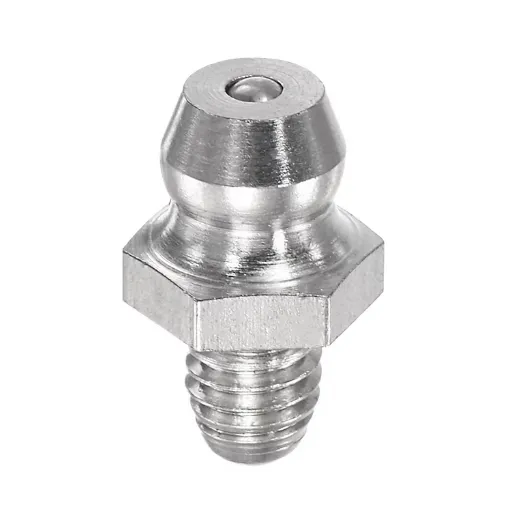
Grease fitting standards vary by region. Matching the right standard keeps your inventory aligned with your customer base.
North America
- 1/4″-28 UNF/SAE-LT: roughly 60–70% of grease points.
- 1/8″-27 NPT: about 20–30%, common in hydraulic equipment.
- 5/16″-24 UNF and 3/8″-24 UNF: frequently used in construction equipment.
Europe
- M6 x 1.0 and M8 x 1.25 dominate passenger and industrial equipment.
- M10 x 1.0 is common on trucks and heavy pivot points.
- DIN 3404 covers button-head high-pressure fittings.
Asia
- Domestic equipment often uses metric threads.
- Export equipment to North America is frequently supplied with imperial threads.
- Buyers sourcing from Chinese factories can often specify the thread standard at the manufacturing stage.
For more details on metric specifications, see our metric grease fittings guide.
Fitting Size, Pressure Rating, and Material Selection
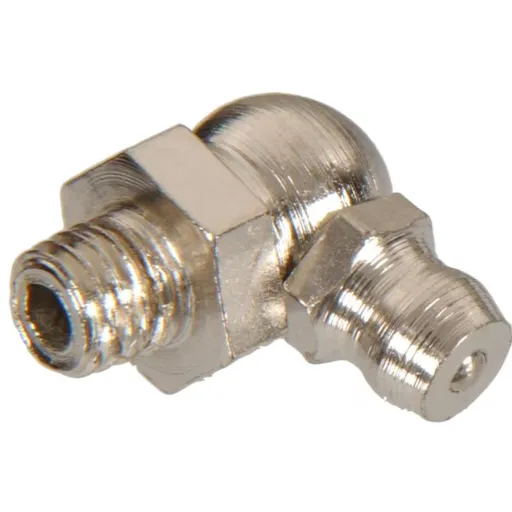
Thread size is only part of the specification. Pressure rating and material determine whether a fitting will last in a given environment.
Standard 1/4″-28 UNF and M6 x 1.0 carbon steel fittings are typically rated for approximately 8,000–10,000 PSI. Button head fittings can handle 10,000–15,000 PSI. Stainless steel 316 offers corrosion resistance for marine, food-processing, and chemical applications.
Recommended torque values:
- Carbon steel straight thread: 7–10 ft-lbs
- Brass straight thread: 5–8 ft-lbs
- Tapered pipe thread: hand-tight plus 1–2 turns
Overtightening any fitting risks cracking the housing or distorting the seal. Always follow the equipment manufacturer’s torque specification when available.
Grease Fitting Size and Coupler Compatibility
Even the correct thread size will not work if the head style does not match the coupler. Standard hydraulic couplers fit 1/8-inch ball check fittings. Button head and flush fittings require specialized adapters.
Color-coding couplers and adapters on the shop floor reduces mismatches. This small step saves time and prevents damage to expensive equipment. For a full overview of grease gun couplers and adapters, read our complete guide to grease gun fittings.
Installation Best Practices
Proper installation protects both the fitting and the port. Start the thread by hand to avoid cross-threading. Tighten straight-thread fittings until the O-ring or washer compresses evenly. For tapered pipe threads, use PTFE tape or thread sealant on NPT fittings, and tighten hand-tight plus one to two turns.
If you are replacing a damaged fitting, inspect the port threads before installing the new part. A damaged port may need rethreading or a thread repair insert. For step-by-step replacement instructions, see our guide on how to install and replace Zerk fittings.
Sourcing Grease Fittings by Size: What Buyers Should Know
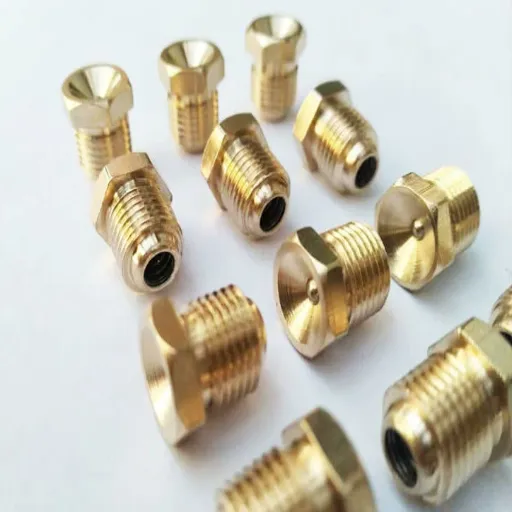
The grease gun and fittings market continues to grow steadily as equipment fleets expand and maintenance demand rises. For buyers and distributors, understanding size-based sourcing keeps inventory efficient and margins healthy.
Standard Sizes with Lowest MOQ
1/4″-28 UNF carbon steel fittings typically have the lowest minimum order quantities, often in the 1,000–5,000 piece range. These sizes are produced in high volume, which keeps pricing competitive and lead times short.
Sizes Requiring Higher Volumes
Stainless steel fittings and larger metric sizes such as M10 and M12 often require higher MOQs or longer lead times. Planning for these sizes prevents stockouts during peak maintenance seasons.
Custom Size Capabilities
OEM manufacturing can produce custom thread sizes, extended shanks, special ball checks, private-label packaging, and laser marking. If your product line needs a non-standard grease fitting size, specify the thread standard, material, head style, and quantity early in the sourcing process.
Looking for a reliable supplier for standard or custom grease fitting sizes? Contact us for product catalogs, bulk pricing, and OEM options.
Common Sizing Mistakes and How to Avoid Them
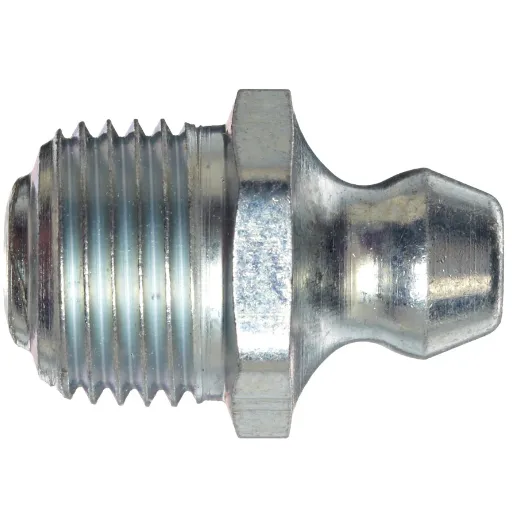
- Confusing 1/8″ NPT with 1/8″ BSPT. Verify with a thread gauge before installation.
- Forcing metric into imperial ports. M6 (6.0 mm) and 1/4″-28 (6.35 mm) are close but not interchangeable.
- Ignoring taper vs. straight. Mismatched sealing methods cause leaks or cracked housings.
- Ordering by nominal pipe size. The measured diameter differs from the nominal diameter.
- Reusing damaged fittings. Damaged threads or ball checks should always be replaced.
Frequently Asked Questions
What is the most common grease fitting size?
In North America, the most common grease fitting size is 1/4″-28 UNF. In Europe and Asia, M6 x 1.0 is widely used.
Are all grease fittings the same size?
No. Grease fittings range from roughly 6 mm to over 13 mm in major diameter, with different pitches, thread angles, and sealing methods.
What thread size is a standard Zerk fitting?
A standard Zerk fitting typically uses 1/4″-28 UNF threads with a straight shank and a 1/8-inch ball check.
Can I use a metric grease fitting on imperial equipment?
No. Metric and imperial threads have different diameters and pitches. Forcing a metric fitting into an imperial port will damage the threads.
What size is a button head grease fitting?
Button head grease fittings usually use 1/8″-27 NPT or 3/8″ NPTF threads with a 3/16-inch ball check diameter.
What is the difference between 1/4″-28 UNF and 1/4″-28 SAE-LT?
Both share the same 1/4-inch major diameter and 28 TPI pitch. However, UNF is a straight thread that seals with an O-ring or washer, while SAE-LT is tapered and seals metal-to-metal.
Conclusion
Choosing the right grease fitting sizes is not just a maintenance detail. It protects equipment, reduces downtime, and prevents costly returns. Four major standards, UNF/SAE-LT, NPT, metric, and BSP, are not interchangeable, and each serves different markets and equipment types. North America favors 1/4″-28 UNF and 1/8″-27 NPT, while Europe and Asia rely on metric sizes like M6 x 1.0 and M8 x 1.25.
Use a digital caliper and thread pitch gauge to confirm taper, pitch, and major diameter before ordering. Keep a grease fitting size chart accessible for your team, and double-check regional standards when sourcing internationally. For buyers who need standard sizes, custom threads, or OEM manufacturing, working with a supplier who understands grease fitting thread sizes makes procurement faster and more reliable.
Need help sourcing the right grease fitting sizes? Request a quote or browse our complete guide to grease gun fittings for related products.