
OEM Grease Fittings Manufacturer in China: Private Label Sourcing Guide
The best OEM grease fittings manufacturer in China is not the one that gives you the best per-piece pricing, but the one whose customization options and minimum order quantities fit your needs. Zhejiang factories usually compete favorably in large volumes of general parts, Guangdong in parts requiring precision tolerance and tooling, and Shandong for lower pricing on heavy equipment parts. Read this guide and learn what the OEM process really entails, what customization options it includes, and how to secure your brand identity even before your first sample arrives.
The part that sells for $1.20 per unit in a U.S. industrial supplier catalog costs only around $0.18 per unit in China. Most of the difference goes to the brand. And that is where OEM comes in: a direct relationship between you and a Chinese OEM grease fittings manufacturer can help you cut prices significantly. More and more wholesalers, fleet operators, and online hardware stores take advantage of such an opportunity.
Carlos owns an industrial supply store in Houston that distributes parts and maintenance supplies to 38 hydraulic repair shops throughout Texas. He used to resell a U.S.-branded product for a standard margin of 18%. But now Carlos is making a bold move and switching to his own line of three SKUs, custom packaging, and brand laser marking for his upcoming 5,000-unit order from a Chinese factory. His gross margins soared from 18% to 47%, which adds up to an additional annual contribution of around $180,000. All he changed was the product packaging.
This guide explains how the OEM grease fittings process actually works inside a Chinese factory, what you can customize, what MOQs and lead times to expect, and how to protect your brand and your designs.
Key Takeaways
- There are 7 steps involved in the OEM manufacturing process, omitting any of which can lead to risks in terms of costs, quality, or schedules.
- MOQ depends on product customization: 500 pieces for stock-only products, MOQ 1,000+ units for those with logos printed, MOQ 3,000+ for customized packaging, and MOQ 5,000+ for customized threading.
- Average OEM manufacturing lead time is 30-60 days; fast manufacturing will involve a 15 to 25% surcharge.
- Zhejiang, Guangdong, and Shandong are China’s primary grease fitting manufacturing bases targeting different OEM manufacturers.
- The factory should be trademarked and have an NNN agreement signed before design disclosure.
What “OEM Grease Fittings Manufacturer” Actually Means
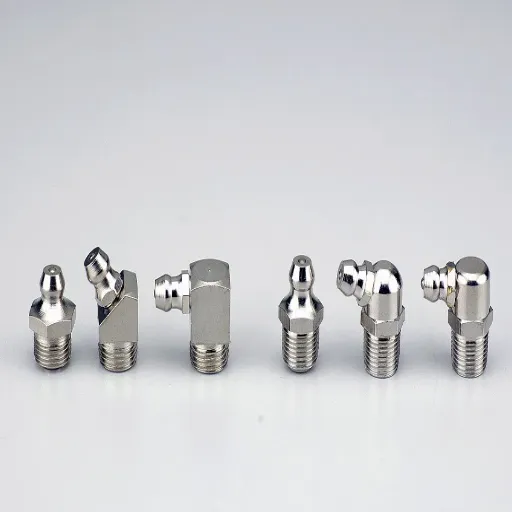
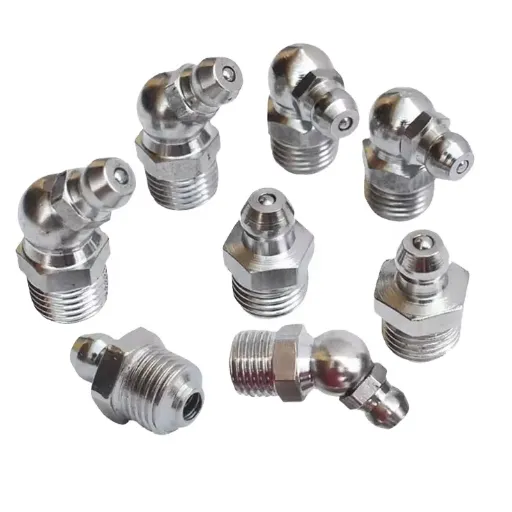
Original equipment manufacturer is commonly abbreviated as OEM. In reality, the term OEM means that a factory is making grease fittings in accordance with your design and under your brand. You decide on design, branding, marketing, and packaging, while the factory provides capacity for manufacturing, tooling, material supply, quality control, and logistics for exports.
The confusion around these terms is common among buyers:
- OEM: You provide design and branding, and the factory manufactures the product
- ODM (original design manufacturer): You choose from a catalog of designs produced by a factory; apply your branding and specify parameters of manufacturing within its tooling capabilities
- Private labeling: A subcategory of OEM or ODM; a product manufactured by the factory but branded and packed under your name without changes to the design.
For the majority of grease fittings, true OEM services do not go beyond the specification of threads, materials, surface finishes, and markings. The geometry of a Zerk-style grease fitting is defined by industry standards like SAE J534 and DIN 71412, so big changes in geometry rarely happen. Buyers typically seek customization in branding (logo and packaging), part numbering, and high-quality manufacturing at affordable prices.
China is the market leader in this category due to high precision machining capabilities, cheap tooling, solid export capabilities, and long experience in manufacturing brass and steel fittings.
Ready to compare partner options? Read our complete guide to grease fitting manufacturers first to vet any factory before requesting OEM samples.
The 7-Stage OEM Grease Fitting Workflow

The OEM project has 7 distinct phases. An omission or skipping of a particular phase normally manifests as a defect, delay, or bad brand reputation.
Stage 1: Specification and drawing review. In this phase, you provide a technical drawing or referential sample. Your OEM supplier reviews the thread compatibility, the material grade, pressure rating, and unique specifications such as ball seat material. Questions are inevitable regarding unique specifications like jaw radius, plating, and unit-of-packaging.
Stage 2: Material selection and certification. Common materials are plain carbon steel, free-cutting brass C36000, and 304 or 316 stainless steels. A reputable OEM factory has mill certificates and material test reports for all materials. Should you be working in an aerospace application requiring traceability, request AS9100D documents upfront.
Stage 3: Sample production and approval. You will receive between 5 and 20 samples based on your technical drawing. You perform quality assessment of the following characteristics: dimensional control, thread engagement, surface finish, and marking. Sample costs vary depending on quantity but are usually reimbursed on the first production order, between $50 to $300 per SKU.
Stage 4: Tooling and mold preparation. This phase is necessary when you are working with custom-made threads or a custom hex size. The cost of producing tooling ranges between $300 to $2,500 and is spread over the first 5000 to 15,000 pieces.
Stage 5: Mass production and in-line QC. The parts are produced in batches during which time hourly samplings are carried out in relation to the following criteria: thread accuracy, dimensional control, and ball seat function. Batch pressure testing at 1.5 times the rated working pressure is industry standard.
Stage 6: Surface finishing, marking, and packaging. Options include zinc plating, nickel plating, black oxide, and passivation, among others. Laser marking of the company logo and part number is done at the tail end of this phase. Packaging assembly entails blister packs, header card, multilingual insert, and barcode labeling.
Stage 7: Pre-shipment inspection and dispatch. Final AQL inspection is conducted using AQL 2.5. Several buyers prefer an independent third-party inspection of the shipment conducted by firms such as SGS, Bureau Veritas, or TUV.
Customization Options: What You Can Actually Brand

Brand owners often underestimate how many points on a grease fitting are customizable. The list goes well beyond a logo.
Laser-Marked Logos and Part Numbers
Laser marking is the standard branding method for grease fittings. It survives chemicals, friction, and high temperatures far better than ink stamping. Logos can sit on the hex flat, the body shoulder, or the head, depending on space. A grease fitting OEM with a custom logo package typically includes a 2D vector art file, a sample placement diagram, and a laser-marking power and feed-rate specification.
Color Coding and Identification Rings
Color anodized sleeves, colored plastic caps, and ring markings help end-users identify thread types or pressure ratings at a glance. Distributors searching for a custom grease fitting manufacturer often request color systems to reduce installation errors at fleet shops.
Branded Packaging and Inserts
Blister packs with a header card carrying your brand are the most common retail format. Multi-language instruction inserts, warranty cards, and barcoded outer cartons are all customizable. Many e-commerce sellers add a QR code linking to product registration. A reliable private label grease nipple supplier quotes blister-pack tooling, header-card artwork, and barcode setup as a single packaged line item.
Custom Thread Profiles and Non-Standard Sizes
If your equipment uses a non-standard thread, you can specify it. Common variations include uncommon BSP sizes, metric pitches outside DIN 71412 defaults, and proprietary fine-pitch threads for specialty mining or aerospace equipment.
Custom Alloys and Heat Treatment
Beyond standard carbon steel, factories produce in 316 stainless for marine and food applications, hardened tool steel for impact resistance, and aerospace-grade alloys for AS9100D programs.
New to grease gun fittings? Start with our complete guide to grease gun fittings for a full overview of fitting types, threading systems, and applications before locking in your OEM specifications.
MOQ and Pricing by Customization Level
Pricing and MOQ both scale with customization. The table below reflects the 2026 market ranges of established Chinese factories. Buyers searching for low MOQ grease fittings China options should expect MOQ to rise predictably with each layer of customization added.
| Customization Level | Typical MOQ | Unit Price Range | Lead Time |
|---|---|---|---|
| Plain factory-stock fitting, no branding | 500–1,000 pcs | $0.10–$0.40 | 15–25 days |
| Standard fitting + custom laser logo | 1,000–2,000 pcs | $0.15–$0.55 | 25–35 days |
| Standard fitting + branded blister pack | 3,000–5,000 pcs | $0.25–$0.85 | 35–45 days |
| Custom thread or profile | 5,000–10,000 pcs | $0.30–$1.20 | 45–60 days |
| Full private label (logo + packaging + barcode) | 5,000–10,000 pcs | $0.40–$1.80 | 50–65 days |
| Premium materials (316 stainless, AS9100D-grade) | 1,000–3,000 pcs | $1.50–$6.00 | 40–55 days |
Two cost drivers buyers often miss are tooling amortization and packaging. A $1,500 tooling fee spread over 5,000 pieces adds $0.30 per unit; spread over 20,000 pieces, it adds $0.075. Branded blister packs typically add $0.08 to $0.25 per unit, depending on artwork complexity.
Choosing the Right Chinese Manufacturing Region

There are three major centers for China’s OEM grease fittings manufacturers. The OEM customer profile differs between each center:
Zhejiang (Wenzhou, Ningbo)
The high-volume center is Zhejiang, where manufacturing plants are equipped with extensive machining lines, which produce general-purpose carbon steel and brass grease fittings. The unit costs are the lowest when it comes to production runs of 10,000+ units. Ideal for: Distributors and e-commerce retailers establishing private label SKUs.
Guangdong (Dongguan, Foshan)
In Guangdong, there is a greater emphasis on precise machining capabilities and tighter tolerances. These are usually the manufacturing plants selected by OEM projects that involve premium finishing, custom alloy components, or even aerospace certifications. The unit price is up to 30% higher compared to Zhejiang. Ideal for: Brand owners developing industrial, aerospace, or professional tools for OEM projects.
Shandong (Linyi, Qingdao)
The specialty center for low-cost products, Shandong, provides cost-efficient fittings for heavy machinery applications and construction equipment. The minimum order quantity can be lower, and the unit price is aggressively set. However, the quality standards may vary greatly between individual manufacturing plants. Ideal for: Cost-conscious distributors and fleet management companies.
Verifying an OEM Factory Before You Commit
Before transferring tooling fees or sharing proprietary drawings, verify the factory the same way professional procurement teams do. Treat every China grease fitting factory OEM quote with the same procurement rigor you would apply to a domestic supplier.
- Business license and export license: Request scanned copies. Check the registered business scope and the export authorization.
- Production capacity: A serious OEM factory provides a video walkthrough or accepts an in-person audit. Look for CNC lathes, thread-rolling machines, plating lines, and a dedicated QC station.
- Sample evaluation: Run dimensional checks with GO/NO-GO thread gauges, pressure test to 1.5 times the rated working pressure, and inspect the plating with a salt spray reference.
- Third-party inspection: SGS, Bureau Veritas, and TÜV are the three most-used inspection partners in China for hardware tools. Quote them in your contract for the pre-shipment AQL.
- Reference customers: Ask for two or three OEM clients in your region. A factory unwilling to share any references is a warning sign.
If your equipment uses imperial threads, cross-check the supplier’s quality system against SAE J534. For metric thread compliance, verify DIN 71412 certification.
Protecting Your Brand and IP
The biggest mistake new private-label buyers make is sharing designs without an IP framework in place.
Trademark Registration
Register your brand with the USPTO for U.S. protection, EUIPO for the European Union, and the WIPO Madrid System for international coverage. File before the first OEM order. If you wait, a faster filer in your destination market can claim the mark and block your imports.
NNN Agreements
Standard Western NDAs do not enforce well in Chinese courts. Use a Non-Disclosure, Non-Use, Non-Circumvention agreement drafted in Chinese, governed by Chinese law, with jurisdiction in the factory’s local courts. NNN agreements protect drawings, sample geometries, and packaging artwork.
Design Ownership Clauses
Your OEM contract should state that tooling, drawings, and design files are your property, even if the factory paid the initial tooling cost (with amortization clauses). Without this clause, the factory can produce parallel runs for other buyers using your tooling.
Golden Sample Agreements
A golden sample is the approved reference unit signed by both parties. All future production must match it. Without a golden sample on file, the factory has no contractual baseline for the AQL inspection.
Aiyana runs a private-label industrial supply company in Phoenix. On her first OEM order, she sent drawings to a Shandong factory before signing an NNN. The factory delivered her order on spec, but two months later, she discovered a competitor in her exact market selling an identical product with a different brand. The factory had not violated any contract because no contract existed. Aiyana now requires an NNN in place before any drawing leaves her office.
Sample Workflow: From Drawing to Approved Production

The sample stage is where most OEM projects succeed or fail.
Step 1: Brief the factory completely. Send a dimensioned drawing or 3D file, the reference material grade, the surface finish specification, packaging artwork, and the target end-use. Vague briefs produce vague samples.
Step 2: Confirm sample fees and tooling charges. Reasonable sample fees run $50 to $300 per SKU. Tooling fees for custom threads run $300 to $2,500. Get both in writing before approving sample production.
Step 3: Run two sample iterations. The first sample lands at 15 to 20 days. Inspect, mark up changes, and return one signed sample with comments. The second sample lands at 10 to 15 days after that. Approve only when the unit matches your brief on every measured point.
Step 4: Sign the golden sample. Both you and the factory sign and seal the approved sample. The factory keeps one, you keep one. This becomes the AQL baseline for all production batches.
Mei manages procurement for an automotive aftermarket brand in Ontario. Her team approved a custom-thread sample by email without signing a physical golden sample. The first production batch arrived with a thread pitch 0.25 mm off her spec. The factory pointed to the email approval, refused a free rework, and offered only a 15 percent rebate. Mei now signs and seals every golden sample before mass production begins.
Common Pitfalls and How to Avoid Them
Five recurring problems show up when working with an OEM grease fitting manufacturer in China.
- Wrong factory size: A 500-piece order at a 500,000-piece-per-month factory gets deprioritized. Match factory capacity to your order size.
- Hidden tooling costs: Some quotes exclude tooling. Always ask whether tooling is included, separate, or amortized.
- Specification drift: Mass production samples sometimes differ from approval samples. Independent pre-shipment inspection catches this.
- Packaging below product quality: A premium fitting in a flimsy blister destroys the brand impression. Spec the packaging with the same rigor as the product.
- No third-party inspection: Self-reported AQL data from a factory is not the same as an SGS or Bureau Veritas report. Budget for inspection on every order.
Working with Oushike as Your OEM Partner
Shanghai Oushike Hardware Tools Co., Ltd. produces OEM and private-label grease fittings for distributors, brand owners, fleet operators, and e-commerce sellers across more than 30 countries. Our OEM service covers:
- Custom laser marking with logos, part numbers, and date codes
- Custom packaging design including blister packs, header cards, multi-language inserts, and barcoded cartons
- Custom thread profiles including non-standard SAE, DIN, BSP, and metric variants
- Material upgrades, including 316 stainless, brass C36000, and hardened tool steel
- Flexible MOQs starting at 1,000 pieces for logo marking and 3,000 pieces for full private-label launches
- End-to-end project management from first drawing review through pre-shipment inspection
Our quality system includes batch pressure testing at 1.5 times rated working pressure, salt-spray testing on plated components, and AQL 2.5 inspection on all outbound shipments.
Conclusion
A Chinese OEM grease fittings manufacturer is the most efficient way to launch or scale a private-label industrial product line. The seven-stage workflow, the regional differences across Zhejiang, Guangdong, and Shandong, the MOQ and pricing tiers, and the IP protections all matter more than the per-piece quote on any single inquiry.
Pick a factory whose capacity matches your order size. Lock down your trademark and NNN agreement before the first drawing leaves your office. Sign a golden sample before mass production. Budget for third-party inspection. These four moves protect the difference between a profitable private-label launch and a costly lesson.
Ready to launch your private-label grease fitting line? Contact Shanghai Oushike Hardware Tools Co., Ltd. for an OEM consultation, sample kit, or factory tour. We help brand owners and distributors move from first drawing to branded delivery with stable production, clear MOQs, and consistent quality.