
M6 Thread Pitch: Coarse vs Fine Thread Explained
M6 thread pitch is 1.0 mm in the standard coarse thread, written M6 x 1.0. The preferred fine pitch is 0.75 mm, written M6 x 0.75. A third, extra-fine pitch of 0.5 mm exists, but it is not the standard fine choice for M6.
Two M6 screws can look identical and still refuse to fit each other. Same diameter, same length, same head. The difference is a single number on the label, and missing it means a stripped hole or a fastener that never seats.
That number is the thread pitch. It’s also the specification most buyers and designers second-guess, because the advice online seems to contradict itself. Fine threads get described as stronger, then described as easier to strip. Both are true, and knowing why separates a confident specification from a guess.
This guide explains what M6 thread pitch actually is, how the three M6 pitches differ, when fine thread earns its place, and how pitch changes the drill, the strength and the tools you need. Every value here comes from ISO metric thread standards, cross-checked against fastener references and our own production work. If you need the wider picture on the fastener itself, our M6 screw size guide covers the full dimensional set.
Key Takeaways
- M6 coarse pitch is 1.0 mm and is the default. A drawing that says “M6” with no pitch means M6 x 1.0.
- M6 fine pitch is 0.75 mm. The 0.5 mm pitch is extra-fine, not the preferred ISO fine size for M6.
- Fine thread has a larger stress area (22.0 mm² against 20.1 mm², about 9% more) yet strips more easily, because less thread metal sits in engagement.
- Pitch sets the tap drill: 5.0 mm for M6 x 1.0, 5.2 mm for M6 x 0.75, and 5.5 mm for M6 x 0.5.
- Default to coarse. Reach for fine only for vibration, precision adjustment, thin walls or sealing.
What Is the Thread Pitch of M6?
M6 thread pitch is 1.0 mm in the coarse series, which is the standard default. The preferred fine pitch is 0.75 mm, and a finer 0.5 mm pitch is available as a supplementary size. Pitch is the distance from one thread crest to the next, measured in millimeters.
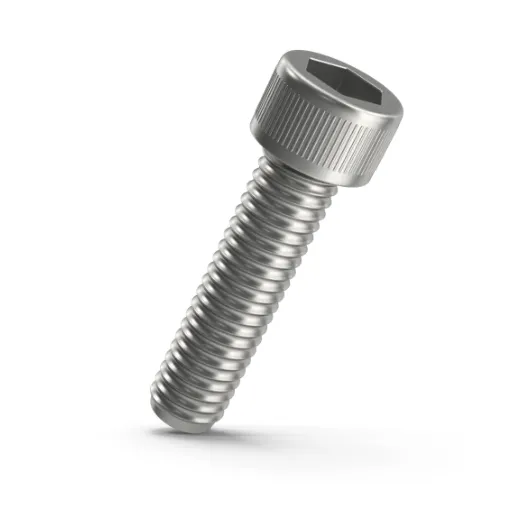
Start with what pitch is not. It isn’t the diameter. Every M6 fastener shares the same 6.0 mm nominal thread diameter, coarse or fine. Pitch describes how tightly the threads are packed along that diameter, and it’s the only thing that changes between M6 x 1.0 and M6 x 0.75.
The practical consequence is simple. A coarse M6 fastener advances 1.0 mm into the hole with each full turn. A fine one advances 0.75 mm. That half-millimeter of difference per turn is what makes one thread behave differently from the other under load.
A visual check helps, but only as a starting point. Coarse threads look sparser, with roughly 10 crests across a 10 mm span. Fine threads look denser, closer to 13 in the same distance. The label is still the authority, so confirm with a gauge rather than trusting your eye.
The Three M6 Thread Pitches at a Glance
M6 is not a single thread. It is a diameter with three pitch options, and only one of them is a default.
| M6 thread | Type | Standard status | Pitch diameter | Tensile stress area | Tap drill |
|---|---|---|---|---|---|
| M6 x 1.0 | Coarse | ISO 261 default for 6 mm | 5.350 mm | 20.1 mm² | 5.0 mm |
| M6 x 0.75 | Fine | Preferred fine pitch (ISO 262) | 5.513 mm | 22.0 mm² | 5.2 mm |
| M6 x 0.5 | Extra-fine | Supplementary pitch under ISO 261 | 5.675 mm | About 24.0 mm² | 5.5 mm |
Two standard formulas produce those numbers. Pitch diameter is nominal diameter minus 0.6495 times the pitch, which gives 5.513 mm for M6 x 0.75. Tensile stress area is 0.7854 times the square of the nominal diameter minus 0.9382 times the pitch, which yields 22.0 mm² for M6 x 0.75 against 20.1 mm² for M6 x 1.0.
That gap of roughly 9% is the origin of the claim that fine threads are stronger. It is also only half the story, which the next section takes apart. For the drill sizes that go with each pitch, our M6 drill size guide covers tapping and clearance holes in detail.
Sourcing fasteners and the tools to check them? Oushike manufactures hand tools for professional use, backed by OEM and private-label programmes for distributors. Request a quote for your range.
Coarse vs Fine Thread: What Actually Changes
The two M6 thread pitches differ in more than the number on the label. Choosing between M6x1.0 and M6x0.75 changes strength, stripping resistance, vibration behaviour and assembly speed, and the trade-offs don’t all point the same way.
| Property | Coarse, M6 x 1.0 | Fine, M6 x 0.75 |
|---|---|---|
| Tensile stress area | 20.1 mm² | 22.0 mm² (about 9% larger) |
| Tensile strength at the same class | Baseline | About 9% higher |
| Stripping resistance | Higher | Lower |
| Stress on the first two threads | About 179% of average | About 231% of average |
| Vibration resistance | Lower | Higher |
| Travel per turn | 1.0 mm | 0.75 mm |
| Cross-threading risk | Lower | Higher |
| Damage and contamination tolerance | Better | Worse |
| Thin-wall suitability | Worse | Better |
| Availability and cost | Universal and cheaper | Limited and costlier |
The contradiction sits in the first three rows. Fine thread carries a larger stress area, so it should hold more load in tension. Then it strips sooner, which sounds impossible until you look at how the load is shared.
A coarse thread cuts deeper, so more thread metal engages along the same length of hole. That depth spreads the load across more flanks and lets the joint tolerate a little damage or contamination.
A fine thread is shallower. It concentrates more of the load on the first two threads, around 231% of the average stress against 179% for coarse. When those front threads shear, the failure walks down the thread and the joint lets go.
Fastener engineering has long accepted this, and standards bodies acted on it. Under SAE specifications, Grade 5 fine-thread nuts carry a reduced proof load of 109,000 psi, while their coarse-thread counterparts hold at 120,000 psi.
The practical reading is blunt. A fine thread is stronger in pure tension but weaker against stripping, and in small fasteners it’s stripping, not tensile stress area, that usually decides when a joint fails. That’s the real reason coarse stays the default.
One point of clarity. Coarse and fine carry no quality difference under ISO 261. One is not a premium version of the other. They are application choices, and the label simply tells you which you hold.
Is M6 Coarse or Fine Thread?
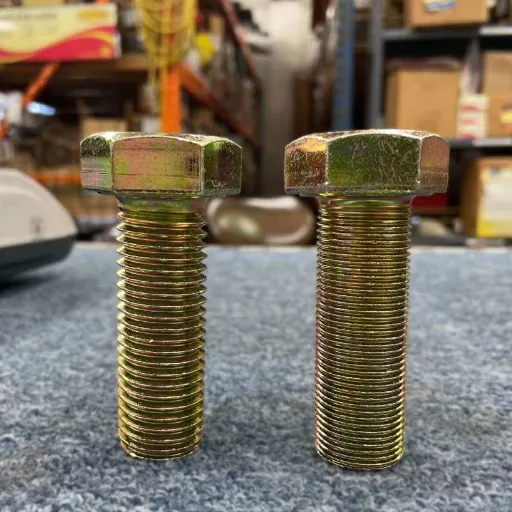
An unmarked M6 is always coarse. If a drawing, bin label or part list says “M6” with no second number, it means M6 x 1.0. Fine threads are never left implicit, because 0.75 mm is not the default for the 6 mm diameter.
Reading the marking takes one rule. The pitch is written only when it departs from coarse. So “M6 x 0.75” tells you fine, while plain “M6” tells you the standard coarse thread.
A full callout adds length to the same pattern. M6 x 1.0 x 20 means a 6 mm diameter, a 1.0 mm pitch and a 20 mm length. When the pitch is coarse, the middle number often disappears and the callout shrinks to M6 x 20.
The failure mode here is guessing. Coarse and fine threads look similar enough in a parts bin that plenty of people identify them by eye and get it wrong. A pitch gauge settles the question in seconds. Our how to measure screw size guide walks through the measuring method step by step, and the naming system behind the M series is covered in metric screw sizes.
When to Use Fine Thread, and When Not To
Fine thread is a targeted tool, not an upgrade. Specify M6 x 0.75 when one of these conditions applies.
- Vibration-critical joints. The smaller helix angle gives a higher self-locking effect, so the fastener resists loosening. Note that a coarse thread plus a Nord-Lock washer or a threadlocker often solves the same problem without changing the fastener.
- Precision adjustment. A 0.75 mm advance per turn gives finer positioning than 1.0 mm, which matters on adjustment screws and set screws.
- Thin-walled tubes and bosses. A shallow thread leaves more wall thickness behind it than a coarse thread would.
- Hydraulic and sealing applications. More engaged threads per unit length reduce the paths a fluid can leak through.
- Higher tensile strength at the same diameter. When a larger fastener will not fit, fine thread buys roughly 9% more stress area.
The not-for list matters just as much.
- Plastics. A fine machine screw generates high radial force over a short distance and can crack ABS or polystyrene, or produce a false lock that feels tight but holds nothing. Use a coarse self-tapping screw or a moulded brass M6 x 1.0 insert instead.
- General assembly. Coarse threads assemble faster and tolerate more contamination and minor misalignment.
- Maintenance and repair. Distributor shelves are coarse-dominated, so a fine fastener is harder to replace later.
- Any joint whose mating thread is already coarse. The two will not mesh at any torque.
Distributors: stocking both pitches is a competitive edge. Oushike supplies hand tools and fastening accessories with flexible MOQs and private-label options, so you can build a fastening line rather than a single bin. Tell us your range requirements.
Metric Thread Pitch Chart: Coarse and Fine, M3 to M12
The M6 pattern repeats across the metric series. Each diameter has one coarse pitch and at least one finer option, and both follow the same naming logic.
| Size | Coarse pitch | Common fine pitch |
|---|---|---|
| M3 | 0.5 mm | 0.35 mm |
| M4 | 0.7 mm | 0.5 mm |
| M5 | 0.8 mm | 0.5 mm |
| M6 | 1.0 mm | 0.75 mm |
| M8 | 1.25 mm | 1.0 mm |
| M10 | 1.5 mm | 1.25 mm |
| M12 | 1.75 mm | 1.25 mm |
Two details in that table catch people out, and both are worth knowing.
First, the same number means different things at different diameters. A 0.5 mm pitch is the fine option for M5, but the extra-fine option for M6, where fine means 0.75 mm. Never read a pitch value without its diameter.
Second, larger sizes sometimes carry more than one fine pitch. M12 is listed at 1.25 mm fine in the ISO 262 selected sizes, and ISO 261 also permits 1.5 mm. Both are valid, and 1.25 mm is the preferred fine value.
ISO metric pitch values come from three standards that are worth naming. ISO 261 sets the general plan of preferred and permitted combinations. ISO 262 narrows that to a selected list for screws, bolts and nuts, which is where M6 x 0.75 appears as the fine size. ISO 965 governs the tolerances, with 6g for external threads and 6H for internal ones.
TR Fastenings publishes a thread conversion table that covers the coarse and fine series side by side, and Engineers Edge lists the ISO metric coarse and fine dimensions in full. For the complete M3 to M24 reference with every dimension, our own metric screw size chart gathers pitch, diameter, tap drill and driver size in one place.
Pitch vs Lead: The Distinction Most People Miss
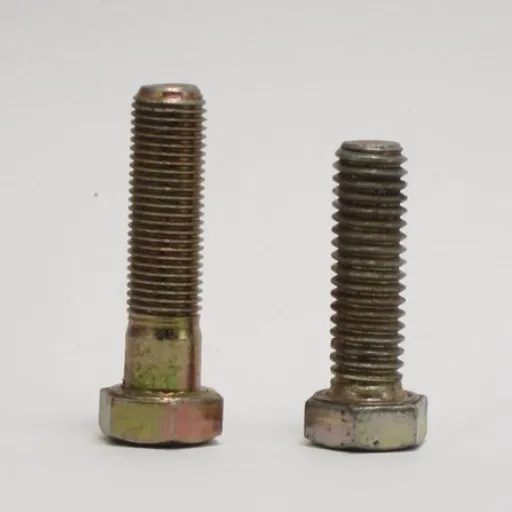
Pitch and lead are often used interchangeably, and for M6 fasteners that happens to be correct. It isn’t correct in general, and the difference is easy to state.
Pitch is the distance between corresponding points on adjacent threads. Lead is the axial distance the fastener travels in one complete 360 degree turn. For a single-start thread, the two are equal. Every standard M6 screw is single-start, so M6 x 1.0 advances 1.0 mm per turn and M6 x 0.75 advances 0.75 mm.
The distinction matters once a thread has more than one start. A multi-start thread carries two or more independent threads, so lead equals pitch times the number of starts. A two-start thread with a 1.0 mm pitch advances 2.0 mm per turn. You will not meet this on a standard M6 fastener, but you will meet the terminology, and knowing which term applies keeps a specification honest.
How Pitch Changes the Rest of the Job
Choosing a pitch isn’t an isolated decision. It sets the drill, the tooling, the clamping precision and the strength of the finished joint.
| Choosing | Tap drill | Crests per 10 mm | Travel per turn | Relative tension strength | Stripping risk | Sourcing |
|---|---|---|---|---|---|---|
| M6 x 1.0 coarse | 5.0 mm | 10 | 1.0 mm | Baseline, better stripping | Lowest | Universal |
| M6 x 0.75 fine | 5.2 mm | About 13 | 0.75 mm | About 9% higher, worse stripping | Moderate | Limited |
| M6 x 0.5 extra-fine | 5.5 mm | 20 | 0.5 mm | About 19% higher, worst stripping | Highest | Rare |
The tap drill column is the one that bites hardest in the workshop. A 5.0 mm bit tapped for a fine thread removes too little material, so the tap loads up and can snap. The same mistake in reverse, a 5.2 mm hole tapped for coarse thread, cuts a shallow thread that strips early.
Torque changes too. A finer pitch reaches the same clamp load at a lower tightening torque, which is useful on sensitive assemblies and risky if the operator works from habit. Stripping and torque limits by grade are covered in our M6 torque specification guide.
Standards, Gauges and the Right Tool for the Job
The tools that settle a pitch question belong on the bench, not in a drawer.
- Thread pitch gauge. Metric blades typically run from 0.5 mm to 6.0 mm. Press the blade against the thread and rock it until the teeth seat. The blade that meshes cleanly carries the pitch value.
- Calipers. A pitch gauge gives you pitch and nothing else, so pair it with a caliper for the diameter.
- Taps matched to the pitch. A coarse tap will not cut a fine thread. Keep M6 x 1.0 and M6 x 0.75 taps separate and labelled.
- A known nut or bolt. Threading a suspect fastener onto a known M6 x 1.0 nut confirms diameter and pitch in one motion.
When Marta, a maintenance technician at a packaging plant, chased a recurring loose guard, her first instinct was to re-tap the frame to M6 x 0.75. A colleague stopped her and pointed at the label: the frame was coarse. Re-tapping would have destroyed a perfectly good thread. The real fix was a coarse M6 x 1.0 fastener with a locking washer, a fraction of the work and fully replaceable from stock.
Sourcing Fasteners and Gauges as a Distributor Line
Pitch choice has a commercial side. A distributor who stocks M6 in only one pitch sends customers elsewhere the moment a fine thread is specified, and fine threads show up in instrumentation, hydraulics and precision equipment.
The stronger play is to carry both pitches alongside the tools that resolve the question. Metric thread pitch gauges, the right taps for each pitch, and calipers turn a single fastener sale into a complete fastening line. The global hand tools market was valued at about US$25.61 billion in 2025 and is expected to reach US$34.51 billion by 2033, according to Straits Research, and fastening accessories sit squarely inside that demand.
Oushike supports distributors building that range with factory-direct pricing, flexible MOQs and OEM or private-label programmes. Private labelling covers packaging and branding, so a two-pitch fastener line can carry your own identity from the first order. Quality control runs across production stages to keep thread tolerances consistent between batches, and export documentation is handled in house for buyers shipping out of Shanghai and Ningbo.
If you are assembling a fastening range, send us your requirement list and our team will map it against current production.
M6 Thread Pitch FAQ
What is the thread pitch of M6?
M6 has a coarse pitch of 1.0 mm, written M6 x 1.0, which is the standard default. The preferred fine pitch is 0.75 mm, written M6 x 0.75. A 0.5 mm extra-fine pitch is also available as a supplementary size.
Is M6 coarse or fine thread?
An unmarked M6 is coarse. If a drawing or label says “M6” with no pitch, it means M6 x 1.0. Fine thread is always written out as M6 x 0.75, because it is not the default for that diameter.
What is M6 x 0.75?
M6 x 0.75 is the preferred fine thread for a 6 mm diameter. It has a 0.75 mm pitch and needs a 5.2 mm tap drill. It is used for vibration resistance, precision adjustment, thin walls and sealing applications.
Is M6 x 0.5 the same as M6 fine thread?
No. M6 x 0.5 is an extra-fine pitch permitted under ISO 261, but it is not the preferred fine pitch for M6 under ISO 262. The standard fine thread for M6 is 0.75 mm, and it is far easier to source.
What is the difference between M6 x 1.0 and M6 x 0.75?
The only difference is the pitch. M6 x 1.0 is coarse and advances 1.0 mm per turn, while M6 x 0.75 is fine and advances 0.75 mm. They are not interchangeable because the thread spacing will not mesh.
Are M6 coarse and fine threads interchangeable?
No. Both share a 6.0 mm diameter and a 60 degree thread angle, but different pitches mean the threads will not mate. Forcing one into the other cross-threads and can destroy the parent thread beyond repair.
Is fine thread stronger than coarse?
A fine thread has a larger tensile stress area, so it is about 9% stronger in pure tension. It is weaker against stripping, however, because its shallower thread engages less metal. In practice coarse threads are more forgiving and remain the default.
Where can I buy M6 fasteners in both pitches, with gauges and taps?
Oushike supplies hand tools and custom tool programmes for distributors and brand owners, with flexible MOQs and private-label options. Share your requirement list and our team will respond with a quote.
Conclusion
M6 thread pitch is the number that decides whether your hardware works in the application, and it comes down to three values. Coarse is 1.0 mm and remains the default for almost every job. Fine is 0.75 mm and earns its place in vibration-heavy, precision, thin-wall or sealing work. The 0.5 mm pitch exists, but it’s supplementary and best avoided unless a drawing specifically calls for it.
Keep the trade-off straight. Fine thread brings about 9% more stress area and strips sooner, because it engages less metal. That’s why coarse threads stay the practical choice and why fine thread needs a reason, not a preference.
The drill changes with the pitch, so match them: 5.0 mm for M6 x 1.0, 5.2 mm for M6 x 0.75, and 5.5 mm for M6 x 0.5. Confirm the pitch with a gauge rather than by eye, because two M6 fasteners that look identical will not fit together.
If you are specifying M6 hardware or building a fastening range for your market, we are glad to help you get the pitch right the first time. Request a quote and our team will support you from a single specification question to a full distributor programme.