
EDC Pry Bar Guide: Titanium, Mini & Keychain Options
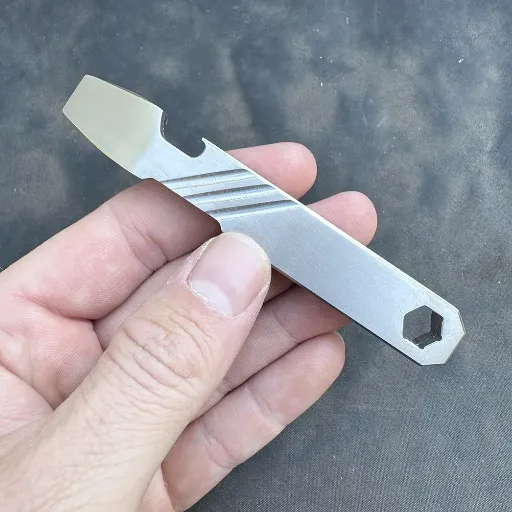
An EDC pry bar is a pocket-sized metal bar, usually two to six inches long, built to handle the light prying, scraping, and opening tasks your knife shouldn’t. Titanium (Grade 5) gives you the lightest, most corrosion-proof daily carry. Heat-treated stainless steel gives you the most prying force for the money.
Here’s the counterintuitive part that most buying guides skip: titanium is not the “strongest” EDC pry bar material. Grade 5 titanium is strong for its weight, but it is softer than hardened steel and will deform first under real leverage. If you carry a bar to pry hard, steel wins. If you carry one so you never notice it, titanium wins.
If you have ever used the tip of a folding knife to open a paint can, you already know why a dedicated EDC pry bar earns its place in a pocket. This guide gives you the decisions that matter: which material, which size, what a good tip looks like, and how these tools are actually made. For the full picture of the category, start with our complete guide to pry bar types and designs.
Key Takeaways
- Titanium is the lightest, most rust-proof choice, but heat-treated stainless steel resists hard prying better and usually costs less.
- The pocket sweet spot is 3.5″–4.3″: long enough for leverage, short enough for a comfortable pocket clip.
- Stock thickness (roughly 0.16″–0.35″), not just the alloy, decides whether a bar bends under load.
- Three or four functions done well beat an eight-in-one with weak, gimmicky mechanisms.
- An EDC pry bar is a single, low-MOQ SKU, one of the easiest tools to private-label and brand.
What Is an EDC Pry Bar?
An EDC pry bar is a small, flat metal bar carried daily for light-duty prying, scraping, opening, and screwdriving so those tasks don’t chip or snap a knife tip. Most weigh under one ounce in titanium and up to about two ounces in steel, and combine a pry tip with a bottle opener and one or two extras.
The “EDC” stands for everyday carry. These tools are a complement to a knife, not a replacement. Where a full-size flat bar or pry bar set lives in a toolbox, an EDC pry bar lives in a pocket, on a keyring, or clipped to a bag.
That gives it a different job description. Its goal is not heavy demolition. Its goal is the endless small friction of daily life: a stubborn battery cover, a staple in a shipping crate, a label that won’t peel, a lid that won’t pop. That is why an edc pry tool earns its keep in small moments rather than big ones.
Titanium vs Stainless Steel vs Carbon Steel
For an EDC pry bar, material is the first decision, and it is the one most guides oversimplify into “titanium is premium.” The right answer depends on whether you carry for convenience or pry for real. The table below is the buyer’s shortcut; the deeper science of alloys, forging, and hardness lives in our guide to how pry bar materials are made.
| Titanium (Grade 5 / Ti-6Al-4V) | Stainless Steel (304 / 420 / 420HC) | Carbon / Tool Steel (coated) | |
|---|---|---|---|
| Typical price | $40–$120 (value Ti from ~$19–$35) | $10–$35 | $15–$50 |
| Weight (3″ bar) | Under 1 oz | ~1.5–2 oz | ~1.5–2 oz |
| Density vs steel | ~45% of steel | Baseline | Baseline |
| Corrosion | Excellent, won’t rust in a pocket | Good; spot-rust possible | Poor unless coated |
| Strength for weight | Highest, but softer than hardened steel | High; heat-treated grades resist distortion | Highest hardness; best tip retention |
| Trade-off | Can deform the tip under extreme leverage | Heavier in a pocket | Needs coating and upkeep |
| Best for | Daily keychain/pocket carry, low maintenance | Heavy prying, jobsite use, best value | Maximum tip durability with maintenance |
Two rules keep buyers out of trouble:
- Match the material to the task, not the price tag. Titanium buys light and rust-proof. It does not buy harder. For prying paint-shut trim or wedging a stuck component, heat-treated steel is the better and cheaper tool.
- Aluminum is not an EDC pry-bar material. A few novelty tools use it, but it deforms too easily for real prying. Skip it if you actually intend to pry.
Mini-story: the knife that retired itself. When Marcus started carrying a $120 folding knife on hiking trips, he loved it, right up until he used the tip to pry open a stuck paint lid and rolled the edge. A friend handed him a $25 titanium pry bar. “It’s softer than your knife steel,” the friend said, “but that’s the point. It’s the tool you’re allowed to abuse.” Marcus has carried it daily for two years. His knife tip has been factory-sharp ever since.
EDC Pry Bar Sizes: Keychain, Pocket & Full-Size
Size is a balance between leverage and whether you’ll actually carry the thing. The scale runs from a keychain pry bar to a full-size pack tool, and most people land in the middle.
| Size band | Length | Weight guide | Carry method | Best for |
|---|---|---|---|---|
| Keychain / mini | 2″–3″ | 0.1–0.7 oz | Keyring, lanyard hole | Discreet daily carry; light prying only |
| Pocket (most popular) | 3″–4.3″ | ~0.6–1.5 oz | Deep-carry pocket clip | The all-round sweet spot, real leverage, still pocket-friendly |
| Full-size / heavy | 4″–6″ | ~1.3–5 oz | Pocket, belt, pouch | Maximum leverage; better as a pack tool than a keychain item |
A few practical notes:
- 3.5″–4.3″ is the pocket pry bar sweet spot for most people. It is long enough to give real leverage and short enough to sit in a pocket without a bulge.
- Under two inches is a mini pry bar, not a prying tool. It is great for opening packages and popping bottle caps, but it won’t move a jammed part.
- Carry method is a spec, not an afterthought. A pocket clip means fast one-handed access. A keyring hole means you’ll always have it, but it adds bulk to your keys. Choose the attachment for your pocket, not the nicest product photo.
If you want to understand how length converts into leverage across every pry bar size, our pry bar sizes and leverage chart covers the full range.
What to Look For in an EDC Pry Bar
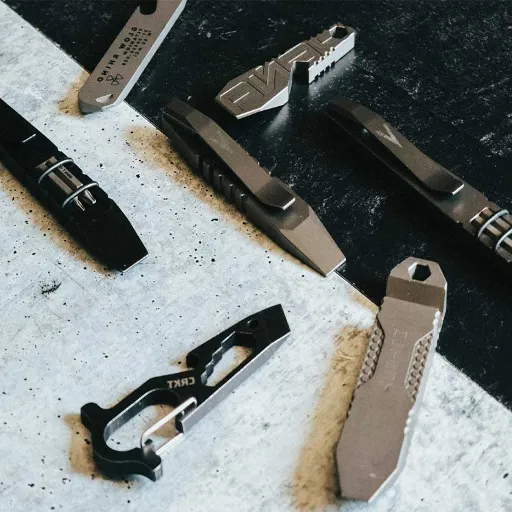
Once you’ve picked a material and a size, a short checklist separates a tool you’ll keep for years from one you’ll replace in a month.
- Material matched to the task, titanium for light daily carry, heat-treated steel for hard prying.
- A size you’ll actually carry, 3.5″–4.3″ pocket is the default; smaller for a keyring, larger for a pack.
- Stock thickness for rigidity, roughly 0.16″ for a slim profile up to 0.3″–0.35″ for a rigid bar.
- A tip geometry that fits your real gaps, thin tips get under staples and tabs; stout tips survive force.
- A carry method that suits you, deep-carry clip, keyring, or lanyard.
- Minimal, well-built functions, a pry tip plus a bottle opener beats an eight-in-one with weak mechanisms.
- Finish and corrosion protection, anodize or PVD on steel, native oxide on titanium.
Can an EDC Pry Bar Break or Deform?
Yes, and it usually bends before it breaks. Under extreme leverage, a good bar deforms slowly rather than snapping, which is the safer failure mode. Titanium gives first; heat-treated steel resists more. Thin tips roll or chip if you twist them sideways. The fix is simple: pick a bar matched to your real tasks, keep stock thickness in mind, and never extend a small bar with a pipe to force a big job.
One more question people search for: can you fly with an EDC pry bar? A bladeless titanium bar is generally TSA-friendly, but rules vary by country and venue. Confirm current guidance before you travel, and expect some event venues to treat any pocket tool as a restricted item.
Best EDC Pry Bar Picks by Category
Rather than rank brands, it helps to know which build fits which user. The table below maps category-level specs to the people they serve. Oushike’s own EDC range is built to these specifications for both retail and private-label buyers.
| Category | Material | Typical size | Weight | Key features | Who it’s for |
|---|---|---|---|---|---|
| Best overall | Grade 5 titanium | 3″–4″ | ~0.6–1 oz | Pocket clip, bottle opener | The daily carrier who wants one good tool |
| Best budget | Coated stainless | 2.5″–3″ | ~0.6 oz | 5–7 functions, TSA-friendly | First EDC tool, gift buyers |
| Best keychain | Titanium | 2″–3″ | <0.7 oz | Keyring hole, lanyard | Minimalists, keyring carry |
| Best for heavy prying | Heat-treated stainless | 4″–5″ | ~1.5–2 oz | Thick stock, stout tip | Jobsite, garage, real torque |
| Best minimalist | Titanium | 1.75″–3″ | ~0.3 oz | Flat bar, single function | People who carry a knife already |
| Best multitool | Titanium + steel | 4″–5″ | ~2 oz | Hex bit, wrench, ruler | Gear-forward users |
| Best premium | Grade 5 titanium | 3.4″–4″ | ~1 oz | Deep-carry clip, milled finish | Buy-once buyers |
A bar like the Gerber Shard defines the entry tier, while tools like the TEC Accessories Ti-Pry define the premium titanium class. Those names are useful market context, not Oushike recommendations. What matters is the spec pattern: the best EDC pry bar for most people is a 3.5″–4.3″ titanium bar with a deep-carry clip and one or two well-made extras.
If you want a mini bar to ride alongside a full kit, it pairs naturally with a pry bar set that covers the longer lengths.
EDC Pry Bars for Brands & Resellers
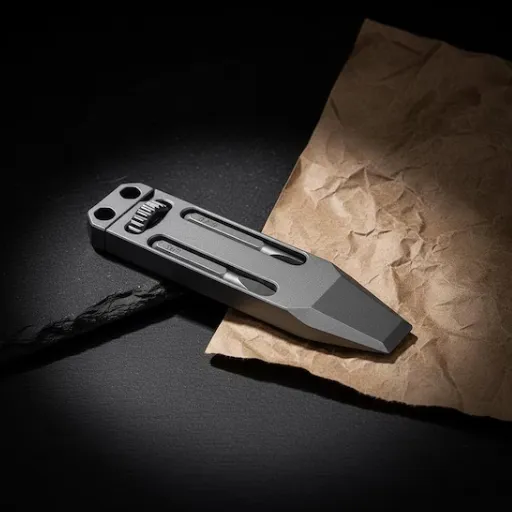
Here’s what most consumer guides never mention: the EDC pry bar is one of the easiest tools in the hardware category to private-label. It is a single SKU, it travels well as a gift item, and the category is dominated by factory-direct OEM production. That makes it a strong line for an e-commerce seller or a new tool brand.
What’s customizable is broader than most buyers expect:
- Material and grade, Grade 5 titanium, stainless, or coated carbon steel
- Size and thickness, typically 65–120 mm in length, 3–5 mm thick
- Tip geometry, the profile that decides how the tool performs in the hand
- Finish, anodize, stonewash, sandblast, or PVD
- Branding, laser-marked logos and retail or gift packaging
Mini-story: the gift SKU that kept selling. Daniel runs a small outdoor-gear store and wanted a low-cost item to reach free-shipping thresholds. He private-labeled a 3.5″ titanium EDC pry bar with his own logo and a kraft gift box. It sold modestly at first, then became his best repeat seller during the holiday season, because buyers kept coming back for a second and third. “It’s the perfect add-on,” he said. “People buy one for themselves and three as gifts.”
Oushke manufactures EDC pry bars factory-direct, from CNC and laser-cut titanium and stainless to finished, branded, retail-ready tools. Explore our custom pry bar manufacturing capabilities or see the wholesale pry bar program for distributor pricing. To start a private-label run, our custom hand tools team will confirm specifications and samples.
The global hand tools market reached an estimated US$25.61 billion in 2025 and is projected to grow to US$34.51 billion by 2033, a 3.8% CAGR according to Straits Research. Small, brandable tools like the EDC pry bar are one of the simplest ways for a new seller to enter that market.
EDC Pry Bar FAQ
What is an EDC pry bar used for?
An EDC pry bar handles light-duty tasks: opening packages, scraping labels and caulking, prying paint-can lids, popping battery covers, turning flathead screws, opening bottles, and removing staples or nails. It protects your knife’s edge from work the blade shouldn’t do.
Is titanium or stainless steel better for an EDC pry bar?
Titanium is better for daily carry: it is lighter, will not rust, and is often non-magnetic. Stainless steel is better for hard prying, because heat-treated grades resist bending and cost less. Match the material to your tasks.
Are titanium pry bars worth it?
For light, worry-free everyday carry, yes. Titanium cuts weight by roughly half versus steel and never rusts. For heavy prying or hammering, heat-treated steel is the better and often cheaper choice, because titanium is softer and can deform.
How big should an EDC pry bar be?
Aim for 3.5″ to 4.3″ for pocket carry: enough for real leverage, small enough to clip in a pocket. Choose 2″–3″ for a keyring and 4″–6″ for maximum leverage in a pack.
Can you carry an EDC pry bar on a plane?
A bladeless titanium or steel bar is generally TSA-friendly, but rules vary by country and some venues restrict any pocket tool. Confirm current guidance before you travel.
Can an EDC pry bar replace a knife?
No. It is a complement to a knife. The pry bar takes the abuse (scraping, prying, twisting) so the blade stays sharp and undamaged.
How are custom or private-label EDC pry bars made?
Factories cut the bar from titanium or stainless using CNC and laser cutting, then apply a finish such as anodizing or PVD, laser-mark your logo, and package it retail-ready. Programs often start at low volumes, which is what makes the category easy to test. For the flat, thin profiles many people start with, see our flat pry bar and wonder bar guide.
Conclusion
The right EDC pry bar comes down to three decisions. Match the material to the task: titanium for light daily carry, heat-treated steel for hard prying. Pick a size you’ll actually carry: 3.5″–4.3″ is the pocket sweet spot. And check the tip and stock thickness so the bar resists bending instead of failing at the first stubborn job. Keep the functions minimal, and you’ll get a tool you reach for daily instead of one that sits in a drawer. If you’re still mapping the wider category, our pry bar guide covers every type and design.
If you’re sourcing tools rather than buying one, the EDC pry bar is a single, low-MOQ SKU that brands beautifully and sells as both a self-purchase and a gift. Browse our professional hand tools range or request a bulk quote to start a private-label EDC line with factory-direct pricing.