
Nut Runner Torque Ranges and Specifications: A Complete Guide
A nut runner’s torque range spans from 0.03 newton-meters on a micro electric tool for electronics to over 80,000 newton-meters on a hydraulic system for heavy construction. That is a range of more than two million to one. Knowing where your application falls on this spectrum is the first step to choosing a tool that will tighten your fasteners correctly without stripping threads or leaving joints loose.
Yet most buyers never see torque specifications presented clearly. Product pages list individual tools, but no guide explains the full spectrum across all power sources. This creates a knowledge gap that leads to mismatched tools, rework, and sometimes field failures.
This guide maps nut runner torque ranges across all four power sources, explains ISO accuracy classes, and provides a torque-to-bolt-size reference table you can use to match any fastener to the right tool.
Key Takeaways
- Pneumatic nut runners cover the widest torque spectrum, from about 1 Nm for precision assembly to over 13,500 Nm for heavy-duty bolting.
- Electric EC nut runners deliver the highest accuracy, with ranges from 0.03 Nm to 4,800+ Nm and repeatability to plus or minus 1%.
- Hydraulic systems handle extreme torque from 50 Nm to over 80,000 Nm for mining, wind energy, and subsea applications.
- Cordless nut runners offer portable torque from 0.5 Nm to 2,000 Nm on modern battery platforms.
- Always select a tool with a 20 to 30% torque headroom above your fastener requirement to ensure reliable performance.
What Determines a Nut Runner’s Torque Range?
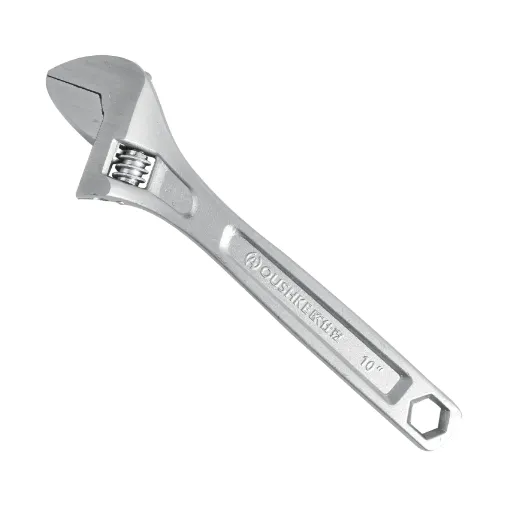
A nut runner’s torque range is not arbitrary. It is determined by four engineering factors that work together to set the minimum and maximum torque a tool can deliver reliably.
Power source is the primary driver. Pneumatic tools use compressed air motors that can be scaled from tiny vane motors for precision work to large piston motors for extreme torque. Electric tools use brushless servo motors with precise electronic control. Hydraulic tools use fluid pressure that multiplies force through pistons. Cordless tools use battery-powered brushless motors with the same electronic control as corded electric tools but with power limitations from the battery.
Gearbox design multiplies the motor’s output. A planetary gearbox with multiple stages can increase torque dramatically while reducing speed. The ratio between input and output speed determines the torque multiplication factor.
Motor or air motor size sets the base power available. Larger motors produce more torque but add weight and bulk. This is why a tool rated for 5,000 Nm is physically larger than one rated for 50 Nm.
Tool configuration also matters. Handheld tools have practical limits based on operator handling. Fixed tools mounted on automation cells can be larger and heavier because the machine supports the reaction force. For more on how these configurations differ, see our guide to types of nut runners.
Nut Runner Torque Ranges by Power Source
The table below is the starting point for matching a power source to your torque requirement.
| Power Source | Minimum Torque | Maximum Torque | Typical Accuracy | Best Application |
|---|---|---|---|---|
| Pneumatic | ~1 Nm (0.7 ft-lb) | ~13,500 Nm (10,000 ft-lb) | +/- 3-8% | High-speed assembly, harsh environments |
| Electric (EC/Servo) | ~0.03 Nm | ~4,800+ Nm (3,500+ ft-lb) | +/- 1-3% | Precision, traceability, automation |
| Hydraulic | ~50 Nm (37 ft-lb) | ~80,000+ Nm (59,000+ ft-lb) | +/- 3-5% | Ultra-heavy bolting, confined spaces |
| Cordless (Battery) | ~0.5 Nm | ~2,000 Nm (1,475 ft-lb) | +/- 1-3% | Portability, field service, flexibility |
This table answers the most common question buyers ask: Which power source do I need for my torque requirement? The answer depends on more than just the number. Accuracy, environment, and duty cycle all play a role. For a deeper comparison of electric and pneumatic trade-offs, see our electric vs pneumatic nut runner comparison.
Pneumatic Nut Runner Torque Ranges
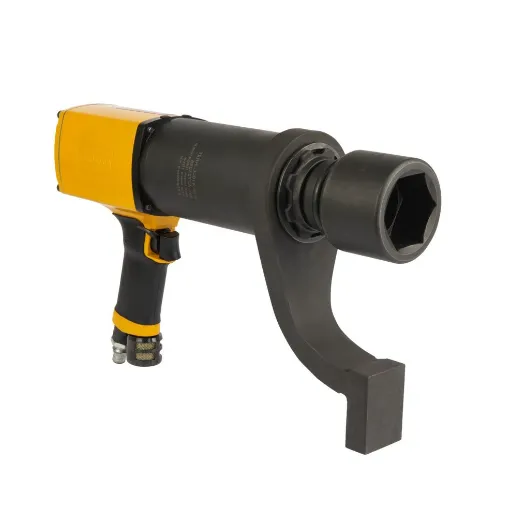
Pneumatic nut runners cover the broadest torque spectrum of any power source. This is because compressed air systems can be scaled from tiny precision tools to massive industrial torque wrenches.
Small Precision Pneumatic Nut Runners
Small-angle and inline pneumatic nut runners designed for electronics and light assembly deliver 1.1 to 8.3 foot-pounds, or about 1.5 to 11.3 newton-meters. These tools use high-speed vane motors with small planetary gearboxes. They are common in appliance and electronics assembly, where fasteners are small but cycle time matters.
Mid-Range Pneumatic Nut Runners
Industrial angle and inline pneumatic nut runners in the 3/8-inch to 1/2-inch drive range deliver 25 to 325 foot-pounds, or 34 to 440 newton-meters. These are the workhorses of automotive chassis assembly, general machinery production, and construction equipment manufacturing. The shut-off clutch prevents over-torquing by disengaging when the target value is reached.
Heavy-Duty Pneumatic Nut Runners
Heavy-duty pneumatic tools like the Atlas Copco RTP series deliver 1,600 to 6,000 foot-pounds, or 2,170 to 8,136 newton-meters. These use large air-pressure-regulated motors and are common in mining, heavy equipment, and structural steel applications. Tools at this level require reaction arms or fixturing because the operator cannot physically absorb the reaction torque.
Pneumatic Torque Wrenches
Pneumatic torque wrenches use a non-impacting torque multiplier design. Instead of delivering blows like an impact wrench, they apply smooth, continuous torque through a planetary gearbox driven by an air motor. Leading manufacturers like RAD and TorcStark offer ranges from 150 to 8,500 foot-pounds, or 203 to 11,527 newton-meters, with accuracy of plus or minus 5% and repeatability of plus or minus 2%.
Pneumatic tools generally achieve accuracy of plus or minus 3 to 8%, which is acceptable for most industrial assembly but not sufficient for aerospace or critical automotive applications.
Electric Nut Runner Torque Ranges
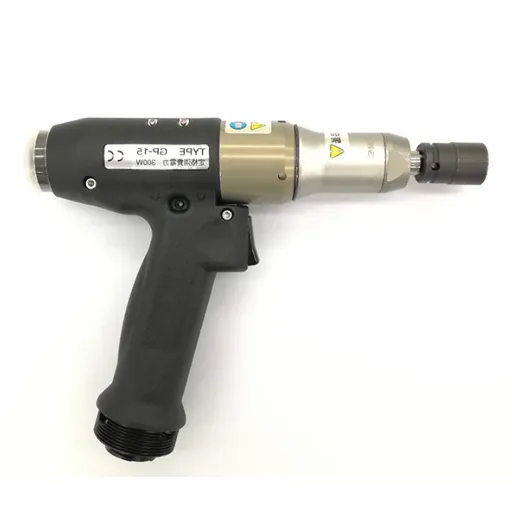
Electric nut runners, particularly brushless EC servo models, deliver the highest accuracy of any power source. The electronic control system measures torque through a transducer and stops the motor precisely at the target value.
Micro Electric Nut Runners
Micro electric nut runners for electronics and medical device assembly start at just 0.03 newton-meters. These tools use tiny brushless DC motors with precision gearboxes. They are often integrated into automated cells with screw feeding systems. At this torque level, even a slight variation can crack a circuit board or strip a micro fastener.
Standard Electric Nut Runners
Standard handheld electric nut runners cover 5 to 300 newton-meters. The TONE GNR-31E, a popular industrial model, delivers 150 to 300 newton-meters with plus or minus 5% accuracy and an LED torque indicator. These tools are common in automotive engine assembly, appliance manufacturing, and general industrial fastening.
Heavy Electric Nut Runners
Heavy-duty electric nut runners extend from 300 to 2,000 newton-meters. These tools are larger and often use pistol-grip or angle configurations to manage the reaction force. They are used in railway wheel assembly, heavy machinery production, and wind turbine nacelle assembly.
Fixtured EC Nut Runners
Fixtured EC nut runners mounted on automated cells can deliver up to 4,800 newton-meters or more. The robot or fixture absorbs the reaction force, allowing the tool to focus purely on delivering torque. These systems achieve plus or minus 1% accuracy and are standard in aerospace engine assembly and critical automotive applications.
Electric tools consistently outperform pneumatic tools in accuracy. Where pneumatic tools achieve plus or minus 3 to 8%, electric EC tools routinely achieve plus or minus 1 to 3%, with premium fixtured systems reaching plus or minus 1%.
Hydraulic Nut Runner Torque Ranges
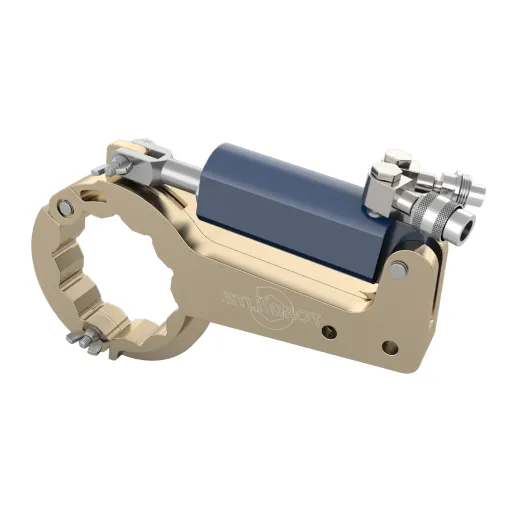
When torque requirements exceed what pneumatic or electric tools can deliver, hydraulic systems take over. Hydraulic nut runners use fluid pressure to generate force, which is then converted to torque through a piston or gearbox.
Standard Hydraulic Torque Wrenches
Standard handheld hydraulic torque wrenches deliver 400 to 677 newton-meters. These are common in general maintenance, pipeline work, and structural steel applications. Greenlee and Specialised Force both offer models in this range that operate at 1,000 to 2,000 psi hydraulic pressure.
Heavy Hydraulic Torque Wrenches
Heavy-duty hydraulic systems deliver 1,000 to 10,000 newton-meters. These tools use square drives from 1 inch to 2-1/2 inches and are standard for wind turbine tower flange bolting, bridge construction, and heavy pipeline connections. A typical wind turbine tower bolt requires 1,000 to 5,000 newton-meters, which falls squarely in this range.
Ultra-High Torque Hydraulic Systems
For the most demanding applications, ultra-high torque hydraulic systems can deliver 10,000 to 80,000 newton-meters or more. These are used in mining crusher mounting, subsea equipment installation, and large structural steel erection, where bolt sizes exceed M64. At this level, hydraulic bolt tensioners are sometimes used instead of torque wrenches because tensioners stretch the bolt directly rather than applying torque through threads.
Hydraulic tools achieve accuracy of plus or minus 3 to 5%, which is adequate for construction and energy applications where the primary requirement is achieving sufficient clamp force rather than precise torque values.
Cordless Nut Runner Torque Ranges
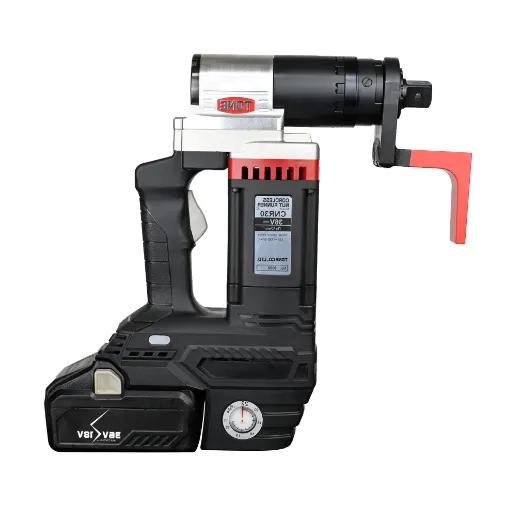
Cordless nut runners have closed the gap with corded electric tools in recent years. Modern brushless motors and lithium-ion battery platforms deliver torque and accuracy that rival corded models, with the added benefit of full portability.
Precision Cordless Nut Runners
Small cordless nut runners for electronics and light assembly deliver 0.5 to 50 newton-meters. These tools typically run on 12-volt battery platforms and are common in field service and repair applications where access to power is limited.
Standard Cordless Nut Runners
Standard cordless nut runners on 18-volt or 20-volt battery platforms deliver 5 to 400 newton-meters. This covers the majority of assembly and maintenance applications, from appliance manufacturing to automotive repair. The battery platform matters: a 12-volt tool cannot deliver the same torque as a 36-volt tool, even with the same motor design.
High-Torque Cordless Nut Runners
High-torque cordless models on 36-volt or specialized battery platforms can deliver 400 to 2,000 newton-meters. These are increasingly common in construction, field maintenance, and wind energy applications where operators need torque without the constraints of cords or hoses.
A wind farm maintenance crew in northern Germany switched from hydraulic power units to high-torque cordless nut runners for tower bolt retightening. The cordless tools eliminated the need to carry 15 kilograms of hydraulic equipment up 100-meter towers. For retightening checks at 800 to 1,200 newton-meters, the cordless tools had sufficient capacity and cut setup time by 30 minutes per tower. For a full guide to cordless options, see our cordless nut runner buyers guide.
Torque-to-Bolt-Size Mapping
The most practical question buyers face is not what a tool can deliver, but what torque their fastener actually needs. The table below maps common metric bolt sizes to typical torque requirements for three common grades.
| Bolt Size | Grade 8.8 (Nm) | Grade 10.9 (Nm) | Grade 12.9 (Nm) | Common Application |
|---|---|---|---|---|
| M6 | 10-12 | 14-17 | 17-20 | Electronics brackets, small panels |
| M8 | 25-30 | 34-41 | 41-49 | Appliance housings, light machinery |
| M10 | 49-59 | 68-82 | 82-98 | Automotive body, general assembly |
| M12 | 86-103 | 119-143 | 143-171 | Automotive chassis, machinery frames |
| M16 | 210-252 | 292-350 | 350-420 | Engine blocks, structural steel |
| M20 | 420-504 | 583-700 | 700-840 | Heavy machinery, railway assemblies |
| M24 | 725-870 | 1,005-1,206 | 1,206-1,447 | Wind turbine nacelle, bridge bolts |
| M30 | 1,450-1,740 | 2,010-2,412 | 2,412-2,894 | Tower flanges, heavy construction |
| M36 | 2,500-3,000 | 3,470-4,164 | 4,164-4,997 | Mining equipment, subsea structures |
To use this table, find your bolt size and grade. Then add a 20 to 30% safety margin above the torque value when selecting your tool. This margin accounts for friction variation, tool wear, and calibration drift over time.
An automotive plant in Detroit learned this lesson the hard way. Their procurement team selected nut runners rated exactly to their cylinder head bolt torque of 120 newton-meters. After six months of production, calibration drift and joint friction variation caused 3% of tightenings to fall below specification. The plant upgraded to tools rated for 180 newton-meters, giving them 33% headroom. Rework dropped to zero, and the higher-rated tools lasted longer because they were not operating at their maximum capacity every cycle.
ISO 5393 Accuracy Classes Explained
Torque range tells you what a tool can tighten. The accuracy class tells you how precisely it will hit the target. ISO 5393 defines three accuracy classes for rotary tools used on threaded fasteners.
Class I: Highest Accuracy
Class I tools achieve plus or minus 3% torque accuracy and plus or minus 5% angle accuracy. These are required for aerospace airframe assembly, critical automotive engine bolts, and medical devices where a single fastener failure has serious consequences. Only electric EC nut runners and premium fixtured systems consistently meet Class I.
Class II: Standard Accuracy
Class II tools achieve plus or minus 5% torque accuracy and plus or minus 7% angle accuracy. This is the standard for general automotive assembly, appliance manufacturing, and most industrial production lines. Both electric and pneumatic tools can meet Class II, though electric tools are more consistent.
Class III: Basic Accuracy
Class III tools achieve plus or minus 10% torque accuracy. This is acceptable for non-critical assembly, construction, steel erection, and general maintenance where the primary goal is sufficient clamp force rather than precise torque control. Most pneumatic tools fall into Class III at the edge of their range but can achieve Class II in their optimal operating zone.
Accuracy class should drive your tool selection as much as torque range. A tool that delivers 2,000 newton-meters at plus or minus 10% might leave a joint undertightened by 200 newton-meters. For critical applications, that variance is unacceptable.
How to Choose the Right Torque Range for Your Application
Selecting the right torque range is a five-step process that starts with your fastener and ends with your tool specification.
Step 1: Determine Your Fastener Requirements
Identify your bolt size, grade, and material. Use the torque-to-bolt-size table above to find the baseline torque value. If you are working with imperial fasteners, convert to newton-meters for tool selection. For guidance on the overall selection process, see our guide on how to choose a nut runner.
Step 2: Add a Safety Margin
Select a tool with 20 to 30% headroom above your required torque. If your fastener needs 500 newton-meters, choose a tool rated to at least 650 newton-meters. This margin protects against friction variation, tool wear, and calibration drift.
Step 3: Match Accuracy Class to Application
Critical joints in aerospace, automotive engines, and medical devices require Class I accuracy. General assembly and appliance manufacturing can use Class II. Non-critical construction and maintenance can accept Class III.
Step 4: Consider Duty Cycle
High-volume production lines need tools rated for continuous operation. A tool rated for 1,000 cycles per day will wear faster if it runs 3,000 cycles. Check the manufacturer’s duty cycle specification and match it to your production volume.
Step 5: Plan for Future Needs
Will your product line evolve to need higher torque? If you are entering the electric vehicle market, battery pack fasteners are lighter than engine bolts. If you are expanding into heavy machinery, you may need tools at the upper end of the range. Selecting a tool with growth headroom avoids replacement costs later.
Conclusion
Nut runner torque range is the starting point for every tool decision. Pneumatic tools cover the broadest spectrum from 1 to 13,500 newton-meters. Electric EC tools deliver the highest precision from 0.03 to 4,800 newton-meters. Hydraulic systems handle the extreme values from 50 to over 80,000 newton-meters. Cordless tools offer portable flexibility from 0.5 to 2,000 newton-meters.
The key is matching your fastener requirement to the right power source and accuracy class, then adding a 20 to 30% safety margin. A tool that is undersized will wear prematurely and risk undertightening. A tool that is oversized is inefficient and harder to control.
If you need help matching a nut runner to your specific torque requirements, or if you want to explore OEM nut runner solutions customized for your application, contact our team. For a broader view of where these tools are used across industries, see our guide to nut runner applications by industry. And for the complete picture of nut runner technology, read our complete nut runner guide.