
Needle Nose Vs Long Nose Pliers: Key Differences & When To Use Each
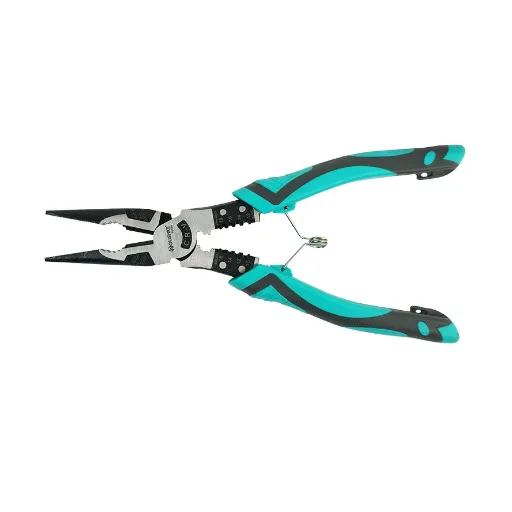
Needle nose and long nose pliers are not the same tool, even though the names are often used interchangeably. The difference comes down to jaw shape and tip strength: needle nose pliers have slimmer, more sharply tapered jaws built for precision work, while long nose pliers have a sturdier, slightly broader profile that grips harder. Understanding this difference matters whether you are reaching for a tool on the bench or planning a pliers line for resale.
Most people first notice the confusion when they search for one name and see both. Retailers list them side by side. Some suppliers call them the same thing. The truth is that manufacturers distinguish the two by how the jaws taper and how much force the tool can handle. This guide settles the question, compares the two directly, and shows you which one fits each job.
In short, you will learn what makes these tools different, when to reach for each one, and why a smart product line usually carries both. For buyers sourcing at scale, there is also a practical look at sizes, materials, and OEM options so you can build a range your customers actually use.
Key Takeaways
- Needle nose pliers have slimmer, sharply pointed jaws for precision work; long nose pliers have broader, stronger jaws for heavier gripping.
- The terms are regional near-synonyms, and “snipe nose pliers” means the same tool in many markets.
- Long nose pliers suit electrical, automotive, and general repair; needle nose pliers suit electronics, jewelry, and fine wiring.
- Most professionals own both, and distributors who stock both serve a wider customer base.
- For sourcing, common lengths run 130-250 mm; materials like chrome vanadium steel with HRC 50+ hardness protect tool life.
Are Needle Nose and Long Nose Pliers the Same?
No. Needle nose and long nose pliers share a similar family design, but they differ in jaw shape, tip strength, and the jobs they handle best. Needle nose pliers use slimmer, more sharply tapered jaws for fine work, while long nose pliers use a broader, stronger profile for general gripping and heavier tasks.
The naming confusion is real and worth clearing up. Wikipedia notes that “needle-nose pliers” are also known as “long-nose pliers” and “snipe-nose pliers.” In everyday conversation, many people use the three names for the same tool. That works fine for casual use. When you compare them closely, though, the distinctions show up in jaw proportions and intended use.
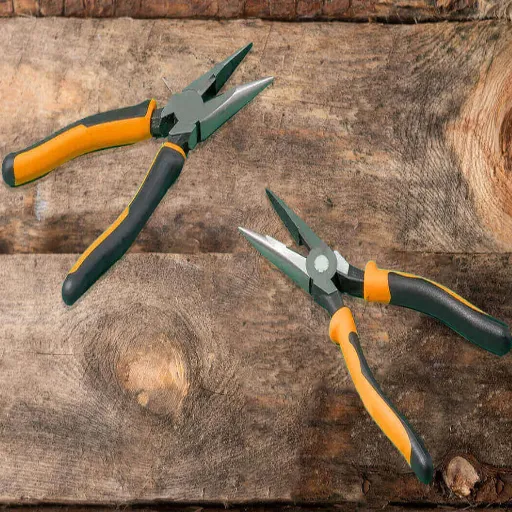
Think of the family this way: long nose pliers are the general-purpose member, and needle nose pliers are the specialized precision member. Both reach into tight spaces. One trades some reach and grip for finer control. For a full look at the pliers family, types, sizes, and sourcing, see our needle nose pliers guide.
Needle Nose vs Long Nose: Key Differences at a Glance
The fastest way to understand the difference is a side-by-side comparison. This table covers the points that matter most when you pick a tool or spec a product. It matches the split that toolmakers like Maun Industries describe: finer jaws for detail, stronger jaws for grip.
| Feature | Needle Nose Pliers | Long Nose Pliers |
|---|---|---|
| Jaw shape | Slim, sharply tapered, almost needle-like | Longer, slightly broader, less pointed |
| Tip size | Fine and pointed | Blunter and stronger |
| Grip strength | Lower torque, built for precision | Higher torque, close to a standard plier |
| Typical uses | Electronics, jewelry, fine wiring, model making | Electrical, automotive, mechanical, general repair |
| Serration | Often smooth to protect soft materials | Often serrated for a firmer hold |
| Common length | 130-200 mm | 160-250 mm |
| Best for | Delicate components and tight spots | Firm gripping and bending in confined spaces |
One more detail separates quality pairs: the joint. Scissor-action jaws pivot at a single point and can squeeze unevenly at the tip. Parallel-action (box-joint) jaws keep the gripping faces flat to each other, which spreads force evenly and protects fragile parts. Precision-grade needle nose pliers often use box-joint construction for this reason.
Long Nose Pliers: Uses and Strengths
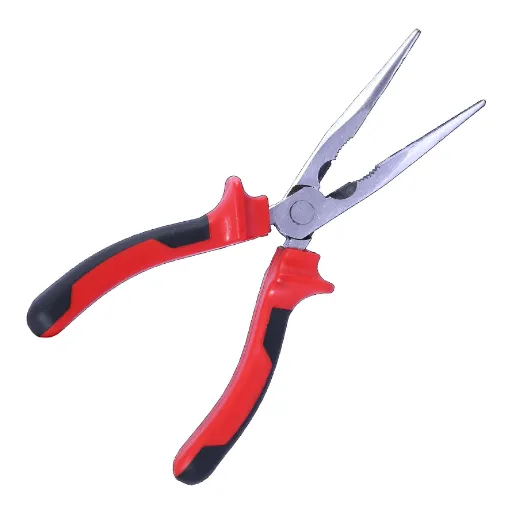
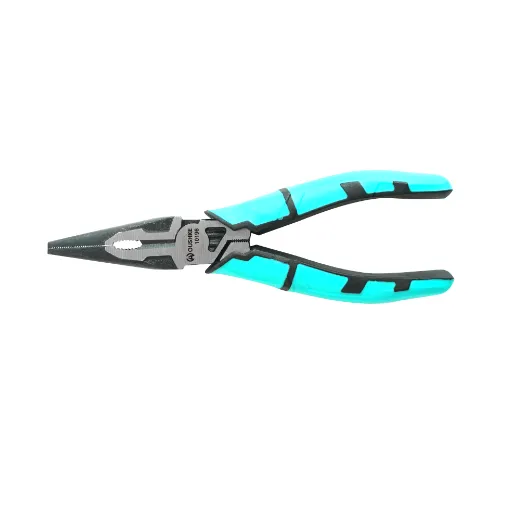
Long nose pliers earn their place as the everyday workhorse for hard-to-reach places. Their broader jaws grip firmly without bending under pressure, and many include an integrated cutter near the joint.
Reach for long nose pliers when you need to:
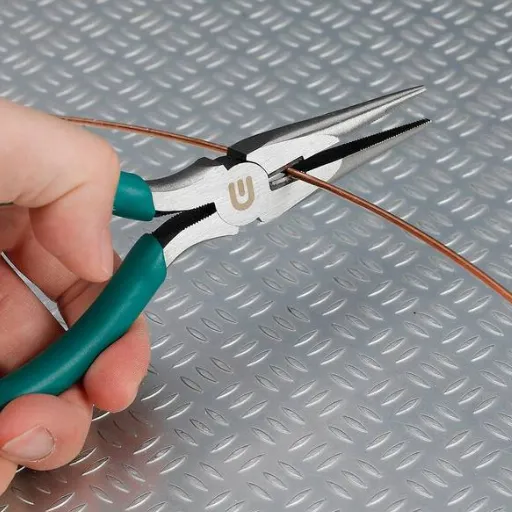
- Bend and shape solid-core wire for electrical work
- Grip bolts, pins, or stubborn parts in mechanical and automotive jobs
- Twist multiple wires together for a secure connection
- Pull nails, staples, or small fasteners out of wood and drywall
- Work in panels, engine bays, and junction boxes where a standard plier cannot fit
They also handle heavier gauge material without damage. That is why electricians keep a 160-200 mm long nose model in their pouch for box work, while automotive techs use them for spring clips, hose clamps, and connectors in recessed areas.
Here is a real example. Dan runs a two-person electrical contracting crew in Portland. Last year he ordered a batch of “long nose” pliers for his team and received tools with very fine, pointed jaws. They handled small wires fine, but when the crew had to twist two 12 AWG solid conductors together, the tips flexed and the grip slipped. A quick call to the supplier confirmed the mix-up: the pointed tools were needle nose, not the sturdier long nose models he expected. Swapping to proper long nose pliers fixed the job in an afternoon. The lesson stuck with him: names get mixed up, but jaw shape decides whether the tool works.
Needle Nose Pliers: Uses and Strengths
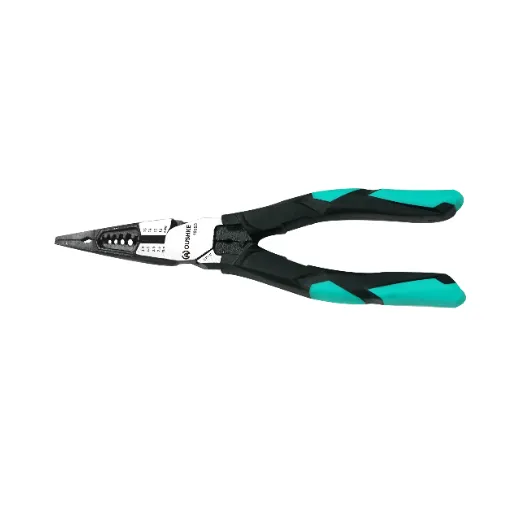
Needle nose pliers are the precision specialists. Their slim, pointed jaws slip into gaps that no other plier reaches, and their lighter grip protects delicate parts from crushing or marking.
Reach for needle nose pliers when you need to:
- Grip tiny screws, pins, and components in electronics and PCB work
- Open jump rings and wrap fine wire in jewelry making
- Place and remove small parts in model making and crafts
- Work with fishing hooks, lures, and other fine tackle
- Handle delicate connectors without crushing them
Smooth-jawed needle nose pliers are a common choice for jewelry and electronics, because a smooth surface will not scratch soft metals or leave marks on finished parts. For the most delicate bench work, precision and ESD-safe versions with parallel jaws protect sensitive components.
Priya runs a small jewelry studio that sells handcrafted pieces online. She keeps a chain-nose needle plier and a round-nose plier at her bench for opening jump rings and forming wire loops. Early on, she used a serrated long nose plier from her general tool kit and noticed tiny scratches on her silver jump rings. Once she switched to smooth-jawed needle nose pliers, the marring stopped and her production time dropped. For a bench jeweler, the difference between the two is the difference between flawless work and rework.
Which Should You Choose?
Choose based on the material you grip and the precision you need. If the job is fine and delicate, needle nose wins. If the job needs leverage and a firm hold, long nose wins. If you do both kinds of work, you need both tools.
Use this decision matrix to match the task to the tool:
| Task | Recommended Tool | Why |
|---|---|---|
| Electronics, PCBs, small pins | Needle nose | Fine tips, lighter grip, precise control |
| Jewelry, wire wrapping, jump rings | Needle nose | Smooth jaws protect soft metals |
| Solid-core wire bending, twisting | Long nose | Stronger jaws handle thicker gauge |
| Automotive spring clips, hose clamps | Long nose (or bent nose) | Firm grip in recessed areas |
| Model making, fishing tackle | Needle nose | Small components, tight reach |
| General household repair | Long nose | Versatile grip and cutting edge |
| Bolts, pins, stubborn parts | Long nose | Higher torque, serrated jaws |
If you buy for yourself, the honest answer is to own one of each. They are inexpensive relative to the frustration of using the wrong tool, and they cover nearly all precision and grip work around a shop or van.
Related Variants: Bent Nose, Snipe Nose, and Parallel Jaw
The family does not stop at two. A few close relatives are worth knowing because they appear in the same product listings and solve specific problems. For the full family tree, see our guide to types of pliers.
Snipe nose pliers are the regional cousin. In many markets, “snipe nose” is simply another name for needle nose or long nose pliers, depending on jaw proportion. Some craftspeople use it for a shorter, finer version favored by watchmakers and fine detail work. When you see the term on a spec sheet, check the jaw dimensions rather than trusting the label.
Bent nose pliers angle the jaws 45 or 90 degrees so you can reach around obstacles. Automotive techs use them for spring clips and hose clamps in engine bays, and jewelers use angled versions for clasps and tight fittings. They bring the same precision as straight needle nose pliers but with better access.
Parallel-jaw pliers keep the gripping faces parallel through the whole stroke. This design distributes force evenly, which is why precision work in electronics and jewelry favors it. It is a construction detail, not a separate category, but it explains why two “needle nose” pliers can feel very different in the hand.
How to Choose Between Them for Your Product Line
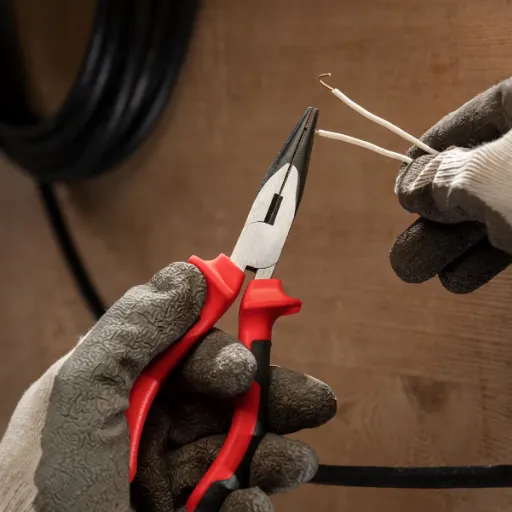
For distributors, tool brands, and e-commerce sellers, the question is less about one tool and more about the range. The hand tools market is large and growing. The global hand tools market is estimated at roughly USD 25-27 billion in 2025, with pliers representing a meaningful segment, and Asia-Pacific, led by China, is the largest producing region. Most professionals and serious DIY users expect access to both needle nose and long nose pliers, so a complete pliers range covers both.
Here is the practical sourcing checklist:
- Size mix: Offer a range from 130-250 mm, with the common lengths broken down in our needle nose pliers sizes guide. Short models suit electronics and fine work; longer models suit electricians and industrial maintenance.
- Material and hardness: Look for chrome vanadium or high-carbon steel with HRC 50+ hardness. This keeps jaws from flexing or losing their edge under repeated use.
- Insulated options: For electrical customers, add VDE-certified models rated to IEC 60900 standards, which carry a 1,000V AC / 1,500V DC working rating and a 10,000V factory test.
- Finish and handles: Dip-coated, vinyl, or dual-material handles improve grip and comfort, and colored handles help electricians identify insulated tools.
- Branding and packaging: Private-label handles, logo stamping, and custom packaging let you sell the same quality under your own brand.
Marta runs a hardware distribution company in Toronto that sells to local electricians and automotive shops. She started with one long nose SKU and one needle nose SKU. Within two quarters, her customers asked for bent nose and insulated versions, and her line grew to six pliers SKUs. The change was small in inventory but large in loyalty. Her buyers stopped going elsewhere for pliers, and repeat orders became routine. The lesson for any distributor is simple: stock the range, not just one option.
Factory-direct sourcing makes this practical. Working directly with a manufacturer means no middleman markup, consistent quality through multi-stage inspection, and flexible MOQs so you can start small and scale. That is how Oushke approaches every pliers line: standard products, custom OEM options, and support from sample to shipment.
Ready to build a pliers range for your market? Contact our team to discuss bulk orders, private-label options, or custom specifications.
Frequently Asked Questions
Are needle nose and long nose pliers the same?
Not exactly. The names are used interchangeably in everyday conversation, but manufacturers distinguish them by jaw shape and tip strength. Needle nose pliers have slimmer, more sharply tapered jaws for precision work. Long nose pliers have a broader, stronger profile for heavier gripping.
Which is better for electrical work?
For most electrical work, long nose pliers are the better choice because their stronger jaws bend and twist solid-core wire without flexing. Electricians commonly use 160-200 mm long nose models. Needle nose pliers still help with fine wires and small components in tight control boxes.
Do needle nose pliers cut wire?
Many models include an integrated cutter near the joint that can cut small-gauge wire. The cutting edge sits close to the pivot, where leverage is highest. For heavier wire, a dedicated cutter is safer and cleaner.
What size do electricians use?
Most electricians choose 160-200 mm long nose pliers, which balance reach with control inside junction boxes. Longer 200-250 mm models add reach for deep work, and shorter models suit fine electronics.
Do you need both?
If you do precision work and heavier gripping, yes. Needle nose handles fine and delicate tasks, and long nose handles grip and leverage. Most professional kits include both, plus a bent nose for angled access.
Conclusion
The answer to the needle nose vs long nose pliers question is a matter of jaw design, not just naming. Needle nose pliers bring fine, pointed jaws for precision work in electronics, jewelry, and model making. Long nose pliers bring a stronger, broader profile for electrical, automotive, and general repair. Both reach into tight spaces, and both earn a spot in a professional kit.
For buyers sourcing at scale, stock the range. Offer straight, long, bent, and insulated options across 130-250 mm. Use quality materials like chrome vanadium steel with HRC 50+ hardness, and keep certifications like VDE and IEC 60900 in mind for electrical customers. A complete pliers line serves more customers, protects your margins, and strengthens your reputation as a reliable supplier.
Shanghai Oushike Hardware Tools supplies durable, factory-direct pliers for distributors, tool brands, and professional buyers worldwide. With flexible OEM and ODM services and strict quality control, we help you build a tool line your customers can trust. Contact our team to discuss bulk orders, OEM customization, or custom specifications.