
Precision Pliers: Types, Uses & ESD-Safe Buying Guide
Precision pliers are small, fine-tipped hand tools, usually 4 to 6 inches long, built for delicate gripping, bending, and cutting in electronics, watchmaking, jewelry, and fine mechanics. Their tips taper to roughly 1 millimeter, and quality models use zero-backlash box joints and ESD-safe handles to protect sensitive components. This guide covers the types, the uses, and the ESD and construction details that decide whether a precision plier protects your work or damages it.
When Marcus, a bench technician at a small electronics repair shop, bought a budget “precision pliers set,” he thought he was saving money. Six months later he learned why cheap tools fail. The tips on two pliers in the set did not meet cleanly, so every capacitor lead he trimmed came out crooked. Worse, the handles were not ESD-safe, and a static discharge ruined a batch of MOSFETs worth more than the tools themselves. The lesson stuck with him, and it is the lesson of this guide: the joint, the tip tolerance, and the ESD rating matter more than the price tag.
Key Takeaways
- Precision pliers are 4 to 6 inch fine-tipped tools for electronics, watchmaking, jewelry, and fine mechanics.
- The three things that decide quality are the box joint, the tip alignment, and the ESD rating.
- ESD-safe pliers use static-dissipative handles and matter most on populated boards and semiconductor work.
- Types include needle, chain, flat, half-round, round, bent, tweezer-nose, and cutters; match the type to the task.
- For resellers, the standard wholesale mix is needle, chain, flat, half-round bent, and a flush cutter, with ESD variants.
What Are Precision Pliers?
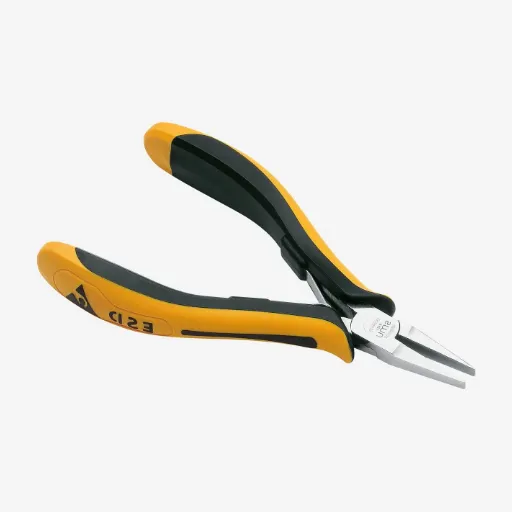
Precision pliers are compact hand tools designed for exact work on small, delicate materials. Unlike standard pliers, they combine four things:
- Fine tips. Long, tapering jaws that narrow to about 1 millimeter, so they reach into tight spaces without touching nearby parts.
- Light, metered action. Precision joints and springs transfer force smoothly, so you do not crush what you are holding.
- Non-marring finishes. Smooth-ground jaws and rounded edges that do not scratch wires, leads, or polished metal.
- ESD-safe options. Static-dissipative handles that protect sensitive electronic components from electrostatic discharge.
Standard pliers trade these features for raw grip and mechanical advantage. Precision pliers trade grip for control, which is exactly what electronics assembly, PCB work, and watchmaking require. If you are working with materials measured in millimeters, you want the tool that can follow them.
For a broader look at the pliers family, our needle nose pliers guide covers the full range, from standard to precision-grade tools.
Types of Precision Pliers
The precision plier family splits into several shapes, and each one does a different job. This table is the fastest way to match a type to a task.
| Type | Jaw profile | Best for | Common length |
|---|---|---|---|
| Needle-nose | Long, tapered, pointed | Reaching recessed spaces, gripping thin wire, placing components | 130-160 mm |
| Chain-nose | Flat, tapered, non-rounding | Gripping and bending flat work; electronics and jewelry | 120-150 mm |
| Flat-nose | Flat, parallel jaws | Aligning, holding, straightening small parts | 120-145 mm |
| Half-round | Curved cross-section, straight or 45° bent | Contact gripping of cylindrical parts, lead bending | 115-145 mm |
| Round-nose | Conical, fine tips | Loops, coils, and curves in wire without damage | 115-145 mm |
| Bent-nose | 25°-60° offset tip | Navigating crowded boards and junction boxes | 120-160 mm |
| Tweezer-nose | Ultra-fine, delicate tips | SMD placement, watch hairsprings, micro components | 110-140 mm |
| Duckbill | Broad, flat, thin jaws | Lab work, delicates, flattening with a smooth jaw | 125-160 mm |
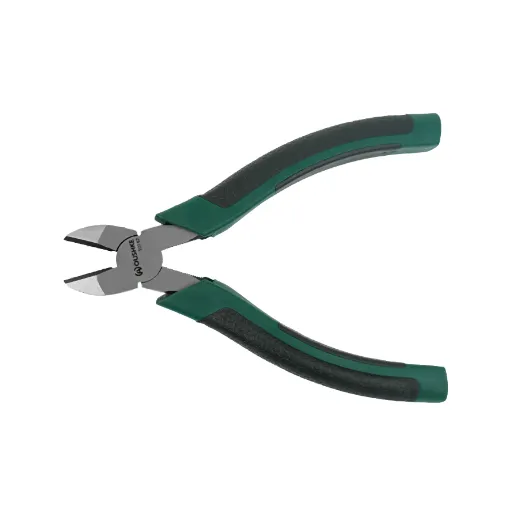
| Cutters | Sharp precision edges | Trimming leads and fine wire; flush cut for PCB work | 115-125 mm |
Within cutters, the cutting style matters:
- Flush cut. Leaves a flat, smooth edge. Best for trimming PCB leads, because it prevents sharp “spikes” that can short adjacent traces.
- Semi-flush cut. Leaves a slightly pointed edge, with a cleaner cut than standard cutters.
- Standard cut. Leaves a pointed edge but tends to stay sharper longer.
Most technicians keep three or four types on the bench: a needle-nose for reach, a chain-nose for general grip, a bent-nose for obstructions, and a flush cutter for trimming. Sets that add a round-nose and a flat-nose cover jewelry and fine mechanics too. If you are stocking a line, those six types make up the core assortment that resells consistently.
Length and size choices are covered in our needle nose pliers sizes guide, which maps 130-250 mm lengths to different trades.
What Are Precision Pliers Used For?
Precision pliers are used wherever small, delicate, or hard-to-reach components must be gripped, held, bent, cut, or shaped accurately. The main applications are electronics assembly and repair, SMD and PCB work, watchmaking, jewelry making, and detailed model and hobby work.
| Application | Recommended type | ESD required? | Why |
|---|---|---|---|
| PCB / SMD assembly and rework | Tweezer-nose + flush cutter | Yes | Precise placement without fouling neighbors; flush cut avoids lead spikes |
| Electronics repair and soldering | Needle-nose + diagonal cutter | Yes for IC-adjacent work | Lead bending, component removal, tight box access |
| Watchmaking and fine mechanics | Tweezer-nose, flat-nose, round-nose | Yes for quartz movements | Hairsprings and gears; non-marring tips; antistatic for electronic movements |
| Jewelry making | Chain-nose, round-nose, bent-nose | No (metal only) | Loops, jump rings, shaping with smooth jaws |
| Model building, RC, sprue cutting | Flush cutter, needle-nose | No | Sprue trimming, small part handling, 3D print cleanup |
| Lab and delicate handling | Duckbill (smooth), flat-nose | Optional | Holding thin sections and samples without damage |
A good example of why the right type matters: An SMD assembly worker placing 0402 resistors, which are smaller than a grain of rice, uses a tweezer-nose plier rather than a standard needle-nose. The standard tool’s wider jaws would push neighboring components out of place. The tweezer-nose applies just enough control to seat the part without touching anything else. It is a small difference in geometry that saves real time on every board.
For hands-on technique, our how to use needle nose pliers guide walks through grip, jaw positioning, bending, and trimming step by step.
ESD-Safe Pliers: What They Are and When You Need Them
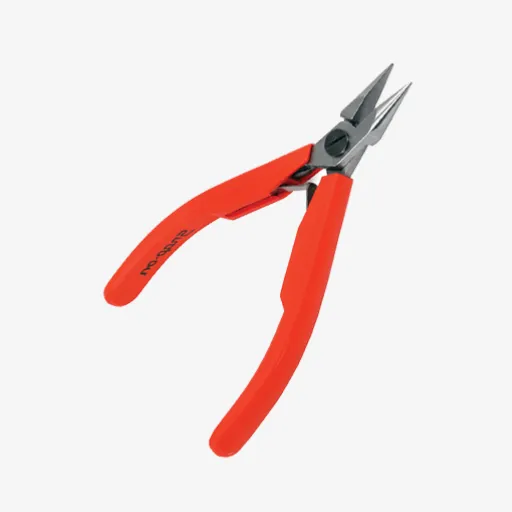
ESD-safe pliers, also called anti-static pliers, use static-dissipative handles and materials that drain static charge gradually instead of letting it arc into sensitive components. Their handles measure roughly 10⁶ to 10⁸ ohms of surface resistance, high enough to slow the discharge, low enough to prevent buildup.
Why does this matter? Electrostatic discharge can damage or destroy semiconductors, MOSFETs, and integrated circuits, often invisibly and at voltages well below what a person can feel. A static event you never notice can shorten the life of a component or kill it outright. That is why electronics manufacturers run formal ESD control programs to standards like IEC 61340-5-1 and ANSI/ESD S20.20, and why ESD-safe tools are standard in those facilities.
When do you need ESD-safe pliers?
- Populated boards. Working on or near mounted ICs and semiconductors.
- Component handling. Placing or adjusting sensitive parts by hand.
- Cleanroom and production lines. Where ESD control is mandated.
- Watch repair on quartz movements. Electronic movements are static-sensitive.
When can you skip them?
- Unpopulated boards and general repair. No sensitive parts present.
- Heavy wiring and mechanical work. No electronics involved.
- Metal-only tasks like jewelry. Static is not a concern.
ESD-safe tools cost more, so buy them where they matter and keep standard tools for the rest. Note the difference from insulated pliers: ESD-safe tools protect the component from static, while insulated tools protect the user from live voltage. They answer different questions and are not interchangeable.
Box Joint vs Lap Joint: Why Construction Matters
The joint is the heart of a precision plier, because it determines whether the fine tips meet cleanly. There are two main designs.
- Box joint. One blade nests through the other, so the jaw stays aligned under load. Quality precision pliers advertise “zero-backlash” or “play-free” box joints, and this is the feature to look for.
- Lap joint. A simpler single-pivot design with more lateral play. Acceptable for heavy work, but the wandering tips make it a poor choice for precision tasks.
Why it matters: fine tapered tips must meet with no gaps and no step. If the tips are misaligned, every grip becomes a bend, and delicate work turns into scrap. This is the number one quality failure in budget precision pliers, and it is also the number one thing to check when sourcing.
Here is a quick test anyone can run. Close the pliers and look at the tips under a bright light. Do they touch along the full jaw? Squeeze gently and watch for side-to-side movement at the tip. A good precision plier should feel tight and stable, with no play. If you see a gap or a wiggle, walk away.
Construction quality extends beyond the joint. Look for high-grade tool steel, oil-hardened and tempered, with hardness around 57-64 HRC, and cutting edges induction- or laser-hardened to about 62-64 HRC. Check that the heads are polished rather than chrome-plated, because chrome can flake off and cause circuit faults on populated boards. Smooth-ground jaws and rounded edges are the marks of a tool designed for delicate work.
How to Choose Quality Precision Pliers
When you are choosing precision pliers, work through these criteria in order.
- Match the type to the task. Choose the jaw shape for the job first: tweezer-nose for SMD, flush cutter for trimming, chain-nose for general grip.
- Check the joint. Prefer box-joint construction with zero backlash. Test for tip alignment and side-to-side play.
- Check the ESD rating. Confirm the handles are static-dissipative to a stated standard, and verify the supplier’s claim, not just the marketing.
- Confirm the steel and hardness. High-grade tool steel, HRC 57-64, with hardened cutting edges if the tool cuts.
- Look at the finish. Polished, deburred jaws and rounded edges. Avoid tools that show sharp edges or rough grinding.
- Consider the spring and handle. A smooth double spring reduces hand fatigue on repetitive work, and multi-component grips improve control.
Precision pliers vs. tweezers deserves its own note. For extremely fine work, such as placing an SMD part or handling a watch hairspring, a precision tweezer often gives better control than any plier. Tweezer-nose pliers sit in the middle: they add a spring-loaded grip and more control while keeping a fine tip. The rule of thumb is that if you only need to hold and place, a tweezer is enough; if you also need to bend, grip firmly, or apply metered force, a plier wins.
Sourcing Precision Pliers Wholesale
Precision pliers are a steady, growing category, and the numbers back it up. The global hand tools market was about US$25.61 billion in 2025 and is forecast to reach US$34.51 billion by 2033, a 3.8% compound annual growth rate, according to Straits Research. Pliers and gripping tools make up roughly 18.9% of that market, and the narrower tool pliers segment is projected to grow from US$1.01 billion in 2024 to US$1.36 billion by 2031.
On the electronics side, the ESD control market is estimated at US$5.84 billion in 2025 and expected to reach US$8.62 billion by 2032. Growth is driven by electronics manufacturing, and Asia-Pacific is the largest region by far.
For a distributor or brand owner, that means a precision-plier line sells into two demand pools at once: the electronics industry, which buys ESD-safe and miniature tools, and the craft and hobby market, which buys the same shapes in standard and stainless versions.
China manufacturing hubs. The precision and ESD plier supply base concentrates in two regions: Jiangsu (Xuzhou, Zhangjiagang, Suzhou), home to established plier factories with full in-house production, and Guangdong (Shenzhen, Dongguan, Chaozhou), which specializes in anti-static tweezers and electronic tools.
Specifications to give a factory. When you source a precision-grade line, specify clearly:
- Type mix. Needle, chain, flat, half-round bent, round-nose, and a flush cutter.
- Jaw style and tip tolerance. The tip geometry and alignment standard, which is the whole game in precision work.
- Steel grade. Tool steel, chrome-vanadium, or stainless, with the target hardness.
- ESD handle material. Confirm the dissipative rating and standard, such as IEC 61340-5-1.
- Finish. Polished, deburred jaws; no chrome flaking risk.
- Packaging. Blister cards, tool rolls, or sets for resale.
MOQ, pricing, and lead time. On the China wholesale market, individual precision pliers typically run from about US$1.28 to US$6 or more per piece depending on spec, with sets priced higher. Wholesale MOQs are commonly 100 to 1,000 pieces, and custom-logo or branded orders usually start around 1,000 pieces. Lead times typically run 15 to 45 days after deposit. These are directional benchmarks; your final figures depend on the spec sheet and the factory.
OEM and private label. The real advantage of sourcing factory-direct is the ability to build your own brand. Custom handle color, logo, set composition, ESD variants, and packaging are all available. A good partner guides you through the mix that sells, starting with a test order and scaling the full range.
Quality and inspection checklist. Before you commit, confirm the supplier provides raw-material certificates, jaw-alignment inspection, hardness testing, and pre-shipment inspection reports. For ESD tools, ask for the standard they test against. The same discipline that protects you from misaligned tips protects your customers and your brand reputation.
If you are building an electronics tool line, our wholesale pliers buying guide covers assortment planning, margins, and import logistics in more detail.
Precision Pliers FAQs
What are precision pliers used for?
Precision pliers are used for delicate gripping, holding, bending, and cutting in electronics assembly and repair, SMD and PCB work, watchmaking, jewelry making, and detailed model building. They reach where standard pliers cannot and apply controlled force that does not damage small parts.
What is the difference between precision pliers and regular pliers?
Precision pliers are smaller, with finer tips (down to about 1 mm), lighter action, zero-backlash box joints, and smoother, non-marring finishes. Regular pliers trade control for stronger grip.
What are ESD pliers?
ESD pliers, or anti-static pliers, use static-dissipative handles that drain electrostatic charge gradually so it cannot damage sensitive electronic components. They are tested to standards such as IEC 61340-5-1 and ANSI/ESD S20.20.
What is a box joint on pliers?
A box joint is a construction where one blade nests through the other, keeping the jaws aligned with no backlash. It is the defining quality feature of precision pliers because it keeps fine tips meeting cleanly.
Are precision pliers the same as tweezers?
No. Tweezers offer finer control for holding and placing only. Precision pliers add grip, force, and the ability to bend and apply pressure. Tweezer-nose pliers combine a fine tip with spring-loaded grip as a middle option.
What are the best precision pliers for electronics?
The core set for electronics is a needle-nose, a chain-nose, a bent-nose, and a flush cutter, ideally ESD-safe. Many technicians add a tweezer-nose for SMD work. Choose by task, then verify box joint, tip alignment, and ESD rating.
Can I get private label precision pliers with my own brand?
Yes. Factory-direct OEM and ODM services support custom handles, logos, set composition, ESD variants, and packaging, usually with branded MOQs around 1,000 pieces.
Conclusion
Precision pliers are small tools, but they do exacting work, and the details decide the outcome. Match the type to the task, verify the box joint and tip alignment, confirm the ESD rating where it matters, and check the steel and finish. For resellers, that same discipline, applied to sourcing, protects your line and your brand.
If you are sourcing precision pliers for your electronics business or building a private label tool line, we can help. Shanghai Oushike Hardware Tools manufactures precision pliers factory-direct with box-joint construction, ESD-safe handle options, and full OEM and ODM support, backed by multi-stage quality control and export experience in 30-plus countries. Contact us for a quote or request our precision pliers catalog.