
Best Pry Bar Set: Top Picks for Professionals & DIY
The best pry bar sets in 2026 are 3-, 4-, 5-, and 6-piece kits, but the one that fits most buyers is a 4-piece set of 8″, 12″, 18″, and 24″ bars. It covers roughly 80% of construction and DIY prying jobs, and it costs less than most single premium bars. Everything beyond that set of lengths is either a longer bar for heavy tear-out or a specialty bar for automotive and mechanical work.
That answer surprises people. Most shoppers assume “best” means “most pieces.” It does not. A set is only as good as the leverage range it covers, and a 12-piece bargain kit with five near-identical short bars gives you less real capability than a focused four-piece kit. If you want the full picture of how these tools relate, our complete guide to pry bar types explains the whole family first.
So the honest ranking question is not which set has the most bars. It is which lengths you actually need, and whether the bars in the set hold up when you lean on them. This guide answers both.
Key Takeaways
- A 4-piece set of 8″, 12″, 18″, and 24″ bars covers about 80% of construction and DIY prying tasks and is the default choice for a first set.
- Choose the set family before the brand: flat sets for trim and finish work, demolition sets for tear-out, rolling-head and indexing sets for automotive and awkward angles.
- A 24″ bar gives roughly 3× the mechanical advantage of an 8″ bar, so the longest member does the hardest work and fails first on cheap sets.
- Only strike a bar the maker marks as a striking bar. Sets with steel strike caps on every bar survive hammer driving; sets with bare vinyl handles crack.
- For heavy professional use, a three-bar kit (7″–10″ flat, 24″–36″ gooseneck, 11″ nail puller) often beats any bargain set.
What Is a Pry Bar Set?
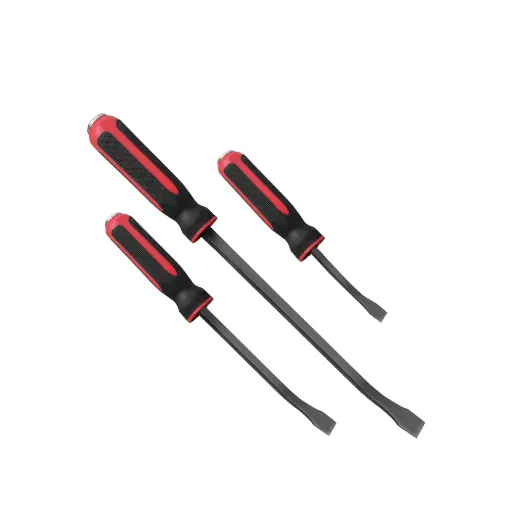
A pry bar set is three or more pry bars sold together, usually graduated in length across the same family, so one purchase covers several leverage ranges. The point of a set is coverage: a short bar for control in tight work, a mid bar for general prying, and a long bar for force on stubborn material. Sets typically run from 3 to 8 pieces, and 4-piece is the most common configuration on the market.
The logic behind buying a set is simple. Leverage changes with length. A longer bar multiplies the force you apply, but it is heavier, harder to control, and needs more room to swing. No single bar is ideal for every job, which is why a graduated set works better than one long bar and a hope.
How Many Pry Bars Do You Need?
For most buyers, four bars cover nearly everything. The reason is leverage, not variety. Each bar exists to solve a different force problem.
- The 8″ bar for control: trim, staples, paint cans, tight gaps.
- The 12″ bar for the floor and siding work in the middle.
- The 18″ bar for lifting boards and pulling nails with accuracy.
- The 24″ bar for genuine force on stuck or heavy material.
Buying more than four rarely adds capability. A set with eight bars often repeats the short lengths and skips the long one, which is exactly backward. If you later need more reach, add a single 36″ or 48″ bar rather than another multi-piece kit. Professionals usually invert the logic entirely and carry just three high-frequency bars, a point we return to below.
What Sizes Should a Pry Bar Set Include?
This is the question every “best set” listicle skips, and it is the one that actually decides value. Match the configurations below to your work.
| Pieces | Typical size ladder | Example sets | Best for |
|---|---|---|---|
| 3-piece | 8″/12″/18″ (rolling head); 12″/17″/25″ | Compact rolling-head and line-up kits | Automotive, alignment, tight storage |
| 4-piece | 8″/12″/18″/24″ (standard); 12″/15″/18″/24″ | Milwaukee 48-22-9214, Westward, SUNEX 9704 | The standard all-round kit |
| 5-piece | 10″/12″/17″/25″/31″ | Mayhew 5-piece, Lang 5-piece | Professional and industrial work |
| 6-piece | 8″/12″/18″/24″/32″/36″ | Ullman PRY-HDL-S1 | Full coverage, “buy once” |
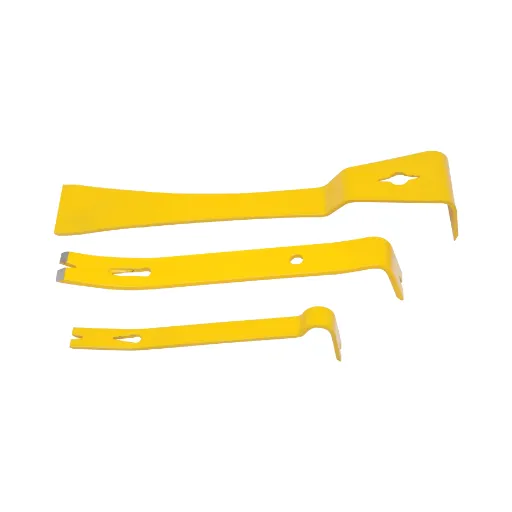
| 4-piece flat set | 5.5″/7.5″/10″/15″ | SHALL, TOOLEAGUE, WOTAHI | Trim, molding, baseboard, flooring |
| 4-piece demolition set | 15″ flat + 30″ demo bar + 44″ bull bar + hammer | Crescent 4-piece, named “Best Set” in Bob Vila’s tested review | Heavy demolition, decks, form stripping |
Two rules make the choice easy:
- Cover the length range, not the piece count. A good set gives you a short bar for control, a mid bar for general work, and a long bar for leverage. Count is secondary.
- The 8″/12″/18″/24″ 4-piece is the default. It handles the wide middle of real work. Add a 36″ or longer bar separately only when you hit serious demolition.
If you want the complete length-to-leverage picture across every category, the pry bar sizes chart maps each length to its working force and typical weight.
The Standard 4-Piece Set
Picture the four bars side by side. The 8″ bar lives in your pocket or pouch and pries trim, staples, and paint cans. The 12″ bar handles flooring, siding, and crates. The 18″ bar lifts boards and pulls nails with real control. The 24″ bar does the heavy prying, and it is the one that separates a good set from a bad one.
When Marcus, a remodeling contractor in Ohio, bought an 8-piece budget kit for a deck-rebuild job in 2024, the four short bars worked fine. The long bar did not. On day two, he leaned into a stuck rim joist with the set’s longest bar and watched it bend into a shallow curve. The replacement cost him more than a proper 4-piece set would have. “It wasn’t the number of bars that failed me,” he said. “It was the one bar that mattered.”
Flat Sets vs Demolition Sets vs Rolling-Head Sets
Before you compare brands, choose the family. A flat set and a demolition set solve different problems, and buying the wrong family wastes money no matter how good the steel is.
| Family | What’s in the set | Length range | Best for |
|---|---|---|---|
| Flat / wonder-bar set | 3–4 thin flat bars with nail slots and rocker heads | 5.5″–18″ | Trim, molding, baseboard, flooring; protects finished surfaces |
| Wrecking / demolition set | Wrecking bars, a pinch bar, a demo bar or bull bar | 12″–48″ | Form stripping, decks, subfloor, pallet teardown |
| Rolling-head / indexing set | Round-shaft bars with a bent claw, or pivoting locking heads | 6″–36″ | Automotive, mechanical work, aligning holes, awkward angles |
The flat family is the one that protects the material, which is why it is the go-to for finish work. Our flat pry bar and wonder bar guide covers that family in depth, including the tip-thickness rule that decides whether trim survives. The wrecking and demolition family is built to destroy, not preserve, and the wrecking bar guide explains the gooseneck designs that do it.
Dana, a finish carpenter in Portland, learned the difference the hard way. After cracking a run of MDF baseboard with a demolition bar in 2023, she switched to a thin flat set for all interior trim. “The heavy bars are faster,” she said, “but they leave marks I have to fix later. The flat set is slower and it saves the wood.” Two budgets, two tool families, and the wrong one costs more than the right one.
Rolling-head and indexing bars solve a different problem entirely: reaching fasteners and seams at awkward angles. If most of your work is automotive or mechanical, that family is the better buy.
Want to see these families side by side before you decide? Our hand tools range groups pry bars, wrecking bars, and demolition tools so you can compare them directly.
Is a Pry Bar Set Worth It? Set vs Single
One buyer’s guide frames it well: buy a set if you expect varied work and are kitting out a first home or truck; buy a single bar if you have one clear job and want the best possible version of that tool. The table below breaks down that choice.
| Buy a set | Buy a single bar | |
|---|---|---|
| Best for | Varied work, first-home or first-truck kits | One clear job done well |
| Value | A budget 4-piece often costs less than one premium bar | You spend once on the best version of that tool |
| Coverage | Multiple lengths, so the right leverage is always at hand | One length only |
| Heavy pro use | Cheap set bars may flex or chip; check the long member | Individual premium bars or a high-end set hold up |
| Verdict | The default for most buyers | Add singles only when the set can’t do the job |
The catch is quality. Forum and review evidence on budget sets is consistent: the longest bar flexes under heavy load, tips chip, coatings rub off, and vinyl handles crack when struck. A set is a false economy if the long bar cannot do the long-bar job. Before you buy any set, read the one detail that separates good bars from bad ones.
What to Look For in a Pry Bar Set
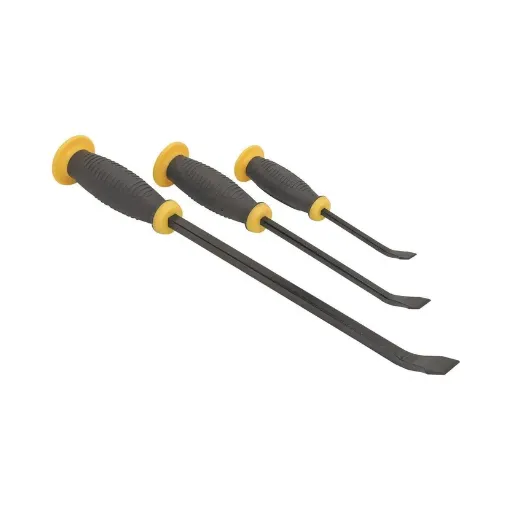
Brand matters far less than these five specifications. Check them in order.
Steel grade. Forged high-carbon steel is the retail standard. Chrome vanadium (Cr-V) flexes before it fractures, which suits prying. Chrome molybdenum (Cr-Mo) is common in rolling-head and indexing heads. Bars listed only as “steel” with no grade are occasional-DIY tools, not working tools.
Construction. Look for one-piece drop-forged bars with no welds. In cheap sets, the weak points are the bar-to-handle joint and the tip, so those are the places to inspect first.
Hardness. Most professional bars are heat-treated to roughly 45–55 HRC at the surface with a tougher core, so the bar bends rather than shatters. The clearest quality marker comes from the manufacturer Gray Tools: a good bar bends slowly past its design capacity, while a poor bar snaps unexpectedly.
Strike caps. This is the single most useful quality signal, and it gets its own check below.
Finishes. Powder coat, enamel, nickel plating, and phosphate coatings all resist corrosion. A powder coat that rubs off in a week is a sign the bar underneath was never meant for daily use.
Can You Strike the Bars in a Set?
This is the fastest quality check, and almost no consumer guide states it plainly: only strike a bar the manufacturer identifies as a striking bar.
Sets with a steel strike cap on every bar survive hammer-assisted driving. Sets with bare plastic or vinyl handles and no cap crack under repeated strikes, which is a documented failure on budget kits. If your work involves driving a bar under a headless nail or a tight board, a strike cap is not a luxury. It is the difference between a tool and a broken handle.
For technique on striking, fulcrum placement, and protecting finished surfaces, see our guide to how to use a pry bar. One rule carries across every set: never extend a bar with a pipe. A cheater bar overloads the tool and causes sudden snapping, which is how pry bar injuries happen.
The Three-Bar Professional Kit
Here is a different way to think about “best set.” Most working pros do not carry a giant kit. They carry three bars that do the vast majority of the work, then add length only for tear-out:
- A 7″–10″ flat bar for trim, molding, and tight-gap prying. It is the highest-frequency bar in a pro’s bag.
- A 24″–36″ gooseneck or wrecking bar for leverage on framing, decking, and demolition.
- An 11″ cat’s paw or nail puller for embedded and headless nails.
Everything outside that trio is either a longer bar for heavy demolition or a specialty bar for mechanical work. This reframes the whole question: the best pry bar set is not the one with the most pieces, it is the one with the right three. If you are building a kit from scratch, start with those three strengths and expand only when a job demands it.
For lighter, everyday-carry options, mini and titanium bars fill a different niche; our EDC pry bar guide covers the compact form factors worth carrying.
Pry Bar Sets for Resellers
For distributors and brand owners, the set is the highest-value pry bar SKU in the category. A single order lifts basket size, and the 4-piece configuration is the most common in the market, which makes it the easiest to sell through. The global hand tools market reached roughly US$25.6 billion in 2025 and is projected to reach US$34.5 billion by 2033, so the category rewards a focused, well-stocked line.
Ready to build a pry bar set line? Request our pry bar catalog and a bulk quote to see set options, packaging, and pricing tiers.
A sensible assortment covers four tiers: a budget flat 4-piece, a mid-range 4-piece 8″–24″, a professional 5–6-piece, and a demolition 4-piece. When Priya, a buyer for a UK tool distributor, rebuilt her pry bar line in 2025, she started with two 4-piece sets instead of the six singles the old line carried. Basket size rose within a quarter, and the shorter shelf list made reordering simpler. Shanghai Oushike manufactures pry bar sets factory-direct with flexible specifications: piece count, length ladders in millimeters, tip geometry, steel grade, finish, logo marking, and retail-ready packaging. Flexible MOQs let you test one set before scaling the range.
To go deeper on sourcing, our pry bar manufacturer guide explains factory selection and quality checks, and the wholesale pry bars guide covers assortment and margin strategy. For private-label packaging and custom branding, see our custom hand tools services. If you are new to importing, start with our overview of importing hand tools from China.
Best Pry Bar Set FAQ
How many pry bars do I need?
For most buyers, four cover nearly everything: an 8″ bar for control, a 12″ and 18″ for general prying, and a 24″ for leverage. Professionals often carry three high-frequency bars instead and add length only for heavy demolition.
What sizes should a pry bar set include?
The standard all-round ladder is 8″, 12″, 18″, and 24″. Flat sets for finish work use 5.5″, 7.5″, 10″, and 15″. Choose by the length range you need, not by piece count.
Is a pry bar set worth it, or should I buy one bar?
Buy a set if you expect varied work, because different jobs need different leverage. Buy a single bar if you have one clear job or do heavy professional work where cheap set bars may flex or chip.
What is the best pry bar set for demolition?
Look for a set with a flat bar plus 30″ and 44″ bars, ideally with a demolition hammer. Alloy steel and through-tang construction matter more than brand here.
Do pry bar sets come with strike caps?
Not always. Steel strike caps on every bar let you drive the bar with a hammer. Sets with bare vinyl handles and no cap will crack under repeated strikes, so check before you buy.
What sizes are in a 4-piece pry bar set?
The most common 4-piece ladder is 8″, 12″, 18″, and 24″. Flat 4-piece sets typically use 5.5″, 7.5″, 10″, and 15″ instead.
What pry bars do professionals actually carry?
Most carry a small kit rather than a large set: a 7″–10″ flat bar, a 24″–36″ gooseneck or wrecking bar, and an 11″ cat’s paw for embedded nails.
Conclusion
The best pry bar set is not the one with the most pieces. It is the one with the right lengths for the work you do. Pick the family first: flat for trim and finish work, demolition for tear-out, rolling-head or indexing for automotive and awkward angles. Then cover the length range with a 4-piece 8″/12″/18″/24″ set for general use, and check two details that decide real quality: the strength of the longest bar and whether the bars carry steel strike caps.
If your work is heavy and professional, a three-bar kit (7″–10″ flat, 24″–36″ gooseneck, 11″ nail puller) often serves you better than any bargain set. And if you are buying to resell, the 4-piece set is the highest-value SKU in the category.
Whichever route you take, buy tools that bend slowly instead of snapping, and never extend a bar with a pipe. That is how a set earns its place in the truck.
Request a bulk pry bar set quote → and see how our range supports your business from first sample to repeat order.