
How to Choose Grease Gun Fittings: A Practical Guide for Industrial Buyers
The suitability of the right grease gun fitting relies on four things: fitting type, which fits your equipment access, thread standard that fits your tapped hole, material that fits your atmosphere, and pressure rating that matches your grease gun output. Get any of these wrong, and you’ll only waste grease, damage equipment, or worse, cause a safety hazard.
Most buyers treat grease fittings as a commodity. They look at the unit price, check the thread size on the box, and place the order. That works until it doesn’t. A metric fitting forced into an imperial thread strips the housing. A standard coupler jammed onto a button head snaps the fitting off. A carbon steel nipple in a saltwater environment rusts solid within months. When that happens, the “cheap” fitting becomes the most expensive part in your inventory.
This guide provides you with a practical guide on how to pick fittings for a grease gun for the first time, which you would learn if you were supplying your fleet, restocking your maintenance store, or procuring inventory for resale. Consequently, this guide offers you a thorough knowledge of how you can match fitting types, thread standards, materials, and pressure ratings to match your application. Also, you can comprehend how to tell from production processes which fittings are reliable and which ones are low-quality, so you can compare suppliers competently. To get a full understanding of the complete grease fitting production pipeline, see our complete guide to grease gun fittings.
Key Takeaways
- Start with the grease gun and coupler you already own, then work backward to the fitting type. This prevents coupler mismatches.
- Metric and imperial threads are never interchangeable. Always verify thread standard with a caliper and thread gauge before ordering.
- Carbon steel works for dry indoor environments. Stainless steel 316 is the standard for marine, coastal, and chemical applications.
- Button head fittings require a dedicated button head coupler. A standard hydraulic coupler will damage or destroy the fitting.
- Factory-direct sourcing with clear specifications reduces unit cost and eliminates the quality inconsistencies common with trading companies.
Why the Right Grease Fitting Choice Matters for Your Operation
The Hidden Costs of Fitting Failures
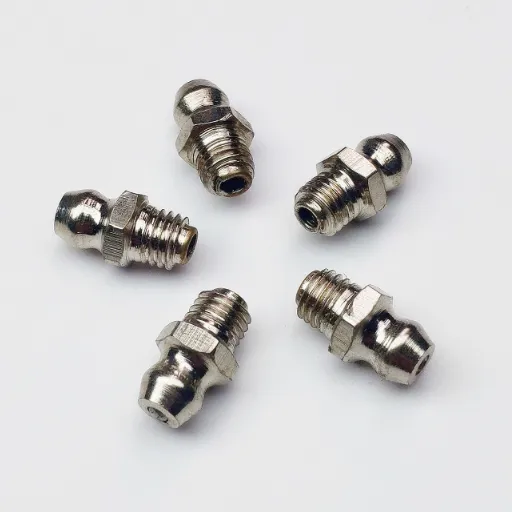
A grease fitting costs pennies. A fitting failure costs hours. When a fitting cross-threads, corrodes, or blows out under pressure, the repair involves more than swapping the part. You disassemble guards, clean contaminated bearings, re-tap damaged threads, and reschedule maintenance windows. In a production environment, that downtime is measured in lost output, not just labor.
For distributors, the cost is different but real. A customer who receives the wrong thread standard or a batch with inconsistent ball check valves stops ordering. Returns eat margin. Complaints damage reputation. The fitting with the lowest unit price often carries the highest total cost of ownership.
How Selection Errors Impact Maintenance Schedules
The result of wrong fitting propagates one issue after another that will eventually lead to improper closures. The misfit coupler leaks grease, so the operator is induced to pump even more to compensate for this leakage. Over-greasing causes blowouts in seals, bearings, and gearboxes. A corrodent fitting is so frozen that the installation technician can actually drill through it, risking the life of the boss. All of the above instances create a longer maintenance cycle and increase the risk of unplanned failure.
In 2019, a maintenance team had been studying experience with the change, from a zinc-coated carbon steel fitting to one made of 316 stainless steel in the cane crushing equipment within a Brazilian sugar mill. The carbon steels had completely covered them with rust in a highly moist environment, and every three months, they literally had to dismantle some components of the roller bearings to replace the pieces. When replaced with stainless, the replacement frequency decreased to once yearly. The stainless fittings were roughly four times more expensive per piece, but with labor and downtime, they would pay for themselves in less than eight months.
Understanding Grease Fitting Types and Their Applications
Choosing the right fitting type starts with physical access, not aesthetics. The fitting head must be reachable with the coupler you have, and the angle must allow the grease gun to connect without interference from guards, hoses, or adjacent components.
Standard (Zerk) Fittings
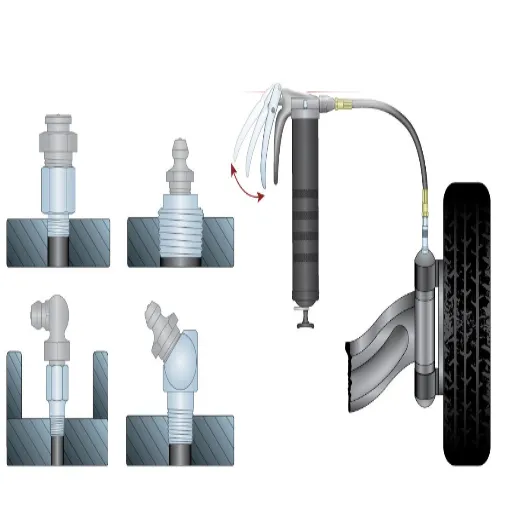
Standard Zerk fittings are the most common type worldwide. They feature a protruding ball check head with a small diameter that accepts standard hydraulic couplers. Straight Zerks work in open, unobstructed areas where the grease gun approaches from above. They offer the simplest connection and the widest coupler compatibility.
Angled Fittings: 45° and 90°
Angled fittings solve clearance problems. A 45° fitting works when moderate obstructions block straight access. A 90° fitting is essential when the grease gun must approach from the side, such as behind guards or between closely spaced components. Some manufacturers also offer 67° angles for specific clearance situations. The rule is simple: match the fitting angle to the actual approach path of the grease gun, not just the installation location.
Button Head Fittings
Button head fittings are fastened with a large, flat disk-shaped head, usually of a diameter of 5/8 inch. They are specifically intended for the process of greasing under high pressure and high volume on equipment that is very large in construction, mining, or agricultural fields. Button head fittings must have a button head coupler. A typical hydraulic coupler won’t do justice and might snap the head off the fitting when there’s pressure on it; this is the most common and one of the most expensive slip-ups in the business.
Flush and Recessed Fittings
Flush fittings are meant to be even with or lower than the surface and prevent snagging in turning shafts, pulleys, and high-traffic areas. Recessed fittings take preventive measures one step further, sitting in a counter-bored hole for maximum protection. These two types of fittings need a low-profile or flush adapter for connecting the grease gun.
Drive-Type and Self-Tapping Fittings
Drive-type fittings are pressed or hammered into untapped holes. They create their own threads in softer materials and are common in sheet metal and quick OEM assembly. Self-tapping variants work similarly but are designed for field repairs where tapping equipment is not available. Neither type should be used in hardened or heat-treated parts.
| Fitting Type | Best For | Pressure Range | Coupler Required |
|---|---|---|---|
| Straight Zerk | Open, accessible areas | 8,000–10,000 PSI | Standard hydraulic coupler |
| 45° / 90° Angled | Tight spaces, behind guards | 8,000–10,000 PSI | Standard hydraulic coupler |
| Button Head | Heavy equipment, high volume | 10,000–15,000 PSI | Dedicated button head coupler |
| Flush / Recessed | Rotating shafts, minimal clearance | ~8,000 PSI | Flush adapter or low-profile coupler |
| Drive-Type | Sheet metal, untapped holes | Low to medium | Standard hydraulic coupler |
For a more detailed breakdown of each type, including installation guidance and common failure modes, see our detailed breakdown of grease fitting types.
Thread Standards: The #1 Source of Ordering Errors
Thread mismatch is the most common mistake when ordering grease fittings. Metric and imperial threads have different diameters and pitches. Forcing one into the other strips threads, cracks castings, and creates leak paths that cannot be sealed.
Imperial Threads (SAE J534, UNF, NPT)
North American equipment predominantly uses imperial threads. The most common is 1/4″-28 UNF, which appears on roughly 70% of grease fittings in SAE-standard equipment. Other imperial sizes include 1/8″-27 NPT and 1/8″-27 PTF for tapered pipe threads, plus 5/16″-24 UNF and 3/8″-24 UNF for larger industrial applications.
Imperial tapered threads (NPT and PTF) seal by thread deformation. They require engagement depth to create a pressure-tight joint. Straight threads (UNF) rely on an O-ring or washer for sealing. Understanding the difference matters when you specify torque and sealant.
Metric Threads (DIN 71412, ISO 3799)
Use European and Asian equipment; they usually have metric threads determined by DIN 71412 and ISO 3799 standards. It is recognizable with M6×1.0, M8×1.25, and M10×1.0 sizes. Metric fittings, very close to their actual sizes, would be easier to identify, unlike the imperial fittings that have always been troublesome, as the nominal mean thread sizes rarely correspond with the nominal size.
How to Identify Your Thread Type
The only reliable way to identify a grease fitting thread is to measure it. Use a caliper to check the outer thread diameter. Use a thread gauge or thread pitch gauge to count threads per inch (imperial) or measure millimeter pitch (metric). Compare your measurements against a thread identification chart before placing an order.
If you do not have the original fitting to measure, check the equipment manual for the specified grease nipple part number. Never guess. The cost of ordering the wrong thread is far higher than the cost of taking five minutes to measure. For exact dimensions and a printable thread size chart, see our grease fitting sizes guide. You can also reference Huyett’s grease fitting thread guide for to-scale measurement circles.
Material Selection Based on Working Environment
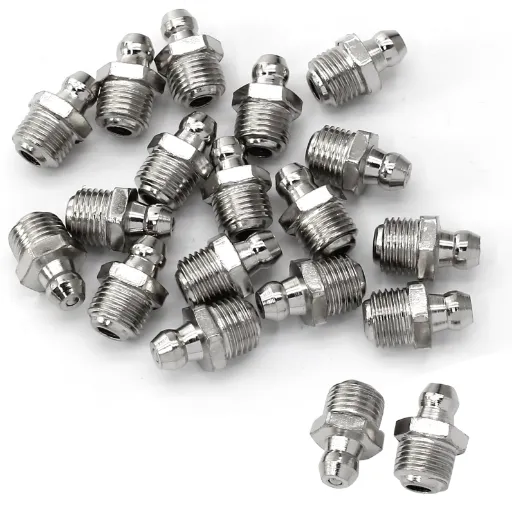
Material choice should be driven by corrosion resistance needs, not just the upfront unit price. The environment determines how long the fitting lasts and how often it must be replaced.
Carbon Steel and Zinc-Plated Options
Zinc-plated carbon steel is the base standard for non-severe indoor industrial environments, automotive dry applications, and storage contained areas. It gives basic corrosion resistance at the rock bottom price. This is a pragmatic entry point in case of bulk customers and simple applications. At the factory gate, basic carbon steel fitting prices are almost always $0.01 to $0.03 per piece, depending on the amount purchased and the finish quality.
Stainless Steel (304 vs. 316)
Resistance to oxidation and very general chemical corrosion make stainless steel 304 suitable for food processing, pharmaceutical environments, as well as being applicable to atmospheric exposure. Adding even higher strength against chlorides and saltwater is an advantage to stainless steel 310, as it increases molybdenum resistance. The lower limit for 316 gauge stainless steel sheet and plate is required in marine, coastal, and wastewater treatment processing applications.
The price differential is a considerable one. Stainless steel pipe fittings are available in different wholesalers, with prices ranging from $0.09 to a high of $0.50 per piece, depending on manufacturer, size, and grade. However, as the case of the Brazilian sugar mill has shown in the past, there are often cases where the overall cost of ownership would favor stainless steel in aggressive environments.
Brass and Specialty Alloys
Brass offers moderate corrosion resistance and excellent machinability. It is therefore broadly used within specialized applications. The need to assess specific chemical compatibility before considering its usage. But in very tough environments, people might go for the likes of Monel, which provides great resistance to the propagative tendencies of saltwater and chemicals, although at a more expensive cost.
| Environment | Recommended Material | Notes |
|---|---|---|
| General indoor industrial | Zinc-plated carbon steel | Cost-effective, adequate corrosion resistance |
| Food/pharma processing | Stainless steel 304 | Meets hygiene standards, good chemical resistance |
| Marine/coastal/saltwater | Stainless steel 316 | Chloride resistance prevents seizing |
| Chemical exposure | Brass or 316 stainless | Verify compatibility with specific chemicals |
| Extreme temperature/pressure | Inconel or alloy steel | Specialty applications only |
Pressure Ratings and Coupler Compatibility
A fitting is only as good as the coupler that connects to it. Pressure rating mismatches and coupler incompatibilities cause leaks, fitting damage, and safety hazards.
Matching Fitting PSI to Your Grease Gun Output
Standard manual grease guns typically generate 5,000 to 10,000 PSI. The majority of Zerk fittings are rated to this pressure. The pneumatic and grease guns that have batteries can go beyond 10,000 PSI, while certain hydraulic systems may top off beyond 20,000 PSI. For any equipment that runs at pressures of more than 10,000 PSI, refer to the high-pressure grease fittings manual. Be sure that the selected fitting’s stipulated pressure capacity is greater than the output of the grease gun, as the margin of safety is included.
Coupler Types and When to Use Each
Standard four-jaw hydraulic couplers work with Zerk and angled fittings. They are the default choice for general maintenance. Button head couplers are required for button head fittings. They distribute pressure across the large flat surface of the fitting head. Flush fitting adapters and needle nozzles handle recessed and hard-to-reach fittings. Locking couplers provide hands-free operation on high-pressure systems. For a deeper look at coupler selection, see our grease gun coupler guide.
Here is the key point most guides miss: selection should start with the grease gun and coupler you already own, then work backward to the fitting. If your maintenance team only carries standard hydraulic couplers, installing button head fittings on new equipment forces you to buy new couplers or use adapters. That adds cost, complexity, and another failure point. Before you specify fittings, check what couplers are already in your tool inventory.
Step-by-Step Grease Fitting Selection Framework
Use this four-step framework every time you specify or order grease fittings. It works for single replacements and bulk procurement alike.
Step 1: Define the Application and Access Point
Identify the lubrication point and the physical space around it. Can a straight fitting be accessed with a standard coupler, or do guards and adjacent components require an angled or flush design? Is this a high-volume point that justifies a button head? Document the access constraints before selecting the fitting type.
Step 2: Match the Thread Standard and Size
Verify the tapped hole specification. Check the equipment manual, measure the existing fitting with a caliper and thread gauge, or cross-reference the old part number. Confirm whether the thread is metric or imperial, straight or tapered, and the exact size and pitch. Never assume compatibility based on visual appearance.
Step 3: Select the Material for the Environment
Find the correct materials for the correct working conditions. An indoor dry environment prefers carbon steel. However, stainless steel 304 or 316 will be required for outdoor, marine, and chemical environments. For instance, food-grade and pharmaceutical applications might actually need some kind of certification. All this should be budgeted at the outset, instead of taking the headache over wasted money for replacements.
Step 4: Verify Pressure Rating and Coupler Compatibility
Confirm that the fitting’s pressure rating exceeds your grease gun’s maximum output. Verify that your maintenance team owns the correct coupler type for the fitting head. If not, include the required coupler or adapter in the same order.
Quick Selection Checklist
- Access point evaluated: straight, angled, flush, or button head?
- Thread standard verified: metric or imperial, exact size and pitch?
- Material matched to environment: carbon steel, 304, 316, or brass?
- Pressure rating exceeds grease gun output?
- Correct coupler type available in tool inventory?
- Quantity, lead time, and packaging requirements confirmed?
What to Look for When Sourcing Fittings in Bulk
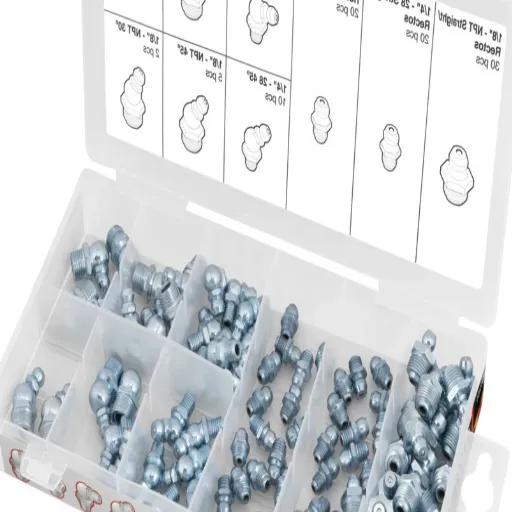
For distributors, maintenance managers, and procurement teams, buying grease fittings in bulk requires checks beyond the specification sheet. The manufacturing quality determines whether your shipment performs consistently or creates headaches.
Quality Indicators to Check Before Ordering
Request samples and inspect them for thread accuracy, ball check valve function, and surface finish consistency. The threads should be clean and free of burrs. The ball check should move freely and seal under light pressure. The plating or finish should be uniform without bare spots or discoloration. Variation between samples is a warning sign of inconsistent production processes.
Understanding MOQ and Lead Times
Standard carbon steel fittings typically carry MOQs of 500 to 1,000 pieces from Chinese manufacturers. Stainless steel and brass variants often start at 100 to 500 pieces. Lead times range from two to six weeks, depending on material, quantity, and customization level. Factory-direct relationships typically offer better lead time reliability than trading company intermediaries because communication flows directly to the production floor.
A German distributor of industrial lubrication equipment learned this firsthand. They had been sourcing grease fittings through a trading company with inconsistent quality and unpredictable lead times. After switching to a direct factory relationship and providing a clear specification checklist, their margin on fittings improved from 18% to 42%. More importantly, customer complaints about thread accuracy and ball check failures dropped to near zero.
Customization and OEM Options
If you are building a private label tool line or serving a niche market, factory-direct manufacturers can provide custom threading, non-standard angles, private labeling, and custom packaging. These options are rarely available through trading companies or stock distributors. When evaluating a manufacturer for custom work, review their existing quality control documentation and request a pilot run before committing to full production.
For buyers interested in OEM and private label options, contact our team to discuss custom specifications, packaging, and MOQ flexibility. For guidance on evaluating and selecting a manufacturing partner, see our grease fitting manufacturer guide.
Common Mistakes to Avoid
Mixing Metric and Imperial Threads
This is the most expensive error on the list. A metric M8x1.25 fitting looks similar to an imperial 5/16″-24 fitting, but the diameters and pitches differ. Forcing one into the other destroys the threads in the housing, which is often a cast part that cannot be repaired easily. Always measure before ordering.
Using the Wrong Coupler on the Wrong Fitting Head
A standard hydraulic coupler on a button head fitting will not seal. It will slip, deform the fitting head, and eventually snap it off. The operator may not notice the problem until the equipment fails due to a lack of lubrication. Stock the correct coupler type for every fitting type you install.
Ignoring Environmental Factors
Carbon steel in a marine environment is a predictable failure. The fitting corrodes, seizes, and must be drilled out. That process risks damaging the boss, which may require welding and re-machining. Specify the right material for the environment, even if the unit price is higher.
Selecting on Unit Price Alone
The cheapest fitting is rarely the least expensive choice when you factor in replacement labor, downtime, and customer returns. Evaluate the total cost of ownership. In most industrial applications, a reliable fitting from a consistent manufacturer costs less over its lifecycle than the lowest bid from an unverified supplier.
Conclusion
Knowing why and how to choose grease gun fittings involves four types of decisions: choice for access pertains to the fitting, compatibility pertains to the thread, environmental factors pertain to the material, and safety pertains to the pressure. Successfully addressing these issues will avoid the most frequent causes of failure in fittings and repairs, as well as warranty issues.
On the part of maintenance teams, the improvement is in reducing flash repairs and better time allocation. For purchasers and buying companies, it means fewer complaints, more loyal customers, and good profit levels. The structure and guidelines contained in this resource ensure that you make those decisions without failure every time.
If what you are looking for are factory-made grease fittings with quality assurance, customization, or even OEM branding assistance, then contact our sales reps. Shanghai Oushike Tools and Hardware provides both the standard and special grease fittings for importers’ brands or OEMs in all regions with friendly MOQs and guaranteed cycles.